EU’s Kallas says attacks on states astride Persian Gulf unacceptable
EU foreign policy chief Kaja Kallas said she had spoken to Iran’s foreign minister Abbas Araghchi about the latest escalation in the Persian Gulf and the state of negotiations with the United States.
She warned that renewed attacks on countries astride the Persian Gulf and critical infrastructure were "unacceptable."
Kallas said she had also been in touch with Kuwaiti Foreign Minister Sheikh Jarrah Jaber Al-Ahmad Al-Sabah.
“A return to full-scale war would come at a tremendous cost to the entire region. The diplomatic route remains the best path out of this war,” she said on X.
Plans for the US military to try to capture Iran’s Kharg Island have been drawn up for months but repeatedly shelved because the operation was considered too risky, CNN reported, citing a senior Pentagon official and two administration officials.
The view inside the White House and Pentagon is that taking Kharg Island, or wiping out the island’s energy infrastructure, would effectively bankrupt Iran and diminish its capabilities to the point that it could not continue in the war, CNN cited the administration officials as saying.
Officials have also told President Donald Trump that such an operation would likely require a significant number of ground troops and could potentially result in heavy US casualties, the report said.
Because of those calculations, the Pentagon and the White House have considered any move to take Kharg Island an “endgame” option — a last resort that could shift the balance of the war, but at a high cost, the officials said, according to the report.
Days before nationwide protest calls for January 8 and 9, Nourabad Mamasani was already under fire. Accounts received by Iran International describe live ammunition, snipers and heavy weapons used in a crackdown that culminated outside the town courthouse.
By January 4, the town in Fars province had entered a second wave of demonstrations, with gatherings reported on Haft-e Tir Boulevard, Imam Boulevard, Shariati Street, the main square and near public buildings as armed forces deployed and internet access was disrupted.
Nourabad, the main city of Mamasani County in southern Iran, had joined the protests earlier than many other parts of the country. Images, witness accounts and information sent to Iran International indicate that government forces began attacking protesters there from January 4 with tear gas, pellet rounds and live fire.
The violence escalated over the following days. By January 10, the area around the Nourabad courthouse had become the scene of a large-scale killing whose full toll remains unclear.
Residents described a heavy security presence from the early hours of the protests. Forces first tried to disperse crowds with tear gas, then opened fire as demonstrations continued. Some residents took shelter inside shops to escape the shooting.
Several protesters, including a 14-year-old girl, were wounded by bullets and pellet rounds during the January 4 crackdown. One witness said a relative was hit by pellets in the eye, nose and abdomen.
Reports also emerged of one protester killed by direct fire and another resident dying from respiratory complications linked to tear gas exposure.
Arya Zarei was among those killed during the Nourabad protests, according to information sent to Iran International. After his death, his family came under pressure to sign an official statement and avoid publicly discussing how he had been killed.
Behnam Izadi, a 35-year-old resident of Nourabad, was also among the early participants in the protests. On January 4, he used his car to help wounded protesters and others in the streets when the vehicle was hit by gunfire and tear gas and badly damaged.
Izadi was wounded in the attack but later returned to the protests. On January 8, according to accounts sent to Iran International, he was killed by a sniper positioned on the roof of a Basij base. The Basij is a paramilitary force under the Islamic Revolutionary Guard Corps. The shot hit Izadi in the head and eye.
Crackdown intensifies
As protests spread on January 8 and 9, strikes across Nourabad became more widespread and security and military forces deployed through the city with military-grade weapons.
Residents burned tires and blocked roads, standing against government forces and pushing them back in some areas.
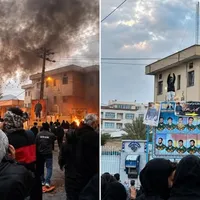
On the evening of January 8, residents heard explosions and sustained gunfire in parts of the city. Electricity was cut for about 20 minutes. Videos and accounts from that night showed thick smoke and shooting in protest areas.
Demonstrators gathered on streets leading to Bank Melli, the Education Department square and the courthouse area, chanting slogans against the Islamic Republic. Government forces responded with live ammunition.
One account sent to Iran International said government forces killed at least 12 protesters on January 9. Iran International has not been able to independently confirm the precise death toll because of internet disruptions, the transfer of bodies and wounded people to facilities linked to the Revolutionary Guards, and pressure on families.
Kamiab Ahmadi was among those killed during those days. A large crowd attended his funeral, and after the ceremony mourners moved toward the city center and the courthouse area.
Protrests in Nourabad Mamasani
Courthouse siege
On Saturday, January 10, protests in Nourabad took an even bloodier turn after funeral ceremonies for several of those killed.
Crowds moved from the funerals toward central Nourabad and gathered near the courthouse by late afternoon.
Multiple accounts said government forces had already positioned themselves inside the courthouse, on its roof and on surrounding buildings before protesters arrived.
As demonstrators approached the courthouse compound, members of the Revolutionary Guards and other armed units opened fire from several directions. Protesters later set fire to the courthouse building after coming under attack.
Witnesses said gunmen fired from the courthouse roof, the building behind Bank Melli, Pezeshkan Street and Koocheh Taxiha, or Taxi Alley, using Kalashnikov rifles, machine guns and heavier weapons.
According to those accounts, protesters were trapped around the courthouse and the shooting began without warning.
One witness said blood loss among the wounded and dead was so severe that blood flowed down the stairs from the building’s second floor to the lower level.
Mehrshad Gha’edi, Armin Shahrivar, Parisa Lashkari, Kamiab Ahmadi, Armin Gorjian and Ali Babakarami are among the names linked by residents to the Nourabad killings.
Residents said government forces removed bodies and wounded people from the area after dispersing the crowd, transferring some to facilities affiliated with the Revolutionary Guards.
Other accounts described wounded people being shot at close range in the streets after the initial assault.
Days later, bloodstains were still reportedly visible outside the courthouse. According to one account, government forces washed the street and sidewalk to remove traces of blood.
After rainfall later blocked a covered drainage canal, residents said two bodies were found there. According to those accounts, some wounded protesters had tried to hide inside the canal while fleeing gunfire and died there.
Bodies, pressure and restricted burials
Reports sent to Iran International show that authorities returned the bodies of those killed gradually, sometimes releasing only a few each day.
Families were required to sign written commitments, hold funerals before 6 or 7 a.m. and prevent large public gatherings, according to those accounts.
Some relatives said they were asked to pay sums ranging from 3 billion to 10 billion rials, or about $1,700 to $5,600, under the label of “bullet costs” before receiving the bodies of their loved ones.
In other cases, families said the release of a body was made conditional on accepting the official claim that the person killed had been a Basij member.
The pressure on families and restrictions on funeral ceremonies did not end public anger. According to another account, clashes broke out again during later funeral processions and government forces attacked mourners.
Amirreza Ahmadi, a 17-year-old who had taken part in protests between January 8 and 11, was arrested about a month later.
He was later released, but died one day after returning home from a cardiac complication, according to the account sent to Iran International. Relatives believe torture and injections of unidentified substances during detention contributed to his death.
The accounts from Nourabad Mamasani suggest the city was not only among the first to join the January protests before the main nationwide calls, but also one of the first places where government forces used live ammunition, snipers and heavy weapons against protesters in an organized way.
The full scale of what happened in Nourabad remains unclear.
Iran International’s public campaign seeks to document the names of those killed, the evidence around their deaths and the accounts of families and witnesses, building a public record of a crackdown authorities have sought to obscure.
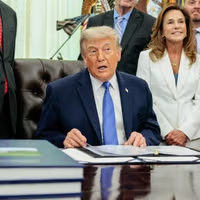
President Donald Trump said on Thursday he would rather not target bridges, power plants or other infrastructure in Iran because such strikes would hurt civilians, adding that ordinary Iranians were suffering under government repression.
“I'd rather not do it because once you do that the people suffer,” Trump said in an interview with Fox News.
“My message to the Iranian people is they're afraid because they have no guns, and the other side has guns, and they have a rally and they get shot,” he added.
Republican Senator Lindsey Graham said President Donald Trump was right to consider taking Kharg Island if no deal with Iran is reached soon, calling the move “the ultimate game changer.”
Graham said the combination of keeping the Strait of Hormuz open and controlling Kharg Island’s operations “by force or blockade” would be the most consequential move Trump could make to regain leverage and end the conflict on favorable terms.
US Treasury Secretary Scott Bessent said damage to US allies in the Persian Gulf would be paid for with funds extracted from Iranian accounts, warning that every attack launched by Iran would deepen the economic and financial consequences it faces.
“The Iranian regime will lose the zero-sum game it is playing,” Bessent said on X.
“Any damage it inflicts on our allies in the Gulf will be paid for with funds extracted from Iranian Accounts. Any tolls paid to the Persian Gulf Strait Authority will be offset by funds extracted from their accounts,” he added.