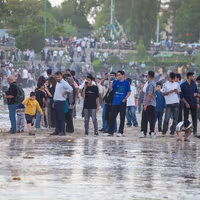
The performance took place on Thursday during Eid al-Ghadir celebrations at Imam Hossein Square in central Tehran. The event, which received extensive coverage from official and semi-official media outlets, featured Binesh Bolour, known professionally as Gheysar, who has lived outside Iran for nearly four decades.
In recent years, the Islamic Republic has sought to transform Eid al-Ghadir into a broader national celebration through large-scale public events held in city streets and squares.
The festival included speeches by clerics, performances by government-approved pop singers and religious vocalists closely associated with hardline political groups. Gheysar took the stage as some members of the crowd chanted “Long Live Iran” and “Death to America.”
Official and semi-official media outlets, including state broadcaster IRIB, widely circulated videos of his appearance. In a caption accompanying one of the videos, IRIB wrote that Gheysar had “shouted out his patriotism and returned to Iran” after the outbreak of the recent war involving Iran, the United States, and Israel.
The newspaper Haft-e Sobh described Gheysar’s participation in an official event as both “surprising” and “taboo-breaking,” noting that it was unprecedented since the 1979 Islamic Revolution.
The newspaper wrote: “Gheysar’s presence in Tehran and his performance should be regarded as an important development with dimensions beyond an artistic event. This form of participation in an official ceremony could symbolize the breaking of one of the cultural boundaries of the past four decades.”
Anti-western statements during the war
During the recent conflict involving Iran, the United States and Israel, Gheysar repeatedly criticized US President Donald Trump and Israeli Prime Minister Benjamin Netanyahu on social media. He also strongly attacked Crown Prince Reza Pahlavi and opposition groups that advocated foreign support for the overthrow of the Islamic Republic.
In one video, he said the Iranian nation had broken the “hegemony of the West” and that he was proud of being Iranian. Following the military confrontation, he published additional videos praising Iran’s military capabilities and said: “We shattered the West’s grandeur, and I am proud of that.”
Mixed reactions online
The singer’s appearance has generated sharply divided reactions on social media. Some users described the government’s decision to allow him to perform as hypocrisy, arguing that the authorities embrace nationalism only when they need public support.
One user, Mehrdad Raha, wrote: “Whenever you see a veteran Iranian singer abroad becoming softer in tone toward the Islamic Republic, know that the government has probably been in contact with them for some time, using intermediaries, with promises of money, sponsorship, travel opportunities to Iran, or other incentives to win them over.”
Gheysar rejected such accusations in a video circulated online. He said this was not his first visit to Iran and insisted that he had not returned for money or to obtain a permanent license to work in the country.
He said he had participated in the ceremony because, like many Shiites, he holds a deep respect for Imam Ali, whom Shiites believe was designated by the Prophet Muhammad as his successor at Ghadir.
The legacy of the “Los Angeles singer”
The controversy also revived discussion about the long-standing phenomenon of the so-called “Los Angeles singer.”
Following the 1979 revolution, many Iranian pop stars and actors left the country, particularly female performers whose singing careers were effectively prohibited under the new political order. Many settled in the United States, especially in Southern California.
For years, recordings by exiled singers circulated inside Iran through cassette tapes and videotapes that were copied and distributed despite official restrictions. Possession or distribution of such material could expose people to legal penalties.
The style of dance-oriented Persian pop music associated with Los Angeles was often portrayed in official discourse as morally corrupt, and the term “Los Angeles singer” frequently carried a derogatory connotation in state media.
Several Iranian outlets referred to Gheysar, who has also performed in Israel, a destination Iranian citizens are generally prohibited from visiting, in exactly those terms while reporting on his recent appearance.
Yet the two songs he performed in Tehran differed markedly from the repertoire that made him famous.
One song was dedicated to his hometown, Tehran. The second, titled “The Children of Minab,” was inspired by damage to a school in the southern city of Minab during the first day of the recent conflict. Iranian media reported that 120 schoolchildren and nearly 40 teachers, staff members and parents were killed in the attack.
Could other exile artists return?
Gheysar’s official appearance has renewed speculation about whether other prominent exile artists might be allowed to return.
Haft-e Sobh asked: “Now we must wait and see whether Gheysar’s return is an exception or whether this path will be opened for other artists as well. Will this remain limited to one person, or could it become a model for the future?”
In recent months, several well-known Los Angeles-based Iranian singers have publicly expressed a desire to spend their final years in Iran.
Among those expressing a desire to return is veteran singer Shahram Shabpareh, who has said he would like to spend the final years of his life and career in Iran.
The possibility of a return by singer Moein has also been the subject of recurring speculation, although reports about potential concerts in Iran have repeatedly been denied by him or those close to him.
For supporters, Gheysar’s appearance may signal a gradual easing of long-standing cultural restrictions surrounding exiled performers.
Skeptics, however, point to the experience of singer Habib, who returned to Iran in 2009 but was repeatedly denied permits to perform, arguing that official approval can be fleeting and does not necessarily translate into lasting artistic freedom.