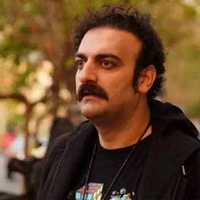
A performance during the music festival in Bushehr (February 2024)
While the Iranian Foreign Ministry teased Iranians with "good news" of an LA-based singer's potential return from exile, the government abruptly halted a beloved 10-day music festival in Bushehr.
•
Like most decisions made by Iranian officials, these decisions were also contradictory and controversial. On the one hand the government is trying to trumpet good mood among Iranians ahead of the 1 March election to lure reluctant voters to the polls, and on the other hand, by shutting down a festival that has been going on for its third year, it proved that it is against culture, and cultural activities if they are not necessarily consistent with the regime's ideology.
Nasrallah Moein, a renowned Esfahani singer residing in the US since the 1979 Islamic revolution, remains banned officially in Iran, yet his music resonates with millions. No wedding ceremony or birthday in Iran is complete without a few songs by Moein and other diaspora singers like him. Some of his songs have even religious motifs, yet the government is against rhythmic dance music.
Last month, Iran's Culture Minister Mohammad Mehdi Esmaili said that Moein can come back to Iran although he should seek permission from the authorities to perform. At the same time, an Iranian lawyer warned that the singer will have to go to jail for at least 28 years before he could even think of singing in public.
A performance during the music festival in Bushehr (February 2024)
However, Hassan Shamaizadeh, another popular Iranian singer in Los Angeles wrote in a social media post that Moein laughed at the news of his return to Iran, knowing what the government would do once they have him in their hands.
The saga hinges on officials' interpretation of a 1980s song by Moein expressing a desire to return to Esfahan.
The Music festival in Bushehr initiated by locals three years ago, attracted thousands annually. It centered on reciting and singing the poems of renowned Iranian poet such as the mystic Omar Khayyam.
For nine nights, the guests and musicians from all over Iran sang Khayyam's song which are invariably about man's life being precious, but otherwise short. Khayyam's teaching about enjoying life while it lasts is in absolute contrast to the regime's fatalistic ideology which is all about death and martyrdom.
On the tenth night, festivities abruptly halted when security forces intervened, disappointing attendees eager for Lorestan's musical performance. Organizers managed a private closing ceremony, lamenting the missed opportunity for public celebration.
A performance during the music festival in Bushehr (February 2024)
According to Khabar Online website in Tehran, the organizers of the festival, however, managed to celebrate the final ceremony with Lorestan's musicians behind closed doors without the public being there to enjoy the music and dance.
Shyly criticizing the security officers, Khabar Online asked: "What do the people in southern Iran have other than their pains and their dances?" Local people and musicians say the reason for the authorities' sensitivity was that visitors from other cities continued singing and dancing in the streets of Bushehr every night until the next morning.”
Even Islamic Republic officials have said at times that Iranians desperately need to enjoy life as they are overwhelmed by all sorts of economic and social pressures. Despite the acknowledgement, in the conflict between their outdated ideology and people's intellectual and emotional needs they always take side with the ideology and that is one of the main issues that separate the Iranian people from their government.
Reformists are lauding former President Mohammad Khatami as “a winner” for not voting in Iran’s “stage-managed” elections, although some social media users question his motives.
For the first time in his political career, the formerly popular reformist president refrained from voting, despite Supreme Leader Ali Khamenei’s repeated declarations that voting is a religious duty. Khatami has not made any statements since Friday’s polls regarding his abstention.
Reformist parties and groups such as the Etehad-e Mellat (Nation’s Unity) party, who were denied having any candidates, did not outrightly boycott the elections, but declined endorsement of any candidates .
In a tweet after the closure of the polls, the leader of the Reforms Front, Azar Mansouri, confirmed that Khatami had not voted and said this was in accordance with the Reformist’s previously announced strategy.
Azar Mansouri, the leader of the Reforms Front
Ali Nazari, editor of Mostaghel (Independent) newspaper, tweeted that not voting caused “Khatami’s voice to be heard,” adding that a year ago, the reformist leader had issued a statement about the crisis in the country and written a comprehensive letter to Khamenei, to which he never received a response.
Former Reformist lawmaker Mahmoud Sadeghi said that Khatami's abstention was in accordance with a 15-point statement he issued last year during popular protests, and called it “a source of grand transformations for the Reformists.”
“The winner of Friday’s elections was Mohammad Khatami, who returned to the people's arms,” a Khatami supporter tweeted.
Some other social media users, however, allege that Khatami’s political act was masterminded by the regime to mislead the people and preserve clerical rule with “turban-wearing opposition”.
“Khatami did not vote to look like one of us, so that in 1404 (2025) he has the legitimacy to invite people to participate in the presidential elections ... For whatever reason he didn't vote, his intention was to hurt us,” another tweet said.
“Reformists have a very small window to return to the fold of the people … They will never have a chance in Iran's future if this is only a warning to the government [after which] they will return to their factory setting [position],” another tweet said.
Khatami issued the statement referred to by Sadeghi on February 19, 2023, in the wake of the regime’s brutal crackdown on Woman, Life, Freedom protesters. Some reformist figures such as Behzad Nabavi, then a member of the presiding board of the Reform Front, said later that they considered the statement as “the manifesto of reformism”.
In the statement Khatami had stressed that people had the right to be disillusioned with Reformists just as they are with the ruling system but suggested non-violence and civil methods as the only way forward.
The system’s attempts to “satisfy a small part of the society that it considers loyal to itself” at the cost of dissatisfaction of the “majority of the society who … have lost hope in a better future” was “a big mistake” that the ruling system was making, he said in the statement.
“System” and “ruling system” are often used by politicians in Iran and the media to refer to Supreme Leader Ali Khamenei and his loyalists in power.
While stressing that “physical overthrow” of the powerful government by the ordinary people was not plausible, Khatami urged the “ruling system” in his statement to “reform itself” and called for fair, free, and competitive elections, freedom of all political prisoners, freedom of the media, and the rule of law.
More significantly, he advocated for the reform of several critical state institutions, including the Guardian Council and Expediency Council, both of which are appointed by Khamenei. Additionally, he urged for the cessation of the Khamenei-controlled military's interference in politics and a shift in foreign policy direction, moving from isolationism to engagement with the global community.
He emphasized that the Assembly of Experts should fulfill its responsibility of overseeing the performance of the Supreme Leader and entities under his authority. Furthermore, he advocated for the cessation of the Guardian Council's "arbitrary supervision," which has enabled it to eliminate all political rivals in elections, according to Khatami's statement.
In February Khatami had asserted that the March 1 elections were far from being free, fair, and competitive and had spoken of widespread dissatisfaction among educated youth, elites, as well as “over 50 percent of the population who abstained from voting in the 2020 and 2021 elections” and “the millions who had cast blank votes in the past few elections” including the presidential elections of 2021.
Elections of the parliament and Assembly of Experts Friday had the lowest turnout in the four-decade history of the Islamic Republic despite Supreme Leader Ali Khamenei’s repeated pleas to the people to vote.
In some constituencies the number of blank and invalid votes is higher than the constituency’s top elected representative. These votes are usually cast by those who may have been rounded up and forced to vote against their wish such as government employees, soldiers, and athletes. The high volume of blank votes has gradually turned into a characteristic of every election in the past decade.
The Iranian government's plan to create a DNA bank of people in "high-risk" professions, including journalists, has raised concerns that it could be used to crack down on dissent.
The plan, announced by the head of the Legal Medicine Organization of Iran, Abbas Masjedi, would involve collecting genetic samples from firefighters, flight crews, armed forces, forest rangers, mine workers, and journalists.
Masjedi said that the plan is intended to help identify victims of accidents and disasters, but critics say it could also be used to track and identify individuals who are critical of the government.
The plan can be seen as an attempt to intimidate and silence journalists because the regime can easily use of possible DNA evidence to target its critics.
The plan has also drawn comparisons to China's DNA database, which has been used to track and monitor Uyghur Muslims in Xinjiang province.
The Chinese government has shown how DNA databases can be used to suppress dissent, said Maya Wang, a senior China researcher at Human Rights Watch, suggesting that the Iranian government is taking a page out of China's playbook.
“Human Rights Watch has documented that mass collection and cataloging ofpeople’s DNA form a part of the Chinese police’s countrywide mass surveillance systems, which involves the use of facial and voice recognition technology, big data platforms, among other technologies," she said, adding, “These technologies have empowered the Chinese government to maintain a vice-like grip on a complex society, from cities to its most remote borderlands, hunting down dissidents and neutralizing protests.”
With only 17 days remaining in the current Iranian year, the country’s Supreme Labor Council has yet to convene a session to establish next year's workers' wages.
Within Iran's state-controlled economy, the government sets wages for public sector workers, including thousands of companies and factories, which also determines salaries of ordinary workers in the private sector. According to the law, representatives of the government, official labor unions and employers every year negotiate to set the minimum wage. However, the government increasingly ignores the unions and pushed through unrealistically low wages amid 40-percent annual inflation.
Davood Manzour, the head of Planning and Budget Organization (PBO), said on Saturday that discussions are still underway, with the new levels contingent on anticipated inflation.
He also expressed optimism about negotiations between labor unions and the government, though in recent months, unions have come under increasing pressure from the government amid labor protests, with tightening control over unions to suppress unrest.
This comes as Saeed Fatahi, a union leader, advocated for incorporating a 42 percent inflation rate and a 250 million rial ($400) monthly livelihood basket as benchmarks for wage deliberations. Currently, workers receive less than half of that amount, which is inadequate for food and housing.
Fatahi emphasized the need for labor representatives to hold firm during negotiations, saying any new deal should be within the terms of Article 41 of the Labor Law which states workers' wages, salaries, benefits, and bonuses must be calculated based on the country's inflation rate.
File photo of a group Iranian workers
Criticism was leveled at the Labor Ministry for its handling of past wage negotiations and the dismissal of labor representatives, perceived as an attempt to suppress wage growth and disregard labor laws. As the economic crisis deepens, the government fears the stirring anger fueling ever increasing protests.
Meanwhile, Etemad newspaper on Saturday reported a staggering increase in food prices, with canned fish soaring by 113 percent and red meat by 100 percent in February compared to the previous year.
Economic constraints, such as sanctions and fluctuating oil prices, limit the government's ability to finance wage hikes without risking further economic instability. Additionally, a history of labor unrest and political dissent adds to the government's apprehension, as raising wages could be seen as a concession to pressure groups demanding broader reforms.
Moreover, entrenched interests within the government and business community may resist wage increases to protect profit margins and maintain the status quo. Despite growing calls for reform and social justice, the government's unwillingness to address the wage issue underscores the challenges of balancing economic stability, political considerations, and social justice in Iran's complex socio-economic landscape.
Overall, the financially strained government is procrastinating and advocating for just a 20-percent wage hike, as it appears incapable of raising the minimum wage sufficiently to cover living expenses.
The wage negotiations continue against a backdrop of the Iranian government funding billions of dollars' worth of support to its militant proxies in the region.
From Lebanon to Yemen, Palestine to Syria and Iraq, from training to weapons, Iran continues to be the region's largest state sponsor of terror, according to the latest US annual terrorism report.
Also, recently leaked documents revealed parliamentarians' monthly salaries range from 1.7 to 2.7 billion rials, equivalent to $3,200 to $5,000.
Meanwhile, while Iranian workers await a salary increase of 20 percent amid an annual inflation rate of around 50 percent, the new minimum monthly wage has been set at 115 million Iranian rials or less than $200.
Rights groups such as Human Rights Watch have long noted the erosion of workers rights in Iran. Since 2018, Iranian workers have been facing ever more challenging economic circumstances amid US sanctions. Additionally, Human Rights Activists of Iran (HRANA) have noted the attempts to silence workers' unions amid declining wages, unpaid salaries and dangerous working conditions.
Iran's plan to host 20 Chinese influencers has been slammed as a ploy to portray the country in a more positive light amid arbitrary arrests of foreigners.
Moslem Shojaie on Sunday announced the forthcoming visit of 20 Chinese influencers to Iran within the next two weeks, a propaganda visit to show the regime in a positive light.
Shojaie stated that the influencers, boasting "over 60 million followers" on social media, will embark on a journey across various cities under the project title "Hello Iran," aiming to generate pro-Iranian content on social media platforms.
"The Hello Iran project is planned and implemented in 12 provinces of the country with four themes: nature and climatic diversity, historical and cultural heritage, the Silk Road, and cuisine," added Shojaie.
The move by the Iranian government to grant travel permits to Chinese influencers comes in light of the detention of numerous Western travelers. The discrepancy sheds light on the regime's alleged hypocritical and discriminatory practices towards foreign visitors based on political affiliations.
While Western travelers have often faced arbitrary arrests and even espionage charges for exploring Iran's cultural heritage, the government's embrace of Chinese influencers illustrates a contrast in treatment. Critics argue that the preference for Chinese influencers reflects Iran's prioritization of economic partnerships over human rights and international norms.
Despite its rich cultural heritage and natural beauty, Iran continues to grapple with challenges in attracting foreign tourists, exacerbated by its history of detaining foreigners and dual nationals, along with societal constraints imposed after the Islamic Revolution of 1979.
Ten children have died in Iran due to the discontinuation of medication for Spinal Muscular Atrophy (SMA) in one month amid the country's worsening health crisis.
Ramak Heidari, CEO of the Iranian Dystrophy Association, expressed concern over the situation on Sunday, saying despite assurances from the ministry of health regarding the distribution of medication to SMA patients, “no Iranian medication has been produced or distributed.”
Moreover, the efficacy of existing medications has been questioned by the deputy minister, exacerbating the crisis.
Heidari condemned the actions as “unjustifiable excuses for discontinuing essential medications”, emphasizing that approximately 10 children affected by SMA have died in the past month alone due to the lack of treatment.
Spinal Muscular Atrophy, a rare neurological muscle disorder, severely impacts patients' motor functions causing muscles to become increasingly weak. The only validated medication, Spinraza, has shown efficacy in slowing down the progression of the disease.
The exorbitant price of Spinraza has led to attempts by the ministry of health to hinder its import under false pretexts such as “low effectiveness.” Consequently, many families have resorted to seeking treatment abroad to save their loved ones.
The medication crisis comes amid reports of illegal practices in the pharmaceutical industry. Shahram Kalantari-Khandani, head of the Iranian Pharmaceutical Association, highlighted the issue of non-pharmaceutical investors obtaining rare medications with fake prescriptions and selling them in the open market, further exacerbating the situation.
Last year, Mojtaba Bourbour, an official from Iran's drug importers union, disputed government officials' assertions regarding pharmaceutical self-sufficiency. He revealed that not only do up to 90 percent of raw materials come from countries like China and India, but some medications are also imported from China and marketed under Iranian labels.