• العربية
  • فارسی
Brand
  • Iran Insight
  • Politics
  • Economy
  • Analysis
  • Special Report
  • Opinion
  • Podcast
  • Iran Insight
  • Politics
  • Economy
  • Analysis
  • Special Report
  • Opinion
  • Podcast
  • Theme
  • Language
    • العربية
    • فارسی
  • Iran Insight
  • Politics
  • Economy
  • Analysis
  • Special Report
  • Opinion
  • Podcast
All rights reserved for Volant Media UK Limited
volant media logo

Iran MP warns against post-war rise of ‘liberals’

Jun 5, 2026, 06:31 GMT+1

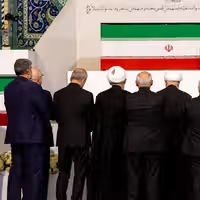
Hardline Iranian lawmaker Hamid Rasaei said the Islamic Republic would win the war but warned supporters of the government that the main danger could come afterward.

Speaking at a state-organized rally, Rasaei said: “This war will certainly end with Iran’s victory, but the problem is after the war.”

He warned that “liberals,” “West-leaning” figures, those who had regrets and officials whose “calculation system has changed” could come to power after the war.

“If they come to power, the situation will become like this,” Rasaei said.

His remarks came amid mounting hardline pressure over negotiations with the United States, with ultra-conservative figures warning against concessions and accusing some officials of weakening the Islamic Republic’s wartime position.

Most Viewed

Calls for diplomacy grow in Tehran amid fresh escalation
1
INSIGHT

Calls for diplomacy grow in Tehran amid fresh escalation

2
INSIGHT

Lebanon emerges as new obstacle to Iran-US talks

3
EXCLUSIVE

Iran sidelines ultra-hardliners from pro-government nightly rallies

4
VOICES FROM IRAN

Citizens report growing use of children in Iran security activities

5

Stolen Revolution: new book traces Iran’s path from revolution to mafia state

Banner
Banner
•
•
•

Spotlight

  • Iran turns to Iraq’s Umm Qasr as new hub to bypass US blockade
    EXCLUSIVE

    Iran turns to Iraq’s Umm Qasr as new hub to bypass US blockade

  • As US talks stall, Iran moderates warn of renewed unrest
    INSIGHT

    As US talks stall, Iran moderates warn of renewed unrest

  • Iran's services imports surge as goods trade slumps
    ANALYSIS

    Iran's services imports surge as goods trade slumps

  • Tehran hardliners demand escalation as Trump says talks are progressing
    INSIGHT

    Tehran hardliners demand escalation as Trump says talks are progressing

  • Citizens report growing use of children in Iran security activities
    VOICES FROM IRAN

    Citizens report growing use of children in Iran security activities

  • Will Israel's new Mossad chief carry on the push for regime change in Iran?
    INSIGHT

    Will Israel's new Mossad chief carry on the push for regime change in Iran?

More Stories

Oman oil terminal suspends loading after explosion near berths

Jun 5, 2026, 06:22 GMT+1
Oman oil terminal suspends loading after explosion near berths
100%

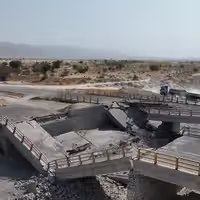
Oman’s Mina al Fahal oil terminal has suspended oil loading after an explosion near its single-buoy mooring berths, Reuters reported, citing two people familiar with the matter.

The explosion occurred between the SBM 1 and SBM 2 berths and was caused by an alleged drone attack, the sources said.

It was not immediately clear when the incident took place.

Several supertankers were seen anchored off the port on Friday, according to LSEG shipping data cited by Reuters.

The report comes after Iranian state media said Wednesday that Tehran had targeted a US military ship carrying what it described as a “control and command center” as it approached Iranian territorial waters in the Gulf of Oman. US Central Command denied that claim.

Iran oil exports has plunged after US blockade

Jun 5, 2026, 04:16 GMT+1

Iran's crude oil exports fell 84% in May compared with the previous month and were 87% below their 12-month average through the end of April, according to shipping industry journal Lloyd's List.

The publication said the sharp decline came amid intensified US pressure on Iran's oil-export network and continued disruption to shipping in the region.

Lloyd's List also reported that Tehran has increasingly relied on smaller tankers to move crude, as Very Large Crude Carriers (VLCCs) face a higher risk of interception by US forces.

As US talks stall, Iran moderates warn of renewed unrest

Jun 5, 2026, 03:59 GMT+1
•
Behrouz Turani
As US talks stall, Iran moderates warn of renewed unrest
100%
Residents gather along the Zayandeh Roud in Isfahan to celebrate the return of water to the river, June 3, 2026

As indirect contacts between Tehran and Washington continue and regional actors push to keep negotiations alive, competing signals continue to emerge from Iran's political establishment.

On Thursday, the Revolutionary Guards said no lasting calm would be achieved in the region unless Israel withdrew from Lebanese territory and halted attacks, while senior adviser Mohsen Rezaei insisted Iran would not give a “green light” to negotiations until all of its demands were met.

Against that backdrop, two political insiders from different camps have issued unusually direct warnings about Iran's domestic vulnerabilities, arguing that economic hardship and the widening gap between the state and society could fuel renewed unrest.

In a June 1 interview with the moderate daily Etemad, prominent centrist politician Hossein Marashi described a deep structural and cultural disconnect between the state and society.

He warned that unless the political system adapts by addressing economic inefficiencies, acknowledging cultural differences and creating channels for dissent, unrest will continue to recur.

The leadership in Tehran, Marashi argued, remains at odds with a large segment of the population over cultural and political issues and should align governance with the expectations of at least 70% of society.

According to him, the divide between state and society has become so entrenched that many Iranians now separate their attachment to the country from their view of the government.

Marashi also said one of the Islamic Republic's fundamental failures has been its inability to build a strong economy and a trusted judiciary. Protests, he argued, should not be viewed as isolated incidents but as repeated expressions of accumulated public frustration.

A similar theme emerged this week in an op-ed by reformist commentator Nasser Zakeri in Sharq newspaper.

Reviewing Iran's recent military and geopolitical challenges, Zakeri contrasted what he described as the resilience of Iran's defense sector with decades of economic underperformance marked by unemployment, chronic inflation and weak productivity.

He argued that policymakers should use the experience of the past year to identify which institutions proved resilient under pressure and which did not.

Zakeri also challenged those who portray revision as a betrayal of the Islamic Republic's core principles, arguing that even policies once considered successful must be reassessed when circumstances change.

Such arguments remain politically sensitive in a system where calls for reform or revision are often portrayed by hardliners as attempts to weaken the ideological foundations of the state.

Although Marashi and Zakeri approached the issue from different angles—one focusing on public dissatisfaction and the other on institutional performance—both arrived at a similar conclusion: military strength and crisis management alone cannot guarantee long-term stability unless the political system addresses deeper economic, social and political grievances.

Late on Thursday, reports emerged that Pakistan's Interior Minister Mohsin Naqvi would return to Tehran as part of efforts to keep the Iran-US negotiating track alive.

The diplomatic process remains uncertain. But the warnings from Marashi and Zakeri suggest that, for some voices inside the establishment, the more pressing question may be whether the state can address the domestic challenges that persist regardless of whether negotiations succeed.

Iran's services imports surge as goods trade slumps

Jun 5, 2026, 03:43 GMT+1
Iran's services imports surge as goods trade slumps
100%

Iran's imports of services surged to a record $25.5 billion in 2025 while merchandise imports fell sharply, according to newly released data from the Central Bank of Iran, highlighting a significant shift in the country's trade structure.

Services imports accounted for roughly one-quarter of Iran's total imports during the year, an unusually high share for an economy traditionally dominated by trade in physical goods.

At the same time, Iran's exports of services declined, pushing the country's services trade deficit to a record $17 billion. The deficit was 52% higher than in 2024 and roughly three times larger than in 2020.

Separate central bank data on foreign trade in goods point to an equally dramatic contraction in merchandise trade.

Read the full article here.

Oil heads for weekly gain as traders watch Iran talks, Hormuz risks

Jun 5, 2026, 03:01 GMT+1

Oil prices were little changed on Friday as traders awaited greater clarity on negotiations between Washington and Tehran, though crude remained on track for weekly gains after hostilities earlier in the week reignited concerns about a prolonged energy shock.

Brent crude hovered around $95 a barrel and was set to rise more than 3% for the week. US crude slipped 0.3% to $92.73 a barrel but was still on course for a weekly gain of more than 6%.

Analysts said markets remain focused on the outlook for shipping through the Strait of Hormuz, a key route for global energy supplies.