The dispute intensified after Tehran suspended talks with Washington on Monday, arguing that Israeli military operations in Lebanon violated the broader ceasefire framework established after the recent US-Iran conflict.
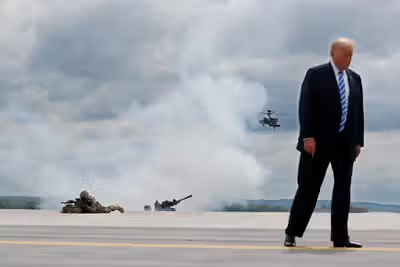
While US President Donald Trump described the interruption as a temporary “little glitch,” Iranian officials have since made clear that a halt to Israeli military operations in Lebanon remains a prerequisite for renewed diplomatic engagement.
On Tuesday, Fars News Agency, which is affiliated with the Revolutionary Guards (IRGC), cited an informed source as rejecting Trump's claims about ongoing, high-speed negotiations.
According to the source, exchanges of messages between Tehran and Washington had stopped “at least for a few days,” while Iran's latest communication to the United States was described as “a clear warning regarding Lebanon.”
Mohammad Bagher Ghalibaf, speaker of parliament and head of Iran's negotiating team, accused the United States of failing to uphold ceasefire commitments, saying on X that enforcement of a naval blockade and Israel's attacks on Lebanon were “clear evidence of US non-commitment to the ceasefire.”
“Every choice has a price, and the bill comes due,” he added.
Ghalibaf later said he had informed Lebanese Parliament Speaker Nabih Berri that Iran would not only suspend negotiations but would also be “in direct confrontation with the enemy” if Israeli attacks on Lebanon continued.
Foreign Minister Abbas Araghchi echoed that position, writing on X that a “ceasefire between Iran and the US is unequivocally a ceasefire on all fronts, including in Lebanon.” He added that any violation on one front “shall be considered a violation across all fronts.”
Tehran sees leverage in talks
With Tehran linking progress in negotiations to developments in Lebanon, the fate of any future agreement increasingly appears tied to the trajectory of the Israel-Hezbollah confrontation.
Some Iranian lawmakers believe Washington will ultimately seek to restrain Israel to prevent a broader crisis.
Ahmad Bakhshayesh, a member of parliament's National Security and Foreign Policy Committee, told Tabnak that the United States would likely increase pressure on Netanyahu's government to avoid further escalation.
Tabnak itself argued that Tehran could use the negotiations as leverage.
“Given that Hezbollah—Iran's most powerful regional ally—entered the conflict immediately following the attacks on Iran, Tehran could leverage the threat of walking away from ongoing negotiations to pressure the United States into restraining Israel,” the outlet wrote.
Growing doubts about a deal
Despite such expectations, several analysts expressed pessimism about the prospects for a final agreement between Tehran and Washington.
Hassan Hanizadeh, a senior analyst on Middle Eastern affairs, told Fararu that Israel's intensified military campaign in Lebanon was “directly designed to pressure Iran and can pose a major risk to the formation of any understanding between Tehran and Washington.”
He argued that Tehran views the attacks as part of broader Western pressure tactics and added: “Evidence shows that Trump has no desire for a comprehensive agreement in the current atmosphere.”
Amir-Ali Abolfath, an expert on US affairs, also questioned the likelihood of a breakthrough.
Speaking to Fararu, he said Israel's confrontation with both Iran and Hezbollah had made negotiations significantly more complicated than in previous rounds.
“The Americans are negotiating to not reach an agreement,” he said. “America proposes conditions that make it seem as though they are shouting: ‘We do not want to reach an agreement with the Islamic Republic,’ because their conditions are unfeasible.”
Other commentators voiced similar doubts. Reza Ghobeishawi, writing in Asr-e Iran, argued that Trump has concluded a deal with Tehran is unattainable and is instead using discussions over reopening the Strait of Hormuz to buy time.