• العربية
  • فارسی
Brand
  • Iran Insight
  • Politics
  • Economy
  • Analysis
  • Special Report
  • Opinion
  • Podcast
  • Iran Insight
  • Politics
  • Economy
  • Analysis
  • Special Report
  • Opinion
  • Podcast
  • Theme
  • Language
    • العربية
    • فارسی
  • Iran Insight
  • Politics
  • Economy
  • Analysis
  • Special Report
  • Opinion
  • Podcast
All rights reserved for Volant Media UK Limited
volant media logo

Tehran cafe sealed over gig deemed ‘satanic activity’
May 31, 2026, 08:53 GMT+1
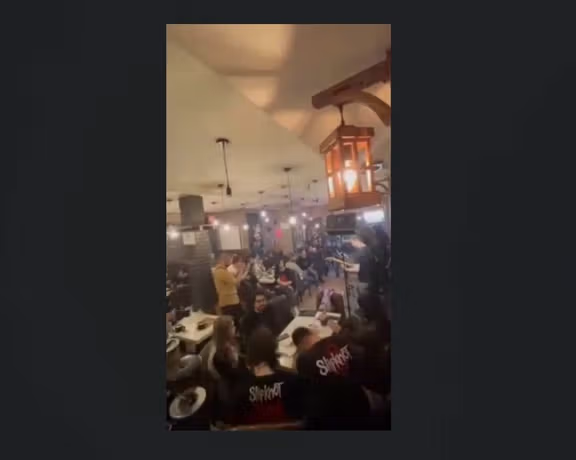
A screengrab from video released by Iran’s state media shows a live music performance at a cafe on Tehran’s Valiasr Street before authorities sealed the venue.

Police in Iran sealed a cafe over accusations that it promoted what authorities called “satanic activities,” state media reported on Sunday.

A video from inside the cafe on Tehran’s Valiasr Street was also released, which appeared to show men and women seated around tables during a live music performance.

In the footage, some audience members could be seen clapping, filming with phones and moving their heads to the music as a performer performed near a microphone and music stand.

The report said Tehran’s public venues police acted after receiving reports about the cafe’s activities.

Authorities accused the cafe of holding Western music events and providing a setting for what officers described as “deviant sects,” involving young men and women.

They also said customers at the cafe had been seen making “strange and unusual movements.”

In May 2024, police arrested over 260 people at an underground rock music festival, branding the event a “satanist gathering.”


Most Viewed

Qatar rejects Iran’s demand for unrestricted release of $12 billion in funds
1
EXCLUSIVE

Qatar rejects Iran’s demand for unrestricted release of $12 billion in funds

2
INSIGHT

Iran factions clash over interim US deal as Trump weighs final call

3
ANALYSIS

Millions face poverty as Iran’s economy reels from war and sanctions

4

Greek man charged in Britain over alleged targeting of Iran International journalist

5
INSIGHT

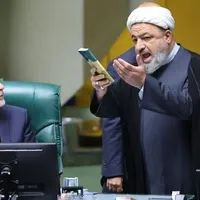
Hardline MP draws backlash over post seen as swipe at Mojtaba Khamenei

Banner
Banner

Spotlight

  • Hardline MP draws backlash over post seen as swipe at Mojtaba Khamenei
    INSIGHT

    Hardline MP draws backlash over post seen as swipe at Mojtaba Khamenei

  • Was the Iran war leverage or a lifeline for Tehran?
    PODCAST

    Was the Iran war leverage or a lifeline for Tehran?

  • Names of some Iran protest victims vanish from Tehran cemetery database

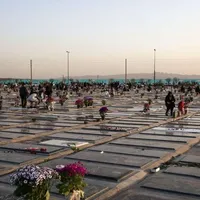
    Names of some Iran protest victims vanish from Tehran cemetery database

  • How four Khamenei family names map the Islamic Republic’s inner circle
    INSIGHT

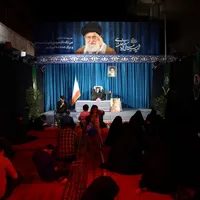
    How four Khamenei family names map the Islamic Republic’s inner circle

  • Witnesses describe gunfire, blocked exits and deadly market fire in Rasht
    SPECIAL REPORT

    Witnesses describe gunfire, blocked exits and deadly market fire in Rasht

  • Iran’s lion-and-sun flag at center of FIFA row before 2026 World Cup

    Iran’s lion-and-sun flag at center of FIFA row before 2026 World Cup

  •  Iran Labels Rock Music Fans Satan Worshippers in Mass Arrest

    Iran Labels Rock Music Fans Satan Worshippers in Mass Arrest

•
•
•

More Stories

Was the Iran war leverage or a lifeline for Tehran?

May 30, 2026, 09:42 GMT+1
•
Negar Mojtahedi
Was the Iran war leverage or a lifeline for Tehran?
100%
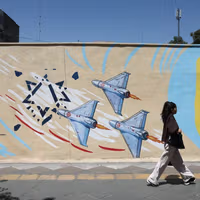
An Iranian woman walks next to an anti-Israeli mural on a street in Tehran, Iran, May 30, 2026.

The Iran war left the Islamic Republic weaker than it had been in years. The question now is whether Washington will turn that weakness into leverage – or give Tehran room to recover through a new deal.

That debate is becoming increasingly urgent as Washington and Tehran move closer to a potential agreement that could extend the current ceasefire and launch a new phase of negotiations over Iran’s nuclear program.

President Donald Trump has suggested a deal may be within reach, while officials on both sides have signaled progress despite major unresolved disputes.

For supporters of the military campaign, the logic is straightforward: Iran entered the talks weaker than it has been in years. For critics, the concern is that diplomacy could give Tehran breathing room just as years of economic pressure, domestic unrest and military setbacks had left it vulnerable.

Speaking to Eye for Iran, former US Treasury official Miad Maleki and national security expert Thomas Juneau offered different answers to the same question: what exactly did the war achieve?

A Regime under pressure

While the two experts differ on what should happen next, both agree that the Islamic Republic emerged from the conflict significantly weakened.

"They've never been so weak. They've never been so vulnerable that they are today, militarily, politically, economically," Maleki said.

The Islamic Republic, he argued, faces mounting economic pressure at home while struggling to maintain the image of strength it has projected for decades. Tehran’s military infrastructure has suffered significant damage, senior figures have been killed, and the economy was already under strain before the conflict began.

Juneau reached a similar conclusion, though from a different angle.

"The regime was clobbered," he said.

Beyond the military and economic damage, Juneau argued that one of Tehran’s core strategic assumptions collapsed during the conflict.

For decades, Iran invested heavily in Hezbollah, Hamas and other regional allies as part of what officials often described as a forward defense strategy. The idea was that any direct attack on Iran would trigger retaliation across the region, deterring adversaries from striking the country itself.

"That failed," Juneau said.

Maleki argues that the regime's losses go beyond military hardware.

The conflict exposed weaknesses in Iran’s air defenses, damaged key infrastructure and further strained a system already struggling with economic collapse, inflation and public discontent. In his view, Tehran entered negotiations not from a position of strength, but because it had few alternatives.

Victory, leverage or lifeline?

Where the two experts diverge is over what happens next.

For Maleki, the central question is why negotiations are taking place now, at a moment when many observers believe the Islamic Republic is under greater pressure than at any point in recent years.

He pointed to growing frustration among some Iranians who believe the conflict exposed vulnerabilities that could have accelerated political change.

"There's some level of disappointment that the fact that the US is negotiating with this regime is bad for the future of a free Iran," he said.

The concern is not that Iran emerged stronger from the war. Rather, it is that Tehran survived a period of extraordinary pressure and may now receive economic or diplomatic relief before those pressures fully take effect.

Juneau sees a different risk.

While acknowledging that the regime has been weakened, he argues that ordinary Iranians may ultimately bear the greatest cost.

"The Iranian people have been thrown under the bus," he said.

The economy, already battered by sanctions, corruption and years of mismanagement, now faces the additional burden of reconstruction. At the same time, Juneau warns that a weakened regime does not necessarily become a more moderate one.

In fact, he believes future protests could face even harsher repression than previous waves of unrest.

"This is a regime now that will have even less tolerance for any kind of popular protests in the future," he said.

The disagreement reflects a broader uncertainty surrounding the talks themselves.

If the objective of the war was to weaken the Islamic Republic’s military capabilities, there is broad agreement that it succeeded. Iran’s regional posture has been damaged, key infrastructure has been hit and some of its most senior figures are gone.

But if the objective was to fundamentally alter Tehran’s behavior, improve conditions for ordinary Iranians or create a pathway toward meaningful political change, the answer remains far less clear.

Maleki believes the conflict became unavoidable as Iran expanded its missile, drone and regional capabilities.

"The conflict was unavoidable. It was coming sooner or later," he said.

Juneau is more cautious.

Asked whether the war was ultimately worth it, he declined to offer a simple yes-or-no answer.

"The negative implications of the war outweigh the positive implications," he said.

That may ultimately be the central dilemma facing policymakers in Washington and the region.

The war weakened the Islamic Republic. Few dispute that.

The unanswered question is whether the diplomacy now taking shape will build on that weakness or alleviate it.

Qatar rejects Iran’s demand for unrestricted release of $12 billion in funds

May 30, 2026, 00:46 GMT+1
Qatar rejects Iran’s demand for unrestricted release of $12 billion in funds
100%
Parliament Mohammad Bagher Ghalibaf (right) and Foreign Minister Abbas Araghchi (left) depart for Doha on Tuesday, 5/25/2026

The recent high-stakes visit of a senior Iranian delegation to Doha, led by Parliament Speaker Mohammad Bagher Ghalibaf, has ended in a major diplomatic setback for Tehran, an informed source with knowledge of the negotiations told Iran International.

Despite Tehran’s firm demands for the immediate and unconditional release of $12 billion in cash upon the signing of an initial Memorandum of Understanding (MoU) with the United States, Qatari officials rejected the request, agreeing to release only half of the amount under strict limitations, the source said.

According to a source close to a Qatari official involved in the discussions, Doha refused to transfer the funds directly or in cash to Iran. Instead, the money will only be made available as credit for Tehran to purchase essential goods and products directly from Qatar.

The restriction comes amid strong US opposition to granting Iran direct, unrestricted access to liquid financial assets.

Washington raised concerns that direct cash injections would provide the Iranian government with vital economic breathing room, allowing it to pay delayed public salaries and procure military equipment or other goods from foreign countries during a time of intense regional strain.

Iran International previously reported that Tehran had set the unrestricted release of the $12 billion held in Qatar as a strict, non-negotiable precondition before it would advance any preliminary diplomatic understanding or sign the proposed framework agreement.

While Speaker Ghalibaf explicitly requested liquid financial assistance to ease Iran's severe domestic economic pressures, Qatar’s counteroffer effectively bars Iran from using the capital at its own discretion in a blow to Tehran’s strategy in US talks.

Rather than gaining direct access to the cash, Tehran is now forced to spend the capped credit line solely within the Qatari market for essential commodities.

To prevent the dispute from derailing the broader, highly sensitive framework talks with the United States, which aim to secure a regional ceasefire and reopen the strategic Strait of Hormuz, all participating parties have reportedly agreed to keep the details of this financial disagreement strictly confidential.

Greek man charged in Britain over alleged targeting of Iran International journalist

May 29, 2026, 13:27 GMT+1
Greek man charged in Britain over alleged targeting of Iran International journalist
100%

A Greek national has been charged under Britain’s National Security Act with assisting a foreign intelligence service, believed to be Iran’s, over the targeting of a journalist at London-based Iran International, British police said.

Counter Terrorism Policing London said Ioannis Aidinidis, 46, who lives in Munich, Germany, was charged under section 3(2) of the National Security Act 2023.

Aidinidis was due to appear at Westminster Magistrates’ Court later Friday.

Police said a 46-year-old man was arrested in West Sussex on May 16 by detectives from Counter Terrorism Policing London, with support from officers from Counter Terrorism Policing South East.

He was detained under section 27 of the National Security Act 2023 and taken to a London police station. Police said warrants for further detention were obtained from Westminster Magistrates’ Court, allowing him to remain in custody until May 30, before charges were authorized after liaison with the Crown Prosecution Service.

The Metropolitan Police said officers did not believe there was any wider threat to the public in relation to the case.

“We know this may cause concern for many people here in the UK, and particularly those working in Persian-language media,” Commander Helen Flanagan, head of Counter Terrorism Policing London, said.

She said police were continuing to work with organizations and individuals to provide safety and security advice, including the person and organization linked to the investigation.

Police said Counter Terrorism Policing continues to work with Persian-language media organizations and others in Britain over threats projected into the UK from Iran.

The case comes amid continued security concerns around Iran International and its staff in Britain.

In a separate case, three people were charged in April over an alleged attempted arson attack on premises linked to the broadcaster in northwest London. Police said that incident caused no damage or injuries.

Two Romanian men are also on trial in London over the 2024 stabbing of Iran International presenter Pouria Zeraati near his home in Wimbledon. British prosecutors have told the court the attack was ordered by a third party acting on behalf of the Iranian state. Tehran has denied involvement.

Amnesty says Iran using war to intensify repression

May 28, 2026, 11:39 GMT+1
Amnesty says Iran using war to intensify repression
100%
A woman lies on the grave of a protester killed during Iran’s January uprising.

Iranian authorities are using wartime conditions to intensify repression through mass arrests, fast-tracked prosecutions, political executions and harsh prison sentences, Amnesty International said on Thursday.

The rights group said more than 6,000 people had been arbitrarily arrested since the US-Israeli military attack on Iran began on February 28, including protesters, journalists, lawyers, rights defenders, dissidents and members of ethnic and religious minorities. It said authorities had carried out at least 39 political executions during the same period.

  • Iran executes man over accusations of spying for Israel

    Iran executes man over accusations of spying for Israel

“Iranian authorities are exploiting the crisis to further erode the human rights of people in Iran,” said Erika Guevara Rosas, Amnesty’s senior director of research, policy, advocacy and campaigns.

Amnesty said Iran’s 88-day internet shutdown, which ended with restrictions on May 26, helped isolate more than 90 million people and obstruct documentation of abuses. It said authorities also criminalized efforts to bypass restrictions through VPNs or satellite internet, including Starlink, with warnings that some cases could fall under the Espionage Law, which carries the death penalty.

“To maintain their grip on power, the authorities have unleashed an all-out assault on people in Iran,” Guevara Rosas said.

The group said detainees had faced enforced disappearance, torture, forced confessions and denial of access to lawyers. It said documented abuses included mock executions, beatings, suspension from hands and feet, solitary confinement, and denial of food and medical care.

Amnesty called on Iranian authorities to release arbitrarily detained people, disclose the fate of those disappeared, lift remaining internet restrictions and halt executions.

“The international community must not allow the Iranian authorities to use the conflict as a smokescreen to deepen their machinery of repression,” Guevara Rosas said.

Iranian students in Canada caught between blackout, debt and fear of return

May 27, 2026, 19:16 GMT+1
•
Mahsa Mortazavi
Iranian students in Canada caught between blackout, debt and fear of return
100%
File photo of a rally against the Islamic Republic in Canada

Shayan Kabiri came to Canada with his family seven years ago. Today, he sees many friends who arrived from Iran alone, hoping to build a more stable future, trapped in a crisis that threatens not only their education but also their mental health and immigration status.

As an advocacy officer with the Iranian Students’ Association at Toronto Metropolitan University, he says many of his peers have no family in Canada and have been living under severe financial and emotional pressure for months.

“Over 99 percent of Iranian students are suffering from this issue – not just emotionally, but financially. Many no longer have access to the money their families send,” he said.

Crisis reaches Canada

According to the latest figures from Immigration, Refugees and Citizenship Canada, around 30,000 Iranian students live in Canada – young people who moved thousands of kilometers from their families in search of safety and stability.

But for many, the crisis is no longer confined to Iran. It has reached their classrooms, dormitories and daily lives in Canada.

  • Canada’s Middle East role: From Pearson’s legacy to passive diplomacy

    Canada’s Middle East role: From Pearson’s legacy to passive diplomacy

Internet restrictions and blackouts in Iran, difficulties transferring money and growing economic pressure on families have left many Iranian students in Canada facing severe financial and psychological strain. Students say they have lost not only reliable access to family support, but in many cases regular contact with parents and loved ones for weeks or even months.

Kabiri says the problem now goes beyond emotional distress. Many international students are struggling to pay tuition and cover basic living expenses.

“Ontario’s laws are such that if you cannot pay your tuition, the university is allowed to expel you. Then there is the risk of having to return to Iran,” he said.

Fear of return

For some students, returning to Iran would not simply mean the end of their education. Many have taken part in anti-government rallies and protests in Toronto and fear they could face serious security consequences if forced back.

Shervin Akhlaghi, captain of the jiu-jitsu team at Toronto Metropolitan University, a member of the university’s Board of Governors and a member of the Iranian Students’ Association, says this has become one of the most urgent concerns among students in recent months.

  • ‘Permit for a terrorist’: Canada opposition asks who cleared ex-IRGC official’s entry

    ‘Permit for a terrorist’: Canada opposition asks who cleared ex-IRGC official’s entry

“Many were active in the rallies. Their pictures have been published. If, for any reason, they cannot continue their education and are forced to return to Iran, God knows what will happen to them,” he said.

He says financial pressure has become so severe that some students are turning to university food banks to meet basic needs.

“Many students are now using emergency food services. The cost of living in Canada is very high, and many are not allowed to work more than a limited number of hours per week,” he said.

Mental health toll

Alongside the financial pressure, family separation, disrupted communication and uncertainty about the future are weighing heavily on students.

Sara Rahimi, a psychotherapist and author, says many Iranian students are experiencing severe anxiety, depression and helplessness.

“These kids feel like they are caught in the middle of a storm. They have no control over their future, nor are they sure they can finish their studies,” she said.

  • Iran sleeper cell fears rise after Austin shooting, Canada gym attack

    Iran sleeper cell fears rise after Austin shooting, Canada gym attack

For many, Rahimi says, losing contact with family is not just a communication problem but a deep emotional rupture.

“It’s like the severing of an emotional umbilical cord for many of these students. They still need their family’s emotional support, and now that connection has suddenly been cut,” she said.

Rahimi also warns that prolonged stress, grief and anger could expose some students to risky behavior or social conflict, potentially jeopardizing their academic or professional future.

Limited support

Some Canadian universities have introduced limited measures, including tuition deferrals, flexible exam schedules, free counseling and emergency relief funds. But students say the support is inconsistent, limited in scope and unavailable at some institutions.

The Ontario government has also recently gained broader authority to intervene in university affairs under Bill 33, the Supporting Children and Students Act, 2025. That authority could potentially be used to mandate special financial or academic accommodations for students from crisis-affected countries.

So far, however, no specific plan or official policy has been announced for Iranian students.

Akhlaghi says student associations from several Ontario universities, including the University of Toronto, York University, Queen’s University and Toronto Metropolitan University, have tried to raise the issue with the provincial government, but the response has been disappointing.

Generic response

According to Akhlaghi, the response from Ontario’s Ministry of Colleges and Universities felt generic and impersonal.

“Our feeling was as if this answer was written by artificial intelligence, because they sent the exact same repetitive response to student associations and even the media,” he said.

In response to questions from Iran International, the ministry did not directly mention Iranian students, saying only that universities and colleges have introduced “measures and supports” for students affected by global crises and advising students to contact their institutions directly.

Student activists say the situation requires more than generic guidance. They say Iranian students are facing overlapping financial distress, mental health challenges, immigration anxiety and fear of return, and need urgent, targeted policies.

Those measures, they say, should include flexibility on tuition payments, emergency financial aid, specialized mental health support and immigration assurances for students who may face danger if returned to Iran.

Beyond the blackout

Although internet access has improved in some parts of Iran in recent days, many students say their difficulties will not disappear quickly.

The sharp decline in families’ financial capacity, continued disruption in money transfers and months of instability have left many students under sustained financial and psychological strain.

For many, this was never only about internet blackouts. It has become a crisis that calls into question their academic future, mental well-being and ability to remain in Canada.