• العربية
  • فارسی
Brand
  • Iran Insight
  • Politics
  • Economy
  • Analysis
  • Special Report
  • Opinion
  • Podcast
  • Iran Insight
  • Politics
  • Economy
  • Analysis
  • Special Report
  • Opinion
  • Podcast
  • Theme
  • Language
    • العربية
    • فارسی
  • Iran Insight
  • Politics
  • Economy
  • Analysis
  • Special Report
  • Opinion
  • Podcast
All rights reserved for Volant Media UK Limited
volant media logo
PODCAST

Was the Iran war leverage or a lifeline for Tehran?

May 30, 2026, 14:03 GMT+1

The Iran war left the Islamic Republic weaker than it had been in years. The question now is whether Washington will turn that weakness into leverage – or give Tehran room to recover through a new deal.

That debate is becoming increasingly urgent as Washington and Tehran move closer to a potential agreement that could extend the current ceasefire and launch a new phase of negotiations over Iran’s nuclear program.

President Donald Trump has suggested a deal may be within reach, while officials on both sides have signaled progress despite major unresolved disputes.

For supporters of the military campaign, the logic is straightforward: Iran entered the talks weaker than it has been in years. For critics, the concern is that diplomacy could give Tehran breathing room just as years of economic pressure, domestic unrest and military setbacks had left it vulnerable.

Speaking to Eye for Iran, former US Treasury official Miad Maleki and national security expert Thomas Juneau offered different answers to the same question: what exactly did the war achieve?

Continue reading

Most Viewed

Qatar rejects Iran’s demand for unrestricted release of $12 billion in funds
1
EXCLUSIVE

Qatar rejects Iran’s demand for unrestricted release of $12 billion in funds

2
INSIGHT

Iran factions clash over interim US deal as Trump weighs final call

3

Greek man charged in Britain over alleged targeting of Iran International journalist

4

Hardline rallies turn Iran’s streets into pressure front against US talks

5
PODCAST

Was the Iran war leverage or a lifeline for Tehran?

Banner
Banner

Spotlight

  • Was the Iran war leverage or a lifeline for Tehran?
    PODCAST

    Was the Iran war leverage or a lifeline for Tehran?

  • Hardline rallies turn Iran’s streets into pressure front against US talks

    Hardline rallies turn Iran’s streets into pressure front against US talks

  • Names of some Iran protest victims vanish from Tehran cemetery database

    Names of some Iran protest victims vanish from Tehran cemetery database

  • How four Khamenei family names map the Islamic Republic’s inner circle
    INSIGHT

    How four Khamenei family names map the Islamic Republic’s inner circle

  • Witnesses describe gunfire, blocked exits and deadly market fire in Rasht
    SPECIAL REPORT

    Witnesses describe gunfire, blocked exits and deadly market fire in Rasht

  • Iran’s lion-and-sun flag at center of FIFA row before 2026 World Cup

    Iran’s lion-and-sun flag at center of FIFA row before 2026 World Cup

•
•
•

More Stories

Was the Iran war leverage or a lifeline for Tehran?

May 30, 2026, 09:42 GMT+1
•
Negar Mojtahedi
Was the Iran war leverage or a lifeline for Tehran?
100%
An Iranian woman walks next to an anti-Israeli mural on a street in Tehran, Iran, May 30, 2026.

The Iran war left the Islamic Republic weaker than it had been in years. The question now is whether Washington will turn that weakness into leverage – or give Tehran room to recover through a new deal.

That debate is becoming increasingly urgent as Washington and Tehran move closer to a potential agreement that could extend the current ceasefire and launch a new phase of negotiations over Iran’s nuclear program.

President Donald Trump has suggested a deal may be within reach, while officials on both sides have signaled progress despite major unresolved disputes.

For supporters of the military campaign, the logic is straightforward: Iran entered the talks weaker than it has been in years. For critics, the concern is that diplomacy could give Tehran breathing room just as years of economic pressure, domestic unrest and military setbacks had left it vulnerable.

Speaking to Eye for Iran, former US Treasury official Miad Maleki and national security expert Thomas Juneau offered different answers to the same question: what exactly did the war achieve?

A Regime under pressure

While the two experts differ on what should happen next, both agree that the Islamic Republic emerged from the conflict significantly weakened.

"They've never been so weak. They've never been so vulnerable that they are today, militarily, politically, economically," Maleki said.

The Islamic Republic, he argued, faces mounting economic pressure at home while struggling to maintain the image of strength it has projected for decades. Tehran’s military infrastructure has suffered significant damage, senior figures have been killed, and the economy was already under strain before the conflict began.

Juneau reached a similar conclusion, though from a different angle.

"The regime was clobbered," he said.

Beyond the military and economic damage, Juneau argued that one of Tehran’s core strategic assumptions collapsed during the conflict.

For decades, Iran invested heavily in Hezbollah, Hamas and other regional allies as part of what officials often described as a forward defense strategy. The idea was that any direct attack on Iran would trigger retaliation across the region, deterring adversaries from striking the country itself.

"That failed," Juneau said.

Maleki argues that the regime's losses go beyond military hardware.

The conflict exposed weaknesses in Iran’s air defenses, damaged key infrastructure and further strained a system already struggling with economic collapse, inflation and public discontent. In his view, Tehran entered negotiations not from a position of strength, but because it had few alternatives.

Victory, leverage or lifeline?

Where the two experts diverge is over what happens next.

For Maleki, the central question is why negotiations are taking place now, at a moment when many observers believe the Islamic Republic is under greater pressure than at any point in recent years.

He pointed to growing frustration among some Iranians who believe the conflict exposed vulnerabilities that could have accelerated political change.

"There's some level of disappointment that the fact that the US is negotiating with this regime is bad for the future of a free Iran," he said.

The concern is not that Iran emerged stronger from the war. Rather, it is that Tehran survived a period of extraordinary pressure and may now receive economic or diplomatic relief before those pressures fully take effect.

Juneau sees a different risk.

While acknowledging that the regime has been weakened, he argues that ordinary Iranians may ultimately bear the greatest cost.

"The Iranian people have been thrown under the bus," he said.

The economy, already battered by sanctions, corruption and years of mismanagement, now faces the additional burden of reconstruction. At the same time, Juneau warns that a weakened regime does not necessarily become a more moderate one.

In fact, he believes future protests could face even harsher repression than previous waves of unrest.

"This is a regime now that will have even less tolerance for any kind of popular protests in the future," he said.

The disagreement reflects a broader uncertainty surrounding the talks themselves.

If the objective of the war was to weaken the Islamic Republic’s military capabilities, there is broad agreement that it succeeded. Iran’s regional posture has been damaged, key infrastructure has been hit and some of its most senior figures are gone.

But if the objective was to fundamentally alter Tehran’s behavior, improve conditions for ordinary Iranians or create a pathway toward meaningful political change, the answer remains far less clear.

Maleki believes the conflict became unavoidable as Iran expanded its missile, drone and regional capabilities.

"The conflict was unavoidable. It was coming sooner or later," he said.

Juneau is more cautious.

Asked whether the war was ultimately worth it, he declined to offer a simple yes-or-no answer.

"The negative implications of the war outweigh the positive implications," he said.

That may ultimately be the central dilemma facing policymakers in Washington and the region.

The war weakened the Islamic Republic. Few dispute that.

The unanswered question is whether the diplomacy now taking shape will build on that weakness or alleviate it.

Trump’s strongest leverage over Tehran may run through Beijing

May 22, 2026, 21:50 GMT+1
•
Negar Mojtahedi
Trump’s strongest leverage over Tehran may run through Beijing
100%
Xi Jinping and Donald Trump walk together during a previous U.S.-China meeting amid growing tensions over trade, sanctions and Beijing’s economic ties to Iran.

The Trump administration’s most powerful pressure point against Tehran may not lie in military action but in China’s deep financial and energy ties with Iran, a former US Treasury sanctions official told the Eye for Iran podcast.

Max Meizlish, a senior research analyst at the Foundation for Defense of Democracies and a former US Treasury official focused on sanctions enforcement, said China may be the real pressure point against Iran as it buys most of Tehran’s oil, helps it evade sanctions and provides the economic oxygen keeping the Islamic Republic alive.

“There’s really no more important enabler of Iranian malign influence and Iranian sanctions evasion than China,” Meizlish told this week’s episode of Eye for Iran.

China buys roughly 90 percent of Iran’s oil exports — a revenue Meizlish says directly finances the Islamic Revolutionary Guard Corps (IRGC), Tehran’s ballistic missile programs and its regional proxy network.

“Chinese purchases of that oil are directly supporting the IRGC, the hardline elements of the Iranian regime,” he said. “All of that is funded and backed by China.”

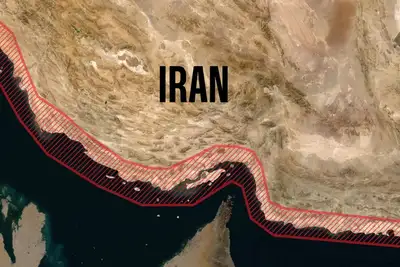
His comments come as tensions rise over Iran’s efforts to exert greater control over the Strait of Hormuz, including reports that Tehran is exploring formalized transit systems and toll mechanisms for ships crossing one of the world’s most critical waterways.

But while global attention remains focused on Iran’s actions in the Persian Gulf, Meizlish argues Washington’s most effective pressure point may lie elsewhere: the financial networks helping Tehran survive economically.

One of the most significant, he says, is Hong Kong.

“If the United States really wanted to, it could bring a lot of pressure there by threatening to cut off all dollar access to Hong Kong as an entire jurisdiction,” Meizlish said.

He pointed specifically to Section 311 of the USA PATRIOT Act, a rarely used mechanism allowing Washington to effectively sever foreign banks from the dollar system by restricting correspondent banking access.

“When we think about Chinese sanctions evasion benefiting Iran, a lot of that money goes through Hong Kong,” he said. “Hong Kong is a global financial hub, and it relies on access to dollars to do that.”

Despite years of “maximum pressure” rhetoric from Washington, Meizlish argues the United States has yet to fully use the economic tools available to it.

“For all the talk of maximum pressure, maximum pressure has been a really effective bumper sticker,” he said. “We need to move from the period of bumper stickers into the period of behavior change.”

The hesitation, he argues, stems largely from fears of Chinese retaliation.

Beijing dominates the mining and processing of rare earth minerals critical to global manufacturing, electronics and defense industries. China could also retaliate against Western firms operating in the country or invoke anti-sanctions laws designed to punish compliance with US restrictions.

“There are a lot of steps that the Chinese could take,” Meizlish warned.

Still, he argues China may be more economically vulnerable than many policymakers assume.

“China’s banking sector is quite fractured. It’s quite vulnerable to economic coercion,” he said, pointing to bad debt, youth unemployment and the country’s prolonged housing crisis.

Meizlish also cited signs Beijing fears the consequences of secondary sanctions. After the United States sanctioned a Chinese “teapot refinery,” he noted, Chinese regulators reportedly warned banks not to extend loans to such firms over concerns they too could become targets.

“To me, all of that supports the idea that the US actually could bring a lot more pressure to bear right now because China is uniquely vulnerable to economic coercion,” he said.

For Meizlish, the broader question is whether Washington is prepared to absorb the economic costs of confronting Beijing more aggressively in order to weaken Tehran.

“We’re in the middle of potentially a once-in-a-lifetime opportunity to fully degrade the Iranian regime’s capacity to exert influence in the region,” he said.

But achieving that, he argues, would require moving beyond symbolic pressure campaigns toward far more aggressive financial enforcement targeting China itself.

“There’s no more important country to tackle than China,” he said. “And there are all these unique economic vulnerabilities that we should be taking advantage of.”

Can Iran’s economy survive a twin squeeze from blockade and blackout?

May 16, 2026, 22:03 GMT+1
•
Mohamad Machine-Chian
Can Iran’s economy survive a twin squeeze from blockade and blackout?
100%
A container is moved at Shahid Beheshti Port in Chabahar, southeastern Iran.

Iran’s internet blackout and the US blockade are pushing the country toward a deeper economic crisis, experts told the Eye for Iran podcast, warning that Tehran is compounding foreign pressure with a self-inflicted assault on its own digital economy.

More than 75 days after Iran imposed sweeping internet restrictions, tens of millions of Iranians remain cut off from the outside world. The blackout has severed ordinary communications, disrupted online businesses and deepened the sense of isolation inside a country already battered by war, sanctions, inflation and a growing shortage of hard currency.

Holly Dagres, a senior fellow at the Washington Institute, says she found in a 2022 report that around 11 million Iranians had online businesses, including many women seeking financial independence through handicrafts, catering, Instagram sales or influencer work.

“This internet shutdown has gravely impacted people,” she told the Eye for Iran podcast, adding that Iranian officials themselves have said 20% of the country’s 30 million-strong workforce has been affected.

Iranian e-commerce platforms, ride-hailing services, streaming platforms and online retailers have all been hit, she said, with hundreds of jobs lost as a result of the blackout.

Dagres said the shutdown also reflects Tehran’s effort to control the information space, not only its stated security concerns. “It’s really not about national security. It’s about who you decide gets control of the internet,” she said.

A self-inflicted economic wound

Siamak Javadi, an Associate Professor of Finance at the University of Texas, said the blackout is not just a political tool but an economic shock inflicted by the state on an already fragile economy.

“The Iranian economy was already in shambles, and you’re inflicting even more damage to the economy by shutting down the internet,” he told the podcast.

Javadi put the economic damage in starker terms. Citing Iranian estimates, he said each minute of internet shutdown costs the economy around $1.5 million in direct losses, or about $80 million a day.

But he said the indirect costs are even more damaging.

“It kills jobs. It kills opportunities. It kills planning,” he said. “If there was any project that they were thinking about undertaking, those projects are going to basically shut down.”

For a developing economy, Javadi said, small and medium-sized enterprises are the backbone of economic life. Shutting down the internet in the middle of a currency crisis and wartime economic shock, he said, amounts to “deliberately killing the economy.”

“It’s like a deliberate, sober decision to kill the economy and basically keep people to fight for their basic necessities,” he said.

The blockade clock

While the internet blackout is damaging the economy from within, Javadi said the US blockade is squeezing the Islamic Republic from the outside by limiting access to oil revenue and foreign currency.

He said Iran’s economy was already weakened before the war by structural problems including corruption, fiscal deficits, capital flight, money-printing and a long-running depreciation of the rial.

The war, he said, added a major supply-side shock and sharply reduced Tehran’s ability to rely on oil income to defend its currency or finance the state.

“What happened during the war, on top of all of these preexisting conditions, is that basically overnight, Iran’s access to oil revenue kind of evaporated,” Javadi said.

He said the blockade is costing Iran an estimated $450 million a day, which he rounded to roughly $12 billion to $15 billion a month.

“That’s substantial for an economy that is like between $350 billion to $400 billion GDP,” he said.

Javadi argued that the Islamic Republic is “definitely on the clock,” especially as oil exports become more limited, more costly and less efficient. With reduced access to oil revenue, limited tax income and small businesses crippled by the blackout, he said the government may eventually struggle to finance even its security apparatus.

“They may not be able to even pay their own security forces and their institution of suppression,” he said.

Still, he warned that the regime does not operate like a normal government. It may allow ordinary economic life to collapse so long as it can preserve the core institutions needed to stay in power.

“They may run out of money to run a business in a normal way. But it doesn’t matter to them,” Javadi said. “As long as they can finance their security forces, they will hold on to power.”

He said that could mean cutting back pensions or leaving ordinary people unable to afford basic necessities while the state prioritizes its coercive machinery.

But the question is not only how long Tehran can keep funding the state under blockade. It is also what kind of economy Iranians are being forced into: one more isolated, more monitored and increasingly cut off from the outside world.

Permanent isolation

Dagres warned that the internet shutdown may be moving Iran toward a more permanent model of isolation.

She said Iran’s domestic internet infrastructure is already functioning in parts of daily life, including banking, ride-hailing and local messaging apps. But those services are monitored, she said, and cannot replace access to the outside world.

“It’s not really hyperbolic anymore” for Iranians to compare the situation to North Korea, Dagres said.

“This seems like this might become the new normal, where only an elite few will have access to the outside world, and everybody else will be living behind this digital wall,” she said.

That wall, she added, is devastating not only psychologically but economically.

For both experts, the crisis facing Iran is therefore not simply the result of outside pressure. The US blockade may be choking off state revenue, but Tehran’s own blackout is choking the businesses, workers and families the state claims to protect.

Can Tehran weaponize the Strait of Hormuz for years to come?

May 9, 2026, 09:55 GMT+1
Can Tehran weaponize the Strait of Hormuz for years to come?
100%
File photo shows IRGC officers during a naval drill in southern Iran

The shadow of a closed Strait of Hormuz no longer looms as a mere threat; it is a reality that has shattered the traditional foundations of the global energy market.

In the latest episode of the Eye for Iran podcast, host Mohamad Machine-Chian sat down with two experts to dissect the fallout: Bozorgmehr Sharafedin, Head of Digital News Services at Iran International and former Reuters Energy Correspondent, and Dr. Iman Nasseri, Managing Director for the Middle East Research at FGE Nexant consultancy, in Dubai.

Together, they painted a picture of a region at a point where a "broken" waterway might be forcing the world to permanently look elsewhere.

Tehran’s unexpected leverage

For decades, the Islamic Republic used the threat of closing the Strait as a rhetorical deterrent. However, according to Bozorgmehr Sharafedin, the actual closure in early 2026 was as much a surprise to Tehran as it was to the world. Having seen their primary deterrents – missile programs and regional proxies like Hezbollah – fail to prevent direct conflict with the US and Israel, the establishment stumbled upon a different kind of power.

"Iranians are also surprised," Sharafedin noted. "The deterrence they didn’t count on that much – the closure of the Strait of Hormuz – became their most valuable card. Now, they are tying the future security of Iran to the management of Hormuz. We had the deputy speaker of the parliament saying that the Strait of Hormuz is our nuclear weapon."

This shift in doctrine has led to a dangerous sense of triumphalism in Tehran. State-controlled media has floated the idea of imposing "transit fees" or "security taxes" on ships, much like the Suez Canal.

But Sharafedin warns that this strategy is fatally short-sighted. Unlike the Suez, which is governed by an international treaty and relative predictability, the Islamic Republic’s logic defies stability. "They will try to impose their political views and preferences on this transit route," he explained. "Many shipping lines simply won't risk it."

The 'broken vase' of global energy

The economic consequences of this closure are already being felt, even if they aren't always visible in the "Brent Crude" price tag seen on news tickers. Dr. Iman Nasseri pointed out that while the public looks at futures prices, the physical market has been in agony.

Dr. Iman Nasseri, Managing Director of FGE-Nexant Dubai (undated)
100%
Dr. Iman Nasseri, Managing Director for the Middle East Research at FGE-Nexant, in Dubai

"The price of jet fuel was over $200 for a prolonged period," Nasseri revealed. "The market is furious and frustrated. We have 12 to 14 million barrels per day of unsupplied demand. In India, many people do not have gas for cooking. The demand destruction has already happened."

This disruption has permanently changed how global powers view the Persian Gulf. Sharafedin cited comments by International Energy Agency (IEA) chief Fatih Birol, saying: "The Strait of Hormuz is like a broken vase. It's broken. The damage is done. It's almost impossible to put it back together." The world is no longer waiting for the Strait to reopen; it is actively building a future without it.

The exodus to alternative routes

The most immediate reaction to the blockade has been a massive surge in investment toward alternative infrastructure. Pipelines that were once considered "economically unfeasible" are now receiving emergency funding. Sharafedin noted that since the start of the conflict in February, the volume of oil transferred via alternative routes has nearly doubled, jumping from 4.2 million to 7 million barrels per day.

"Iraq recently allocated $1.5 billion for a pipeline connecting Basra to Jordan, Syria, and Turkey," Sharafedin said. This diversification isn't limited to the Middle East. Buyers like Pakistan, which relied on Kuwaiti oil for 50 years, are now sourcing crude from Nigeria, Libya, and the United States. Even China, the region's biggest customer, is accelerating its trillion-dollar pivot toward nuclear and solar energy to escape its reliance on the Hormuz bottleneck.

Regional prosperity held hostage

While the global economy may eventually adjust by finding new suppliers, the outlook for the Middle East itself is much grimmer. For the last decade, countries like the UAE, Qatar, and Saudi Arabia have tied their future prosperity to a logic of stability and foreign investment. That dream is now under direct attack.

"The Islamic Republic is single-handedly holding the region down," Sharafedin argued. He pointed out that every time the region moves toward a better future – whether through the Arab Uprisings or attracting tech giants like Amazon AWS – Tehran intervenes to sabotage the stability required for such progress. By attacking infrastructure in Fujairah and targeting tankers in the Red Sea, the regime has signaled that no alternative route is safe.

Eye for Iran host Mohamad Machine-Chian (right) and Bozorgmehr Sharafedin, Head of Digital News at Iran International, May 2026.
100%
Eye for Iran host Mohamad Machine-Chian (right) and Bozorgmehr Sharafedin, Head of Digital News at Iran International, May 2026.

"I don't think many of those countries can now justify the investment of huge data centers," Sharafedin lamented. "Both short-term and long-term, the regional countries will pay a heavy price."

Scenarios for 2027: A prolonged limbo

As the US shifts from "Operation Epic Fury" to "Project Freedom," a new diplomatic phase is emerging, but Dr. Nasseri remains skeptical of a quick fix. He outlined a base-case scenario where the market sees only a "gradual recovery" to about 60% of pre-war levels by late 2026, with the situation remaining largely flat well into 2027.

The fundamental issue, Nasseri argues, is the massive gap between Washington and Tehran’s expectations. "The same regime that has not agreed to terms over the last couple of years will not suddenly do so now," he said. While a potential Memorandum of Understanding (MOU) might provide temporary "happy headlines" to calm traders, the structural reality remains one of severe disruption.

‘Permit for a terrorist’: Canada opposition asks who cleared ex-IRGC official’s entry

May 2, 2026, 09:28 GMT+1
•
Negar Mojtahedi
‘Permit for a terrorist’: Canada opposition asks who cleared ex-IRGC official’s entry
100%
Canada's Prime Minister Mark Carney and Foreign Minister Anita Anand

The Canadian opposition has accused the government of bypassing its own rules after Iran International reported that an IRGC-linked Iranian football official was granted special permission to enter the country despite being inadmissible.

Iran International’s reporting was followed by political backlash in Ottawa, international coverage and Mehdi Taj being turned back within hours of landing in Canada.

Speaking to Iran International’s Eye for Iran, Melissa Lantsman, deputy leader of Canada’s Conservative Party, said the case raised serious questions about who approved Mehdi Taj’s entry and why.

“We need to know who did it, when it happened, how it happened, why it happened, and why it’s never going to happen again,” Lantsman said.

Taj, president of Iran’s football federation, had been expected to travel to Vancouver for the FIFA Congress on April 30 at the Vancouver Convention Center.

Iran International previously reported that Taj was issued a Temporary Resident Permit, or TRP, a tool that allows Canadian authorities to admit a person who would otherwise be barred under immigration law.

Canada listed the IRGC as a terrorist entity in 2024, making people linked to the force inadmissible. Taj has longstanding ties to the Islamic Republic’s security establishment and previously served as an intelligence commander in the IRGC in Isfahan.

Lantsman said the permit showed that the issue was not simply a screening failure.

“Somebody actively made this decision to circumvent our own rules,” she said.

“I can’t believe that I work in a place with a minister who would issue a terrorist a permit.”

Taj was able to board a flight to Canada and land in Vancouver. He was sent back within hours, after Iran International’s reporting on the case had already become public.

That sequence has become central to the political fallout in Ottawa. Critics say the government acted only after the case drew public attention, while ministers have declined to discuss details, citing privacy rules.

Lantsman rejected that explanation in the podcast interview.

“We don’t give privacy to terrorists,” she said. “There is no privacy to people who are inadmissible to our country.”

  • Iran football chief with IRGC ties sent back by Canada after arrival

    Iran football chief with IRGC ties sent back by Canada after arrival

  • Ottawa on defensive after Iran football chief linked to IRGC entered Canada

    Ottawa on defensive after Iran football chief linked to IRGC entered Canada

The issue quickly reached Parliament.

Opposition MPs pressed ministers to explain how a person barred under Canada’s own rules received permission to enter the country.

At Thursday’s meeting of the Standing Committee on Public Safety and National Security in Ottawa, Conservative MP Frank Caputo asked Immigration Minister Lena Diab how a person deemed inadmissible had been granted entry.

Caputo said “the rule of law demands transparency” and asked “who gave him a visa,” saying Iran International’s reporting had brought the case to public attention.

Prime Minister Mark Carney declined to comment on Taj’s case, citing privacy laws, but defended the government’s position on the IRGC.

“Members of the [Iranian] Revolutionary Guard rightly have been prohibited from entering this country and they will not enter this country,” he said.

Foreign Affairs Minister Anita Anand suggested the permit may have been granted and later revoked, saying her understanding was that “there is a revocation of the permission” and that “it was unintentional.”

Lantsman said that response only deepened the need for answers.

“If they unintentionally gave him a permit, then we need to know how that happened and why it happened,” she said. “And if the unintentionality of it was about the revocation, that’s even worse.”

The controversy has turned a single immigration decision into a broader political test of Canada’s handling of officials tied to the Islamic Republic.

Although Canada has formally banned the IRGC, Temporary Resident Permits allow authorities to override inadmissibility in certain cases. Taj’s case has raised questions about how such exceptions are approved and what safeguards exist when national security concerns are involved.

The controversy also comes as anger continues over the Islamic Republic’s crackdown on protests in January, with the IRGC at the center of the state response. Rights groups and Iranian activists have described the violence as among the deadliest episodes in modern Iranian history.

At least three Iranian footballers have been killed during the unrest. Ali Karimi, Iran’s former national team captain, has criticized FIFA’s silence and called on the organization to condemn the killing of athletes and speak out against the crackdown.

Lantsman said the opposition has submitted formal questions in Parliament and would continue pressing the government for details.

“This cannot happen,” she said. “We’re going to continue to keep the pressure on.”

The case has also drawn wider attention beyond Canada. The New York Times, USA Today, Agence France-Presse and The Canadian Press have covered the incident, citing Iran International’s reporting.

For Lantsman, the central issue remains who approved the permit and why.

“Somebody in Canada, somebody very high up in the ministry, decides that it’s in public interest of Canada to have this person here,” she said.

The government has yet to publicly identify who authorized the permit, why it was issued, or what measures are being taken to prevent a similar case.