Iran users still face heavy filtering after blackout, NetBlocks says
Iran’s internet connectivity has largely returned three months after authorities cut access to the global internet, but users still face heavy filtering, internet monitor NetBlocks said on Thursday.
“While connectivity has now largely returned, metrics indicate that users still face heavy filtering, similar to the interim period between the January protests and the start of the war,” it said.
Ahead of the 2026 World Cup, a possible ban on Iran’s lion-and-sun flag has opened a dispute between FIFA and Iranian opponents of the Islamic Republic over identity, representation and politics in sport.
For many Iranians abroad, the World Cup is not only a sporting event. It is also a rare global stage where they can be seen, express identity and say things that can carry serious costs inside Iran.
Now, ahead of the 2026 tournament, that stage has become the center of a new argument. On the surface, it is about a flag. In practice, it is about who gets to define Iran, which symbols are allowed to represent it and where FIFA draws the line between sport and politics.
Ahead of the 2026 World Cup, a possible ban on Iran’s lion-and-sun flag has opened a dispute between FIFA and Iranian opponents of the Islamic Republic over identity, representation and politics in sport.
For many Iranians abroad, the World Cup is not only a sporting event. It is also a rare global stage where they can be seen, express identity and say things that can carry serious costs inside Iran.
Now, ahead of the 2026 tournament, that stage has become the center of a new argument. On the surface, it is about a flag. In practice, it is about who gets to define Iran, which symbols are allowed to represent it and where FIFA draws the line between sport and politics.
FIFA says flags, banners and symbols of a political nature are not allowed inside World Cup stadiums. Football’s global governing body says such rules are intended to preserve the neutrality of sport and prevent stadiums from becoming arenas for political conflict.
But in Iran’s case, many Iranians say that boundary is neither clear nor neutral.
Two flags, two visions of Iran
Opponents of the Islamic Republic say FIFA’s rules effectively privilege Tehran’s post-1979 official flag while treating the historic lion-and-sun banner as political.
The lion-and-sun emblem was used in Iran before the 1979 revolution and is still embraced by many Iranians as a national symbol outside the framework of the Islamic Republic.
The lion-and-sun emblem has deep roots in Iranian history and was used in different forms for centuries. After the 1979 revolution, the Islamic Republic replaced it with a new flag bearing religious and revolutionary symbols. For many opponents of the current system, the older flag has become a symbol of national identity separate from the Islamic Republic.
For them, a ban is not simply the enforcement of a stadium regulation. It is a choice between two competing narratives of Iran.
“If the Iranian government has registered its own symbol as the official flag, why should a symbol that was part of Iran’s history for centuries be considered political?” one Iranian opponent of the Islamic Republic in Los Angeles told Iran International. “Who gets to decide that definition?”
The debate is not new.
During the 2022 World Cup in Qatar, there were reports that some Iranian fans faced restrictions when trying to enter stadiums with the lion-and-sun flag or symbols associated with anti-government protests.
The same question was raised then: whether sports bodies’ definition of a political symbol is truly neutral, or whether it can itself become a political decision.
A changed relationship with Team Melli
The issue is no longer only about the flag.
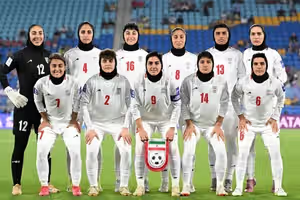
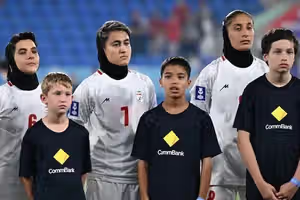
Since the Woman, Life, Freedom movement, the relationship between parts of Iranian society and the national football team has changed significantly.
For decades, even as the Islamic Republic tried to fold public institutions into its official narrative, the national football team remained for many Iranians something larger than the government – a source of national pride, shared memory and collective identity.
After nationwide protests and intensified repression inside Iran, however, part of the public no longer views the team only through a sporting lens. The players’ conduct, silence or public positions, and their relationship with the state have all become politically charged.
Some opponents of the Islamic Republic now say the distance has grown deeper than ever, following the killing of large numbers of Iranians during the January protests and the rise in security pressure after the recent war.
In conversations with Iran International, several Iranian opponents of the Islamic Republic in Los Angeles and Seattle repeated the same argument: for part of the public, this team no longer represents the Iranian people.
“We love football. We love Iran’s national team. We were happy when it won and sad when it lost,” one of them said. “But today, many people feel this is no longer the national team in which they can see themselves.”
For this group, the issue is not hostility toward football or rejection of a national sport. On the contrary, they see themselves as part of a society for which football has long been tied to everyday life and national identity.
Their argument is that when the ruling system tries to use every national symbol – from sport to the flag – for political legitimacy, separating sport from politics becomes difficult.
A symbol of reclaiming identity
In that atmosphere, the lion-and-sun flag is not merely a historical symbol for some opponents of the Islamic Republic. It is an attempt to reclaim a version of Iran they feel has been taken from them.
“If a team that the Islamic Republic considers its representative is going onto the pitch, we also want to show our Iran in the stands,” one protester said.
This is where the dispute becomes more complicated.
If some Iranians no longer see the official team as reflecting their national identity, then barring the symbol they identify with is not viewed as a simple stadium rule, but as another exclusion of their voice from the world stage.
At the same time, some Iranian legal and civil groups are pursuing legal avenues to challenge such restrictions. They argue that banning these symbols conflicts with principles of free expression, particularly in a country such as the United States, where free speech has strong legal protection.
The legal issue is complicated. World Cup stadiums under FIFA management operate under specific tournament rules and are not necessarily governed in the same way as ordinary public spaces.
Still, the anger among opponents of the Islamic Republic is real. Some openly say that even if the flag is banned inside stadiums, they will find other ways to display it.
For them, the question is no longer only whether one flag can enter a stadium. It is who has the authority to decide what Iran is, which symbol represents it and which voices are allowed to be visible on the world stage.
FIFA says politics should not enter sport. But when identity itself has become political for part of a nation, the deeper question is whether people can be asked to leave that identity outside the stadium gates.
Ali Bagheri Kani, deputy secretary of Iran’s Supreme National Security Council, met Taliban Defense Minister Muhammad Yaqoob Mujahid in Moscow on Wednesday, Iran’s state news agency IRNA reported.
Bagheri told Mujahid that the United States and Israel were the “common enemies” of countries in the region and that foreign intervention was the main cause of instability, the report said.
Mujahid told Bagheri that Afghanistan’s soil, airspace and borders had never been a source of threat to Iran, adding that the Taliban had proved this during the US-Israeli strikes, it added.
An Iranian lawmaker said on Thursday that a possible agreement with the United States would violate the Supreme Leader’s red lines on the Strait of Hormuz, the nuclear issue, compensation and Lebanon.
Abolfazl Abutorabi told Iran-based website Didban Iran that the draft under discussion differed “180 degrees” from an earlier 10-point version he said had been prepared under the Supreme Leader’s direct view.
He said reopening the Strait of Hormuz had been placed against the lifting of the naval blockade, but without enforcement guarantees.
“If we open the Strait of Hormuz, what guarantee is there that they will not start the blockade again? No guarantee,” he said.
Abutorabi also criticized reported proposals for the release of Iranian funds, saying Tehran should not give up leverage in Hormuz to receive $12 billion of its own money.
He said a proposed $300 billion fund for Iran lacked enforcement guarantees and accused Washington of trying to deceive Tehran with what he called “a lollipop.”
“JCPOA Two is more damaging than JCPOA One,” he said, referring to the 2015 nuclear deal, adding that he believed the United States would attack again after the World Cup and its elections.
Reopening internet access is against the law, said the spokesman for parliament’s cultural committee on Thursday.
Ahmad Rastineh said the Islamic Republic should use all its capacity to complete the National Information Network, a domestic network cut off from the real internet.
The lawmaker added that “unregulated access” to internet, especially for teenagers, would cause serious harm to the country.
He said a body created by President Masoud Pezeshkian to restore internet access lacked authority because its duties overlapped with those of the Supreme Council of Cyberspace.