Israel may resume military campaign in Iran if talks fail, ambassador says
Israel could return to military action against Iran if diplomacy with Tehran fails to meet core objectives, Israel’s ambassador to Australia told Iran International in an exclusive interview.
Hillel Newman said Israel supported talks between Iran and the United States, but only if they removed what he described as existential threats from the Islamic Republic.
“We’re in favor... of talks as long as they attain the objectives. We cannot compromise on the objectives,” Newman said.
Israel’s Ambassador to Australia Hillel Newman speaks to Iran International in an interview on May 27, 2026.
Israel could return to military action against Iran if diplomacy with Tehran fails to meet core objectives, Israel’s ambassador to Australia told Iran International in an exclusive interview.
Hillel Newman said Israel supported talks between Iran and the United States, but only if they removed what he described as existential threats from the Islamic Republic.
“We’re in favor... of talks as long as they attain the objectives. We cannot compromise on the objectives,” Newman said.
“As I said, the objectives are removal of the nuclear capability, zero enrichment, zero enriched uranium in Iran,” he added. “Also the fact of the ballistic missiles and stopping their support of the proxies which cause unrest in the entire Middle East.”
Newman said Israel was prepared to accept a diplomatic outcome if it achieved those aims.
“If we can attain it through negotiations and diplomatic discussions, fine. If not, we might have to go back to the military campaign in order to attain the objectives, but the objectives must be attained,” he said.
The remarks come as US-Iran talks continue over a possible agreement to end the conflict, with Tehran and Washington still divided over Iran’s highly enriched uranium, sanctions relief, frozen assets and the Strait of Hormuz.
Asked whether Israel would act independently if negotiations produced a ceasefire, Newman said Israel was already giving diplomacy a chance.
“We’re actually now in a kind of a ceasefire which we have declared and accepted because we’re giving a good opportunity in good faith for the discussions, for the diplomatic resolution of the issue,” he said.
Newman said Israel had confidence in US President Donald Trump and described coordination between Washington and Israel as “unprecedented.”
“We have trust, we have confidence in President Trump. We work together closely. There’s coordination,” he said.
He also said any agreement affecting Lebanon would depend on conditions, including whether Iran-backed Hezbollah retreats north of the Litani River.
“We just have to make sure that the Hezbollah terrorists are not launching rockets against Israel and as much as possible not armed and present in the southern part of Lebanon beyond the south of the Litani River,” Newman said. “That’s all we want. We don’t want any territorial aspirations in Lebanon.”
‘Weakening IRGC could open path for Iranians’
Newman said Israel distinguished between the Islamic Republic and the Iranian people, adding that weakening the IRGC, Basij and the ruling establishment could create “a new opportunity” for Iranians.
“In the end, the people of Iran must take their destiny into their own hands,” he said. “By weakening the Basij forces and by weakening the IRGC, by weakening the regime itself, we are opening perhaps a new opportunity for the people of Iran.”
During the Iran war, Israel targeted not only senior commanders and strategic military sites but also checkpoints and street-level security units.
Rauf Derakhshani-Mehr, a 19-year-old university student killed during January protests in the southern city of Dezful, was buried at night under pressure from security forces after his family located his body in a morgue, according to information obtained by Iran International.
Derakhshani-Mehr, a law student at Islamic Azad University, was shot dead during protests on January 9, a source familiar with the case said.
He was struck by a live bullet in the side and had also suffered metal pellet wounds to the left side of his body before the fatal shooting, the source said.
Rauf Derakhshani-Mehr, a 19-year-old university student killed during January protests in the southern city of Dezful, was buried at night under pressure from security forces after his family located his body in a morgue, according to information obtained by Iran International.
Derakhshani-Mehr, a law student at Islamic Azad University, was shot dead during protests on January 9, a source familiar with the case said.
He was struck by a live bullet in the side and had also suffered metal pellet wounds to the left side of his body before the fatal shooting, the source said.
After he was transferred to Ganjavian hospital, his body was left alongside those of several other young protesters in the hospital grounds, according to witnesses and hospital staff cited by the source.
Witnesses said wounded protesters were denied treatment and that several people died because they did not receive medical care. Blood covered parts of the hospital grounds because of the severity of the injuries, they added.
Family searched hospitals and morgues
Derakhshani-Mehr’s family spent hours searching for him and went to the hospital, where officials initially denied he was there despite the family checking different wards.
Emergency personnel later told the family his body was being held in the hospital morgue, but security forces sealed the facility and prevented relatives from seeing him, the source added.
Family members were also given conflicting information by different authorities and were at one point told that he was still alive.
His body was eventually identified at the forensic medicine office in Ahvaz after being transferred there as an unidentified person, according to the account received by Iran International.
Before handing over the body, authorities forced the family to agree that the burial would take place at night and attended only by a small number of people. Derakhshani-Mehr was buried in Shahidabad cemetery in Dezful.
Night burials reported in earlier crackdowns
Security forces in Iran have previously buried slain protesters at night or without notifying their families.
In one case previously reported by Iran International, a 16-year-old boy named Reza who was killed during protests in Karaj was secretly buried by members of the Islamic Revolutionary Guards Corps without his family’s knowledge.
Witnesses said Reza was shot by a sniper around 9 p.m. on January 8 in the Shahin Vila neighborhood of Karaj. He later died after being moved to a residential parking area and then taken to a clinic.
People familiar with the case said the teenager’s family was informed the following day that members of the Revolutionary Guards had buried him overnight and disclosed the location of the grave afterward.
Iranian negotiators are demanding the immediate release of $12 billion in frozen assets held in Qatar as a precondition for advancing talks with the United States, an informed source with direct knowledge of the negotiations told Iran International.
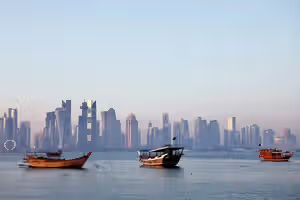
Boats sail at the Doha Corniche with the Doha skyline seen in the background in Doha, Qatar, February 13, 2024.
Iranian negotiators are demanding the immediate release of $12 billion in frozen assets held in Qatar as a precondition for advancing talks with the United States, an informed source with direct knowledge of the negotiations told Iran International.
According to the source, the release of these specific funds in Qatar is a strict precondition for the initial Memorandum of Understanding (MoU) stage.
Tehran has insisted that actual, guaranteed access to this $12 billion must be granted during this first phase before any preliminary diplomatic understanding can move forward, the source said.
The source emphasized that this $12 billion represents only the immediate tranche required to initiate the diplomatic roadmap, and is not the only capital Iran is claiming.
Tehran's broader negotiating position is that all of its frozen assets globally must be unfrozen and fully released as part of any eventual comprehensive agreement, according to the source.
Earlier in the day, IRGC-linked Tasnim News reported that differences between Iran and the United States over one or two clauses of a possible memorandum of understanding remained unresolved.
Tasnim also reported on Sunday that Iran has insisted any initial memorandum of understanding with the United States should include the release of at least part of its frozen assets in the first step.
The report said Tehran had stressed that the released funds must be accessible to Iran.
It added that Washington had sought in recent weeks to link the release of the assets to a possible final nuclear agreement.
Iran wants part of the funds released at the start of any MOU and a mechanism set for releasing the rest during negotiations, according to the report.
Later in the day, Tasnim said US obstruction of some clauses in a potential agreement with Iran, including the release of Tehran’s blocked assets, was still continuing.
Accordingly, there is still a possibility that the agreement could be canceled, Tasnim's report added.
In April, Reuters reported that Washington had agreed to release $6 billion in frozen Iranian assets held in Qatar and other banks. The funds, linked to Iranian oil sales to South Korea, were moved to Qatari accounts under a 2023 prisoner swap but remained restricted to humanitarian use under US oversight, according to the report.