Family forced into nighttime burial after student killed in protests
Rauf Derakhshani-Mehr, a 19-year-old university student killed during January protests in the southern city of Dezful, was buried at night under pressure from security forces after his family located his body in a morgue, according to information obtained by Iran International.
Derakhshani-Mehr, a law student at Islamic Azad University, was shot dead during protests on January 9, a source familiar with the case said.
He was struck by a live bullet in the side and had also suffered metal pellet wounds to the left side of his body before the fatal shooting, the source said.
Rauf Derakhshani-Mehr, a 19-year-old university student killed during January protests in the southern city of Dezful, was buried at night under pressure from security forces after his family located his body in a morgue, according to information obtained by Iran International.
Derakhshani-Mehr, a law student at Islamic Azad University, was shot dead during protests on January 9, a source familiar with the case said.
He was struck by a live bullet in the side and had also suffered metal pellet wounds to the left side of his body before the fatal shooting, the source said.
After he was transferred to Ganjavian hospital, his body was left alongside those of several other young protesters in the hospital grounds, according to witnesses and hospital staff cited by the source.
Witnesses said wounded protesters were denied treatment and that several people died because they did not receive medical care. Blood covered parts of the hospital grounds because of the severity of the injuries, they added.
Family searched hospitals and morgues
Derakhshani-Mehr’s family spent hours searching for him and went to the hospital, where officials initially denied he was there despite the family checking different wards.
Emergency personnel later told the family his body was being held in the hospital morgue, but security forces sealed the facility and prevented relatives from seeing him, the source added.
Family members were also given conflicting information by different authorities and were at one point told that he was still alive.
His body was eventually identified at the forensic medicine office in Ahvaz after being transferred there as an unidentified person, according to the account received by Iran International.
Before handing over the body, authorities forced the family to agree that the burial would take place at night and attended only by a small number of people. Derakhshani-Mehr was buried in Shahidabad cemetery in Dezful.
Night burials reported in earlier crackdowns
Security forces in Iran have previously buried slain protesters at night or without notifying their families.
In one case previously reported by Iran International, a 16-year-old boy named Reza who was killed during protests in Karaj was secretly buried by members of the Islamic Revolutionary Guards Corps without his family’s knowledge.
Witnesses said Reza was shot by a sniper around 9 p.m. on January 8 in the Shahin Vila neighborhood of Karaj. He later died after being moved to a residential parking area and then taken to a clinic.
People familiar with the case said the teenager’s family was informed the following day that members of the Revolutionary Guards had buried him overnight and disclosed the location of the grave afterward.
Iranian negotiators are demanding the immediate release of $12 billion in frozen assets held in Qatar as a precondition for advancing talks with the United States, an informed source with direct knowledge of the negotiations told Iran International.
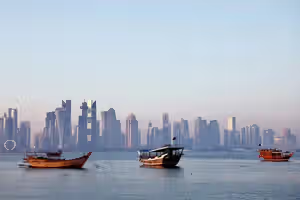
Boats sail at the Doha Corniche with the Doha skyline seen in the background in Doha, Qatar, February 13, 2024.
Iranian negotiators are demanding the immediate release of $12 billion in frozen assets held in Qatar as a precondition for advancing talks with the United States, an informed source with direct knowledge of the negotiations told Iran International.
According to the source, the release of these specific funds in Qatar is a strict precondition for the initial Memorandum of Understanding (MoU) stage.
Tehran has insisted that actual, guaranteed access to this $12 billion must be granted during this first phase before any preliminary diplomatic understanding can move forward, the source said.
The source emphasized that this $12 billion represents only the immediate tranche required to initiate the diplomatic roadmap, and is not the only capital Iran is claiming.
Tehran's broader negotiating position is that all of its frozen assets globally must be unfrozen and fully released as part of any eventual comprehensive agreement, according to the source.
Earlier in the day, IRGC-linked Tasnim News reported that differences between Iran and the United States over one or two clauses of a possible memorandum of understanding remained unresolved.
Tasnim also reported on Sunday that Iran has insisted any initial memorandum of understanding with the United States should include the release of at least part of its frozen assets in the first step.
The report said Tehran had stressed that the released funds must be accessible to Iran.
It added that Washington had sought in recent weeks to link the release of the assets to a possible final nuclear agreement.
Iran wants part of the funds released at the start of any MOU and a mechanism set for releasing the rest during negotiations, according to the report.
Later in the day, Tasnim said US obstruction of some clauses in a potential agreement with Iran, including the release of Tehran’s blocked assets, was still continuing.
Accordingly, there is still a possibility that the agreement could be canceled, Tasnim's report added.
In April, Reuters reported that Washington had agreed to release $6 billion in frozen Iranian assets held in Qatar and other banks. The funds, linked to Iranian oil sales to South Korea, were moved to Qatari accounts under a 2023 prisoner swap but remained restricted to humanitarian use under US oversight, according to the report.
A family-run financial network accused of laundering money for Iran’s Revolutionary Guards has been operating from London and moving funds through shell companies in China and the UAE, according to sanctions records and leaked documents reviewed by Iran International.
On May 11, the British government sanctioned four members of the Zaringhalam family for links to individuals whose activities contribute to instability in the United Kingdom. At least three of them are believed to reside in London.
One of the sanctioned individuals is Farhad Zaringhalam, 44, a specialist in wireless communications and financial technology who earned both his bachelor’s degree and PhD in electronics from King’s College London.
A former Nokia employee who holds British citizenship, he serves on the board of Pergas Petro Trade Group in Iran and manages a company in Singapore. An address registered under his name belongs to a company in Dubai’s Sama Tower, both of which have been sanctioned by the United States for laundering money for the IRGC.
Some members of IRGC money laundering network in London
Farhad did not respond to Iran International’s requests for comment but told the Daily Mail he would challenge the British government’s decision.
The wider Zaringhalam family has long been linked to sanctions evasion and financial networks serving the Islamic Republic.
Nasser Zaringhalam, 66, owns Berelian Exchange. Three years ago, Iran International published exclusive footage of conversations inside his exchange office in which he explicitly referred to circumventing sanctions.
In June 2025, the US Treasury Department sanctioned both Nasser and his exchange house for involvement in terrorism financing.
Documents published by WikiIran show that Nasser and his exchange office registered at least 37 shell companies in the UAE and China and maintained more than 140 bank accounts there to evade sanctions.
One document shows him asking Zagros Petrochemical Company to transfer €3 million to Fanzhian International, a shell company in China. The transaction was processed through Zhishank Bank.
The principal shareholder of Zagros Petrochemical Company is Parsian Oil and Gas Group, which belongs to Ghadir Investment Company, the holding company of the Armed Forces Social Security Organization.
The CEO of Parsian Oil and Gas Group is IRGC Brigadier General Ahmad Vahidi Dastjerdi, a former deputy defense minister.
Ahmad Vahid Dastjerdi, the commander-in-chief of the Islamic Revolutionary Guard Corps (left)
Another leaked document reviewed by Iran International indicates that Nasser Zaringhalam laundered money for Shiraz Petrochemical Company through Moderate General Trading, his UAE-based exchange house, which is also under US sanctions. The principal shareholder of Shiraz Petrochemical is likewise the Armed Forces Social Security Organization.
A separate document shows more than €890,000 transferred through a shell company into a bank account in China before the funds were moved onward to Germany.
According to available records, Nasser Zaringhalam holds citizenship from Saint Kitts and owns a house in Finchley, a district in North London with a large Iranian population.
Britain has also sanctioned Nasser’s son, Pouria Zaringhalam, 29, who holds both British and Saint Kitts citizenship. According to municipal registration records, he has lived in properties in Finchley and Canary Wharf in recent years. In Iran, he serves on the board of Mehr Shabestan Mazandaran Company. British authorities have confirmed he resides in London.
Samples from Mansour Zarrinqalam’s cooperation documents with Persian Gulf Petrochemical Industries Company
Another sanctioned family member, Mansour Zaringhalam, 63, owns Mansour Zaringhalam & Partners Company, also known as GCM Exchange. The United States sanctioned him and his exchange office last year for financing the IRGC.
One leaked document shows Mansour delivering funds belonging to Persian Gulf Petrochemical Industries Company in cash after laundering the money and transferring it back to Iran.
Persian Gulf Petrochemical Industries Company, Iran’s second-largest company by revenue, has been sanctioned for financing the IRGC Quds Force and is a major economic arm linked to the IRGC’s Khatam al-Anbiya Construction Headquarters.
In a contract reviewed by Iran International, Mansour committed himself to creating “a suitable financial structure” for transferring money and receiving foreign currency payments. Another clause stated that he would reduce transfer risks by establishing such a network “while observing security principles.”
Britain also sanctioned Fazlollah Zaringhalam, 74, brother of Nasser and Mansour. Fazlollah, who also holds British citizenship, owns Zaringhalam & Partners Exchange and resides in London, according to the British Treasury.
Eight years ago, one of Fazlollah’s sons, Farshad, who owned an exchange office in Tehran, was sentenced to ten years in prison for disrupting Iran’s foreign exchange system. Another son, Behzad, owns an exchange office in Tehran’s Saadat Abad district.
In Tehran, however, the network’s operations appear to be coordinated in part by Mitra Zaringhalam, sister of the Zaringhalam brothers. The 53-year-old owns Zarin Tehran Investment Company. Both she and her company have been sanctioned by the United States for financing terrorism.
The sanctions come amid heightened scrutiny of Iranian-linked activity in Britain following a string of incidents in North London targeting Jewish sites and media organizations opposed to the Islamic Republic.
The group Harakat Ashab al-Yamin al-Islamiya, which is close to the Iranian government, has claimed responsibility on social media for some of the attacks.
Parham Mehrabi, 18, was killed by direct fire from security forces in Mashhad on January 8, 2026, while standing alongside his father, sources familiar with the matter told Iran International.
His death occurred during the January Massacre, a nationwide crackdown on anti-establishment protests that resulted in the deaths of thousands of people across Iran.
Witnessing the shooting from just a few meters away, Parham's father immediately retrieved his son’s body.