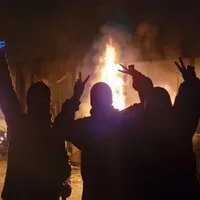
Father carried son’s body through Mashhad protest zone after fatal shooting
Parham Mehrabi, 18, was killed by direct fire from security forces in Mashhad on January 8, 2026, while standing alongside his father, sources familiar with the matter told Iran International.
His death occurred during the January Massacre, a nationwide crackdown on anti-establishment protests that resulted in the deaths of thousands of people across Iran.
Witnessing the shooting from just a few meters away, Parham's father immediately retrieved his son’s body.
Security forces in Najafabad, a major city in Isfahan province in central Iran, implemented deliberate power outages on January 8 and 9 to facilitate a lethal crackdown on protesters.
According to accounts received by Iran International, the use of gunfire under the cover of darkness resulted in dozens of fatalities during these two nights.
These events were part of the January Massacre, a nationwide suppression of anti-establishment protests that led to thousands of deaths across Iran.
Amirhossein Zeinali, a 26-year-old conscripted soldier, was one of the first victims identified from the evening of January 8.
Zeinali had only recently begun his mandatory military service when he was shot by security forces in front of Police Station 12.
According to local witnesses, he was not participating in the demonstrations but was targeted by direct gunfire while he was attempting to help a woman who had been wounded by earlier shots.
Amirhossein Khodadadi, 27, was also killed during the darkness of the January 8 crackdown.
Khodadadi was a cafe staff who, along with his fiancée, had been working long hours to save money for their dream of opening an independent business.
Following his death, government authorities withheld his body for a full week, only releasing it to his family after significant pressure.
Omid Ghasemi Nafchi, 37, died after being struck by a military-grade bullet to the heart during the protests in Najafabad.
A father of two children, aged five and ten, his body was eventually transported to the city of Shahrekord for interment following the fatal shooting.
Mahmoud Maleki, a 38-year-old truck driver, was killed by a direct shot to his side.
His grave in Najafabad bears the inscription "Bahar's Dear Father" (Baba Jan-e Bahar). This refers to his young daughter, who, according to family sources, fulfilled her goal of reading aloud to him by reciting at his graveside after his death.
Vahid Shahrashoub was killed the following morning, January 9, in the vicinity of the Najafabad cemetery.
Shahrashoub, a local vendor, witnessed security forces using municipal waste management trucks to transport the remains of those killed during the previous night's operations, according to sources familiar with the matter.
After he vocally protested the use of these vehicles, security agents shot him in the head and placed his body into the same waste truck.
The operational approach in Najafabad – coordinating utility blackouts with armed intervention and using non-standard vehicles for transporting remains – mirrors reporting from other protest hubs during the January Massacre.
These methods were utilized by security forces to obscure the scale of the casualties and minimize the documentation of violence during the peak of the demonstrations.
Parham Mehrabi, 18, was killed by direct fire from security forces in Mashhad on January 8, 2026.
Parham Mehrabi, 18, was killed by direct fire from security forces in Mashhad on January 8, 2026, while standing alongside his father, sources familiar with the matter told Iran International.
His death occurred during the January Massacre, a nationwide crackdown on anti-establishment protests that resulted in the deaths of thousands of people across Iran.
Witnessing the shooting from just a few meters away, Parham's father immediately retrieved his son’s body.
To prevent security forces from seizing the remains — a frequent occurrence during the crackdown — the father carried the teenager in his arms for hundreds of meters through the protest zone to reach his vehicle, eventually transporting him directly to the family home.
Security forces demand 'rioter' narrative for burial
The day after the killing, security officials refused to grant burial permits unless the family agreed to their terms.
According to sources familiar with the matter, officials coerced the father into signing a written commitment saying his son had been killed by "rioters" rather than state forces.
Authorities threatened to withhold the body indefinitely if the family did not comply with the official narrative.
Conscience over safety
Family and friends remember Parham as a kind and soft-spoken teenager who was deeply devoted to his parents.
His family said that on the night of the protest, his father had tried to convince him to stay home, promising to buy him a PlayStation 5 if he avoided the streets.
In an exchange that has since defined his legacy, Parham replied: "If I don't go, what am I supposed to do with my conscience?"
US and allied forces helped intercept Iranian missile and drone attacks targeting Iranian Kurdish opposition groups in Erbil, sources familiar with the matter told Iran International on Friday.
The Democratic Party of Iranian Kurdistan said its positions were targeted several times overnight and on Friday morning.
Sources from the group told Iran International that “US forces and allies are supporting Iranian Kurdish parties by intercepting and shooting down some of these missiles and drones.”
Attacks on three Iranian Kurdish opposition groups over the past 24 hours had exceeded 15 strikes after another attack was confirmed against the Kurdistan Freedom Party.
Iranian security forces arrested a doctor and an anesthesia nurse from a hospital in Najafabad, in central Iran, on Saturday on security-related charges, Iran International has learned.
The arrests of Dr. Pedram Hadipour and nurse Sobhan Nourian took place at the Montazeri Hospital in Najafabad. The specific nature of the security charges against the medical professionals was not immediately disclosed.
The arrests follow the circulation of graphic footage from the same hospital following protests on Jan. 8 and 9. Those images showed the bloodied bodies of dozens of casualties in various sections of the medical facility.
Iran's president Masoud Pezeshkian speaking at the parliament in this undated file photo
Exclusive information obtained by Iran International points to a growing clash between Iran’s President Masoud Pezeshkian and its military leadership over Monday’s escalation in the Persian Gulf and attacks on the United Arab Emirates.
According to sources familiar with Tehran’s deliberations, Pezeshkian has expressed strong anger at actions by the Islamic Revolutionary Guard Corps, led by Ahmad Vahidi, describing missile and drone strikes on the UAE as “completely irresponsible” and carried out without the government’s knowledge or coordination.
Pezeshkian is said to have described the IRGC’s approach to escalating tensions with regional countries as “madness,” warning of potentially irreversible consequences.
Amid a worsening situation and the risk of the country sliding back into war, Pezeshkian has requested an urgent meeting with Mojtaba Khamenei to press for an immediate halt to IRGC attacks on Gulf states and to prevent further escalation.
He is expected to argue that a narrow window remains to salvage the ceasefire through urgent diplomatic action, and that he should be allowed to signal to international mediators Tehran’s readiness to return to negotiations.
The tensions come as diplomatic efforts to preserve the ceasefire continue, but with a widening gap between military and political approaches inside Iran’s leadership.
At sea, accounts of recent developments remain sharply contested. US officials say commercial ships are continuing to transit and that Iranian threats have been contained.
The IRGC, however, has denied that any passage is taking place and warned that “violating vessels” would be stopped, while Iranian media reported that ships were forced to turn back.
President Donald Trump has stopped short of declaring the ceasefire breached, saying recent exchanges were “not heavy firing” and that “ships are moving.”
In Iran’s power structure, major security and military decisions are ultimately taken at the highest levels of the system and in coordination with key state bodies, underscoring the significance of the president’s request.
Sources close to the presidency, who shared the information with Iran International, say Pezeshkian is deeply concerned about potential international reactions and believes the country cannot withstand a new full-scale war.
He has warned that continued unilateral attacks could trigger heavy US retaliation against critical energy and economic infrastructure—an outcome he reportedly said could lead to widespread destruction and an irreversible collapse in livelihoods.
The political deadlock comes as some observers warn that divided command on the battlefield risks pushing the Islamic Republic toward what they describe as “military self-destruction.”