Trump says US will get Iran's enriched uranium, won't accept Hormuz tolls
President Donald Trump told reporters the United States will "get the highly enriched" uranium stockpiles from Iran.
"We will get it. We don't need it. We don't want it. We'll probably destroy it after we get it. But we're not going to let them have it."
Trump warned that the US is "going to either make sure they don't have a nuclear weapon or we're going to have to do something very drastic."
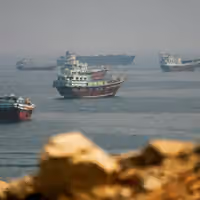
On the Strait of Hormuz, Trump said "we want it open. We want it free. We don't want tolls. It's international. It's an international waterway and not charging tolls."
He said the US blockade is costing Iran $500 million a day as they cannot export anything through their southern waters.
"There hasn't been a ship that's been able to get through without our approval. And the Navy has done an amazing job. And no ship is going to Iran, as you know. No ship is going to or out of Iran without our approval."

US Secretary of State Marco Rubio said Thursday that any Iranian move to impose tolls in the Strait of Hormuz would make a diplomatic deal with Tehran “unfeasible,” calling the plan “unacceptable, completely illegal, and a threat to the world."
"No one in the world is in favor of the tolling system. It can't happen. It would be unacceptable. It would make a diplomatic deal unfeasible if they were to continue to pursue that. So it's a threat to the world if they were trying to do that, and it's completely illegal," Rubio told reporters in Miami on Thursday.
US Secretary of State Marco Rubio said there had been “some progress” in efforts to reach a deal with Iran, citing expected Pakistani diplomacy in Tehran, but cautioned against “overly optimistic” expectations and warned President Donald Trump still had “other options” if diplomacy failed.
“I think we’ve made some progress, but obviously, we’re dealing with a system that itself is a little fractured, the Iranian system," he told reporters in Miami.
“The President’s preference is to do a good deal. That’s his preference. It’s always been his preference. I’m not here to tell you that it’s going to happen for sure, but I’m here to tell you that we’re going to do everything we can to see if we can get one.”
He warned that “if we can’t get a good deal, the President’s been clear, he has other options. I’m not going to elaborate on what those are, but everybody knows what those are."
“There are some good signs, but ... I don’t want to be overly optimistic.”
German prosecutors charged a Danish national accused of working for an Iranian intelligence service and scouting Jewish figures in Germany for possible assassination and arson attacks, including Josef Schuster, head of Germany’s Central Council of Jews, and Volker Beck, a former lawmaker who heads the German-Israeli Society.
A second suspect, an Afghan national arrested in Denmark in November, was charged with attempted participation in murder.
Prosecutors said the Danish suspect was linked to the intelligence service of Iran’s Revolutionary Guard and was in close contact with the Quds Force.
Iran’s judiciary summoned the managing editor of state news agency IRNA after it published a photo report of a woman without hijab who had taken temporary custody of an infant, saying the images violated “law and sharia.”
IRNA quickly removed the entire photo gallery from all its platforms after it sparked backlash among supporters of the Islamic Republic.
Alghadir hospital was already one of the clearest windows into Iran’s January massacre. Now, after a public campaign by Iran International, families and witnesses have come forward with more names tied to the same corridors, storage rooms and rear courtyard.
Iran International has now identified 21 people whose bodies were taken to Alghadir or whose final hours passed through the hospital, including 12 cases detailed in this report.
The accounts add to the record of two nights in which the east Tehran hospital became a transfer point for the wounded and the dead.
On January 8 and 9, witnesses said the streets around Alghadir saw heavy gunfire as security forces opened fire on protesters around Haft Hoz, Tehranpars and Nezamabad.
Inside the hospital, the accounts describe a place where people came for treatment or shelter, only to face the reach of the crackdown inside the wards.
Nights when Alghadir became a crime scene
According to accounts received by Iran International, security forces not only obstructed treatment for wounded protesters brought to Alghadir, but in some cases shot injured people, blocked medical care and moved bodies to storage rooms and the hospital’s rear courtyard.
Witnesses and informed sources said doctors, nurses and other medical staff continued trying to save the wounded despite pressure and threats. They treated protesters in operating rooms, hallways, ambulances and hospital rooms.
One witness said several young protesters entered the hospital to escape security forces chasing them during the demonstrations. Security forces later entered the hospital, closed the doors and fired tear gas inside.
According to the witness, some hospital workers hid protesters in bathrooms and wards, and dressed them in medical clothing to keep security forces from identifying them.
A member of the medical staff said that when more than 70 wounded protesters were brought to the hospital, security forces shot and killed four injured people in front of nurses trying to treat them.
A body taken from home
Sources familiar with the events told Iran International that security forces seized the body of a medical student who had been transferred to Alghadir on January 8 and have never told his family where he was buried.
His family had initially taken the body home to Boumehen, east of Tehran, hoping to prevent authorities from confiscating it and to bury him secretly.
Hours later, security forces found the family’s address using the student’s national identification card, which had been left inside his bloodied jacket. Officers raided the home, used tear gas and took the body away as relatives pleaded with them to leave it behind.
Sources said the family has received no information since then about where he may have been buried.
Iran International is withholding the student’s identity for security reasons.
A courtyard of bodies
A witness who sent video and information to Iran International said Alghadir’s rear courtyard had become a holding and transfer area for the bodies of protesters killed on January 9.
The witness, who had been hit by shotgun pellets during the previous day’s protests, returned to the hospital the next morning for treatment. He said he entered the building to the sound of families crying and shouting.
He walked toward the rear courtyard and morgue area, where he saw blood on the ground and several bodies nearby. Many families were gathered around the hospital grounds, but security forces pushed them away.
After some time, he said, bodies were loaded into pickup trucks and families were told to continue searching at Behesht Zahra cemetery.
“Most of the bodies I saw in the hospital courtyard belonged to people under 30 years old, and there was even the body of a child around 12 or 13 years old among them,” the witness said.
Amirparsa Ashkbous: A student in a blue blanket
Amirparsa Ashkbous was 21 and in his final term studying microbiology. Before joining the January 8 protests, he had sent an audio message criticizing those ignoring calls to gather while people his age were preparing to risk arrest or death.
Iranian slain protester Amir Parsa Ashkbous
According to information received by Iran International, Amirparsa joined protests around Haft Hoz with friends and was shot in the neck by a sniper.
His body was later placed in a blue blanket in the rear area of Alghadir hospital.
A video obtained by Iran International showed his mother searching for his body at the hospital.
Friends described him as kind-hearted and deeply interested in football.
Hossein Naseri: ‘I go for the next generation’
Hossein Naseri, born in 1952, told people around him before joining the January 9 protests that he was not afraid for himself.
“I am at ease about the safety and welfare of my children, and it does not matter what happens to me,” he said, according to relatives.
“I am going to the protests for a better future for the next generation.”
Slain protester Hossein Nasseri
When others urged him to wear a mask to protect himself from security forces, he replied: “Let me be sacrificed for you young people.”
Naseri was shot on his second night at the protests. The bullet hit a main artery in his leg. People at the scene drove him to Alghadir hospital, and sources said he was still alive when he arrived.
As the wounded were being brought in, security forces raided the hospital, forcing the person who had taken Naseri there to flee.
Four days later, Naseri’s wife found his body alone at Kahrizak morgue.
Relatives said he was buried without a normal funeral while his two children, both outside Iran, still did not know what had happened to their father.
Ali Rouzbahani: Buried in bloodied clothes
Ali Rouzbahani, 36, from Lorestan province, was killed on January 8 and his body was taken to Alghadir hospital.
Slain protester Ali Rouzbahani
Sources said that when his family came to collect him that evening, a hospital worker warned them to remove the body the same night before security forces could seize it.
The family secretly transported him to Lorestan and buried him without a public funeral. He was not placed in a shroud. He was buried in the bloodied clothes he had been wearing when he was killed.
Pouria Gholamali: Driven by economic hardship
Pouria Gholamali, 32, worked in Tehran’s computer market. Relatives said the rising dollar and the deep recession in the market had affected his life and work, and pushed him toward the protests.
Slain protester Pouria Gholamali
He was killed near Haft Hoz on January 8 by gunfire from government forces. His body was later left in Alghadir’s rear courtyard.
People close to him said he loved nature and spent much of his free time traveling.
Mohammad Talebi Toroghi: Shot in the head
Mohammad Talebi Toroghi, 35, was shot during the January 8 protests in the Haft Hoz area.
Slain protester Mohammad Talebi
Sources said the bullet struck him in the back of the head. His body was taken to Alghadir hospital and later handed over to his family.
Talebi Toroghi was born in Tehran and was the son of a man killed in the Iran-Iraq War.
Sources described him as a martial artist, a professional motorcyclist and someone deeply interested in riding.
Shahabeddin Sameni: Found after hours of searching
Shahabeddin Sameni, born in 1979, was shot in Nezamabad neighbourhood on January 8, according to sources familiar with the case.
Slain protester Shahabeddin Sameni
Sources said a live bullet was fired at his head from above Narmak Mosque.
His family searched hospitals and other centers for hours before finding his body around 2 a.m. on January 9 in Alghadir’s rear courtyard.
Sameni had a child who was a university student. Sources said that despite his stable financial situation, he had joined protesters in the streets.
After his death, security forces put heavy pressure on his parents to accept that their son had been a Basij member.
The Foundation of Martyrs contacted the family several times, but his father refused. He was later threatened with the confiscation of property.
Peyman Chinisaz: Left in storage for days
Peyman Chinisaz, 53, was from Bandar Anzali. He was shot in the stomach on January 8 in Tehran’s Nezamabad neighborhood and taken to Alghadir hospital.
Slain protester Peyman Chinisaz
A source close to the family said his relatives did not know his fate for several days. When they first went to the hospital, they were told he was not there.
His body, the source said, had been kept for five days in one of Alghadir’s storage rooms.
The family believes Chinisaz was left without proper care after reaching the hospital and died from bleeding.
He was married and had three children, a son and two daughters.
Mohsen Shahmohammadi: Died after two weeks in coma
Mohsen Shahmohammadi, born in 1988, was shot during the January 8 protests near Tehranpars First Square.
Slain protester Mohsen Shahmohammadi
The bullet struck his abdomen and kidneys. He was transferred to Alghadir and remained in a coma for about two weeks.
Sources said his condition was critical from the time he was wounded until his death. He died on January 23 from the severity of his injuries.
Shahmohammadi was unmarried.
Hamidreza Haghparast: Died from blood loss
Hamidreza Haghparast, from Rasht, was shot near Haft Hoz during the January 8 protests.
Slain protester Hamidreza Haghparast
The bullet struck his genital and groin area, leaving him severely wounded.
Sources said Haghparast was left for a long time first on Haft Hoz street and then at Alghadir hospital. He died from severe bleeding and lack of timely care.
Haghparast’s body was not released to his family for four days. Sources said officials made the release conditional on “council approval” and a written pledge from the family.
Haghparast, born in Rasht, was his mother’s only companion and breadwinner. He was buried on January 11 at Bagh-e Rezvan cemetery in Rasht..
Abolfazl Najafi-Aroun: Family forced to pay for burial
Abolfazl Najafi-Aroun, 25, was shot with three live rounds on the evening of January 8 near Tirandaz intersection in Tehranpars.
Slain protester Abolfazl Najafi
He was taken to Alghadir and underwent surgery. Family members and people close to him said he remained conscious for several hours after the operation and even spoke with those around him. A short time later, the family was told he had died.
Relatives said authorities did not allow him to be buried in Behesht Zahra. They said the family was charged 10 billion rials, about $5,555, for a burial permit in Robat Karim, near Tehran. The amount, they said, was separate from the cost of the bullets.
People close to Najafi-Aroun described him as warm-hearted, loyal and loved by friends and relatives.
Hosseinali Sarani: Family paid to recover body
Hosseinali Sarani, 44, was from Aliabad-e Katul in Golestan province. He was transferred to Alghadir after being shot on January 8.
Slain protester Hosseinali Sarani
Relatives said the family received his body after one week.
They said they were forced to pay 5 billion rials, about $2,780, to recover it.
Hani Ganji: Family received wrong body
Hani Ganji, 49, was shot from behind at close range in Tehranpars on the evening of January 8. He was taken to Alghadir and died from severe bleeding.
Slain protester Hani Ganji
After pressure from authorities and after signing a pledge, his family received a body and took it to a workshop in Pardis, Boumehen.
The next day, when no doctor agreed to issue a death certificate, the family took the body first to the Pardis police station and then, with a police letter, to Kahrizak.
When the family went to Behesht Zahra for the funeral and burial, they discovered they had been given the wrong body.
After hours of searching, they were finally able to recover Hani’s body and bury him late that day.
A growing record
The 21 people identified by Iran International are not a full list of those taken to Alghadir hospital.
They are the names recovered so far from one hospital, in one part of Tehran, after two nights of killing.
The first report showed Alghadir as a place where the massacre became visible: the overflowing morgue, bodies in storage rooms and the rear courtyard, and families searching through blankets and body covers.
The new accounts show something else as well: how that record is still growing, one witness, one family and one name at a time.