On Monday, President Donald Trump said he had halted plans to attack Iran following requests from Qatar, Saudi Arabia, the UAE “and some others in the region.”
The same day, Iran’s state television claimed Trump had backed down from threatening military action “at least five times in recent weeks” because he feared Iran’s “firm response.”
On Tuesday, Trump again underscored the volatility of the standoff, saying the United States “may have to give them another big hit” and claiming Tehran was “begging” for a deal.
Rahman Ghahramanpour, a Middle East politics expert, told Tehran-based Khabar Online that both Tehran and Washington increasingly see the confrontation as a “competition over resilience,” with each believing renewed brinkmanship could strengthen its negotiating position.
Khabar Online journalist Mohammad Aref Moezzi described the current dynamic as a familiar “neither war nor peace” scenario: sustained pressure and confrontation without a clear decision to escalate into full conflict or pursue a comprehensive agreement.
Both sides, he argued, still believe they can force concessions without paying the cost of war.
For Iran’s leadership, the overriding objective remains survival and persuading Washington to abandon any notion of regime change.
Ghahramanpour argues that Tehran is trapped in a struggle for survival while Washington faces what he calls a “credibility trap.” The United States wants a visible strategic victory; the Islamic Republic increasingly treats simple endurance as success.
Despite striking numerous military targets in Iran, Washington has yet to achieve a major political breakthrough. In the United States, particularly amid partisan rivalries, that is often framed as a failure for Trump. In Iran, the same reality is presented as proof the Islamic Republic withstood American pressure.
He also noted that many in Israel believe Trump’s presidency may represent the best opportunity to secure full US cooperation against Iran, adding to pressure for a more decisive confrontation before political circumstances change.
The widening gap between Iranian and American perceptions has effectively frozen negotiations.
Although some hardliners in Tehran advocate pre-emptive action, the government appears unwilling to be seen as the side that starts a war.
Washington, meanwhile, continues tightening sanctions and maintaining pressure while also signaling that military action remains an option if diplomacy stalls.
Another Iranian scholar, Ali Asghar Zargar, told Fararu on Tuesday that neither side benefits from the current deadlock.
He described the standoff as a mix of attrition, geopolitical rivalry and competing political narratives in which Iran remains under heavy pressure while the United States has yet to achieve its core objectives.
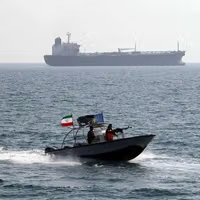
Zargar also argued that Washington cannot realistically use the Strait of Hormuz as a unilateral pressure tool given the global dependence on the waterway, warning that the longer the impasse continues, the greater the risk of escalation or miscalculation.
What increasingly unites both Iranian and American analysts is the sense that the current stalemate may be unstable, and that neither side has yet found a credible path out of it.