• العربية
  • فارسی
Brand
  • Iran Insight
  • Politics
  • Economy
  • Analysis
  • Special Report
  • Opinion
  • Podcast
  • Iran Insight
  • Politics
  • Economy
  • Analysis
  • Special Report
  • Opinion
  • Podcast
  • Theme
  • Language
    • العربية
    • فارسی
  • Iran Insight
  • Politics
  • Economy
  • Analysis
  • Special Report
  • Opinion
  • Podcast
All rights reserved for Volant Media UK Limited
volant media logo

Iran war clouds summer travel as jet fuel costs soar

Apr 29, 2026, 07:16 GMT+1
Passengers stand in a line at the terminal hall after flights resumed at Imam Khomeini International Airport, amid a ceasefire between US and Iran, in Tehran, Iran, April 25, 2026.

European airlines are facing their biggest test since the COVID-19 pandemic as the Iran war drives up jet fuel prices, disrupts Middle East routes and raises concerns about possible fuel shortages ahead of the summer holiday season.

Jet fuel prices have risen nearly 84% since the start of the war on February 28, according to Reuters. Airlines have so far softened the impact through hedging, which allows them to lock in fuel prices, but some of those protections are starting to run out as the conflict drags on.

“There is a risk that we’ll see rationing of fuel supply, particularly in Asia and Europe,” Willie Walsh, head of the International Air Transport Association, told Reuters, though he said supply remained robust for now.

Walsh said the crisis was still far smaller than the pandemic-era collapse in travel, because demand for flights remains strong. “I think COVID was on a completely different scale,” he said. “What we’re seeing here is, in effect, a cost issue for the airlines.”

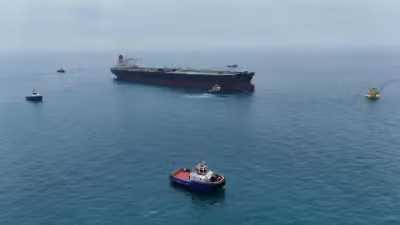
The aviation pressure is tied directly to the Iran war and the disruption around the Strait of Hormuz, a critical route for global oil and gas flows. Repeated stops and starts in peace talks, combined with uncertainty over the reopening of Hormuz, have kept energy markets under strain.

Some carriers are already warning of weaker bookings and higher costs. EasyJet and tour operator TUI have reported drops in forward bookings and issued profit warnings, while Air France-KLM, IAG and Lufthansa are expected to report first-quarter results in the coming days after raising prices and cutting capacity in response to the war.

Persian Gulf carriers have been hit hardest. Cirium Ascend data cited by Reuters showed flights operated by Middle Eastern airlines fell 50% year-on-year in March, while bookings for the second and third quarters through major regional hubs are down 42.5%.

Still, the impact is uneven. Wizz Air said summer bookings remain strong, Ryanair’s Michael O’Leary played down the risk of supply disruption, and Finnair said the crisis had so far helped demand for its Asian flights. Global passenger capacity remains nearly 2% higher than in 2025.

Most Viewed

Diplomatic window reopens as shadow of Iran war lingers
1

Diplomatic window reopens as shadow of Iran war lingers

2

More Iranian teenagers at risk of execution, rights groups warn

3

Iran hangs two more political prisoners as execution wave widens

4

Economic crisis drives Iranians to sell hair, rent laptops

Banner
Banner
Banner

Spotlight

  • Iran managing the inflation statistic, not the inflation
    ANALYSIS

    Iran managing the inflation statistic, not the inflation

  • China helps Iran chip away at US air superiority despite Xi’s no-arms pledge
    ANALYSIS

    China helps Iran chip away at US air superiority despite Xi’s no-arms pledge

  • Why Iran's leaders failed to see this generation coming
    INSIGHT

    Why Iran's leaders failed to see this generation coming

  • Security forces seized Iran hospital, sent wounded protesters to morgue
    EXCLUSIVE

    Security forces seized Iran hospital, sent wounded protesters to morgue

  • Where steak is a dream
    VOICES FROM IRAN

    Where steak is a dream

  • From cafes to buskers, Tehran tightens its grip on the fabric of everyday life

    From cafes to buskers, Tehran tightens its grip on the fabric of everyday life