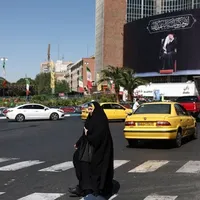
Iran blackout hits 63 days, NetBlocks says families cut off
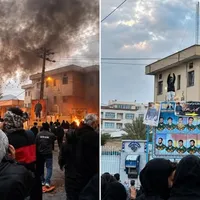
Iran’s internet blackout has reached 63 days, totaling more than 1,488 hours of disruption, NetBlocks said on Friday, warning the prolonged restrictions are limiting communication with the outside world.
The group said the shutdown is preventing many families abroad from checking on relatives’ safety and wellbeing as connectivity remains severely restricted.
Construction signs along Wellington Street in front of Parliament Hill the day after the Liberal Party secured a majority by winning all three seats in special elections, in Ottawa, Ontario, Canada, April 14, 2026.
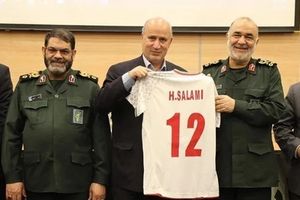
Canada’s government is under pressure to explain how Mehdi Taj, Iran’s football chief and a former intelligence officer of the Revolutionary Guards, was briefly allowed into the country after being granted a special permit despite Canada’s IRGC ban.
Speaking to reporters Thursday, Prime Minister Mark Carney declined to discuss Taj’s case, citing privacy laws, but defended the government’s position on the IRGC.
“Members of the [Iranian] Revolutionary Guard rightly have been prohibited from entering this country and they will not enter this country,” he said.
The comments followed reporting by Iran International on how Taj, president of Iran’s football federation and a former intelligence commander in the Islamic Revolutionary Guard Corps, received a Temporary Resident Permit, or TRP. The permit allows Canadian authorities to admit a person who would otherwise be barred under immigration law.
The issue moved quickly to Parliament. At Thursday’s meeting of the Standing Committee on Public Safety and National Security in Ottawa, Conservative MP Frank Caputo pressed Immigration Minister Lena Diab to explain how a person deemed inadmissible had received permission to enter Canada.
Caputo said “the rule of law demands transparency” and asked “who gave him a visa,” saying it took Iran International’s reporting to bring the case to public attention.
Taj, the president of Iran’s football federation, has longstanding ties to the Islamic Republic’s security establishment. After the 1979 revolution, he served as an intelligence commander in the IRGC in Isfahan, where units were involved in monitoring internal dissent, including among Kurdish populations.
Canada listed the IRGC as a terrorist entity in 2024, a move that makes people linked to the force inadmissible. Even so, Taj was issued a TRP to attend the FIFA Congress in Vancouver.
Sources who spoke to Iran International said Taj arrived in Canada but was turned back within hours. He and two people accompanying him left at 10:05 p.m. Tuesday after being questioned by authorities.
The immigration ministry commented only after his departure. It declined to name him, citing privacy laws, and said broadly that people linked to the IRGC are not welcome in Canada.
Taj’s brief presence came just before the FIFA Congress at the Vancouver Convention Centre, where members of the Iranian diaspora had planned protests after Iran International’s report.
A protester holds demonstration placards outside the Vancouver Convention Centre during the 76th FIFA Congress on April 30, 2026.
Political backlash in Ottawa
The case has put the government under pressure from opposition figures who say Taj’s short stay does not answer the central question of why he was issued a permit at all.
Opposition Leader Pierre Poilievre criticized the government publicly, raising concerns about how a person deemed inadmissible was granted entry in the first place.
Conservative Deputy Leader Melissa Lantsman also pointed to Iran International’s reporting as she pressed the government for answers.
“Good riddance. He didn’t just get on a plane and come here to be sent back. Did the Liberal government issue him a permit? Yes or no?” she said.
Conservative MP Michelle Rempel Garner rejected the argument that the system had worked because Taj was ultimately refused entry.
“Come on, this guy was issued a permit. They made a conscious decision,” she told reporters Thursday in Ottawa.
She has described the case as evidence of serious immigration screening failures and called for accountability.
In the Senate, opposition leader Leo Housakos pressed the government in sharper terms.
“Your government can't seem to show the IRGC the door, but it can find a way to roll out the welcome mat… What’s the point of listing the IRGC if you're not serious about throwing him out of our country?” he said.
Foreign Affairs Minister Anita Anand suggested the permit may have been granted and later revoked.
“It’s not my personal lead, but my understanding is that there is a revocation of the permission. It was unintentional,” she said, pointing to a possible breakdown in the process.
International coverage and fallout
The case, first reported by Iran International, has since moved into wider international coverage. The New York Times, USA Today, Agence France-Presse and The Canadian Press have all covered the incident, citing the reporting that brought Taj’s entry to light.
The episode has turned a single immigration decision into a broader test of Canada’s policy toward officials tied to the Islamic Republic.
Canada has formally listed the IRGC as a terrorist entity, barring people linked to it from entering the country, yet discretionary tools like Temporary Resident Permits allow authorities to override that inadmissibility.
For critics, Taj’s case has exposed the space between the government’s public position and the way exceptions can be made in practice.
The controversy also comes amid deep anger over the Islamic Republic’s human rights record, including what has been described as one of the deadliest crackdowns in modern history earlier this year, adding to concern among Iranian-Canadians over how Western governments handle officials tied to Tehran.
Demonstration placards are seen outside the Vancouver Convention Centre during the 76th FIFA Congress
Questions still facing the government
Taj’s brief entry and rapid removal have left the government facing the same basic issue that first put the case in public view: who approved the permit, why it was granted despite Canada’s inadmissibility rules, and what safeguards are in place to prevent a similar decision.
What began with Iran International’s reporting has become a political fight in Ottawa, one that now sits at the crossing point of immigration law, national security and Canada’s approach to the Islamic Republic.
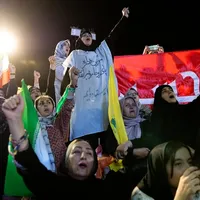
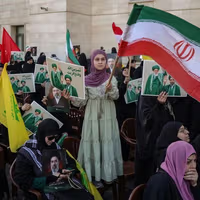
A hardline Iranian lawmaker threatened Arab rulers in the region during a pro-Islamic Republic rally, warning that their palaces would not be safe if Iran’s senior leaders were targeted.
Mahmoud Nabavian, a member of parliament’s national security and foreign policy committee, said regional governments should prevent military bases on their soil from being used against Iran.
“If any assault is carried out against our great leaders, none of the kings of the Arab countries or their palaces in the region will remain safe, and they will all be sent to hell,” Nabavian said.
A senior adviser to the UAE president said no unilateral arrangement by Iran over the Strait of Hormuz could be trusted after what he described as Tehran’s “treacherous aggression” against its neighbors.
Anwar Gargash said on X that the ongoing debate over Hormuz must be grounded in collective international will and international law, rather than Iranian control or guarantees.
“In the ongoing discussion about the Strait of Hormuz, the collective international will and provisions of international law emerge as the primary guarantor of freedom of navigation through this vital passage,” Gargash said.
His remarks come as regional governments push back against Iran’s efforts to shape new rules for the strategic waterway, where shipping has been disrupted throughout the war.
The US naval blockade of Iranian ports has left Tehran struggling for a way out, exposing the limits of its strategy of using the Strait of Hormuz as leverage while continuing oil exports through shadow shipping networks, the Wall Street Journal reported.
Iran initially appeared to gain leverage after the war began in February by disrupting traffic through the Strait of Hormuz, a route for roughly a fifth of global oil and liquefied natural gas supplies.
But the United States later responded with a blockade of Iranian ports, cutting into the network of tankers that had long helped Tehran move oil to China despite sanctions, the report said.
“There is no evidence any Iranian oil cargo has crossed the US blockade and reached Chinese customers or other buyers,” the Journal reported, citing commodities-data firm Kpler.
The report said 44 commercial vessels working for Iran had been ordered to turn around or return to port, according to US Central Command.
Alternative routes appear limited. The Iranian Shipping Association said only about 40% of Iran’s trade could be redirected away from blockaded ports, according to Fars.
The blockade has sharpened divisions inside Iran’s ruling system, the report said, with moderates favoring negotiations while hardliners argue that the blockade amounts to an act of war and requires a military response.
“The blockade is increasingly viewed in Tehran not as a substitute for war, but as a different manifestation of it,” Hamidreza Azizi, a visiting fellow at the Berlin-based SWP research institute, told the Journal.
The report said Iranian officials have discussed possible escalation using weapons not yet deployed, while IRGC-linked Tasnim recently mapped undersea internet cables in the Strait of Hormuz in what appeared to be a warning that regional communications infrastructure could be targeted.
The Journal said Tehran presented regional mediators with an offer last weekend to stop attacks in the strait in exchange for an end to the war, lifting of the US blockade and postponement of nuclear talks.
President Donald Trump, however, told aides to prepare for an extended blockade that could remain in place until Iran accepts his nuclear demands, the report said.
“The blockade is genius, OK, the blockade has been 100% foolproof,” Trump told reporters this week.
The Journal said the war has left more than a million people out of work in Iran, pushed food prices higher, prolonged the internet shutdown and helped drive the dollar to about 1.81 million rials as the blockade shows no sign of ending.
Iran’s deputy parliament speaker said the Pakistan talks with the United States began with the direct approval of the Islamic Republic’s Supreme Leader, in an apparent response to claims of confusion and infighting inside Tehran’s decision-making structure.
Ali Nikzad said the American side opened the talks by raising demands including a 20-year halt to Iran’s nuclear activities and the handover of enriched uranium.
He said the demands were “firmly rejected” by the Islamic Republic.
The remarks come after President Donald Trump canceled a planned trip to Pakistan by US envoys Steve Witkoff and Jared Kushner, saying there was “tremendous infighting and confusion” within Iran’s leadership and that “nobody knows who is in charge.”
The Pakistan track has also been strained by a basic sequencing dispute: Washington has pushed for nuclear restrictions, including a long halt to enrichment, while Tehran has sought to first end the war, address shipping and the Strait of Hormuz, and only then move to wider issues.