Trump says Iran must 'get smart' on nuclear deal

US President Donald Trump said in a post on Truth Social that Iran was failing to agree on a nonnuclear deal and warned it should “get smart soon.”
“Iran can’t get their act together. They don’t know how to sign a nonnuclear deal. They better get smart soon!” Trump wrote.
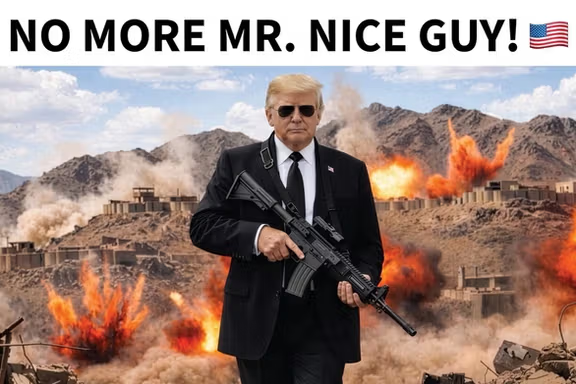
Trump also shared an image of himself with the words “no more Mr nice guy,” as tensions remain high between Washington and Tehran.



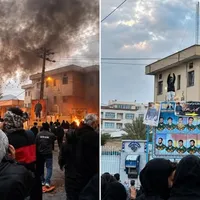



Armed attackers opened fire on a police patrol in Zahedan in southeast Iran, killing one officer and wounding three others, state media reported on Wednesday.
Police in Sistan-Baluchestan province said the patrol was securing the area when it came under fire. The slain officer was identified as Mohammadreza Nezamdoost.
Authorities said efforts were under way to arrest those responsible.
Iran International viewers reported widespread layoffs, soaring prices of basic goods, unemployment, food insecurity and growing inability to pay rent, as economic pressure deepens during the war.
One viewer said at least 2,000 people had been laid off across production, industrial and service units in Rasht, a city in northern Iran.
Another viewer said Islamic Republic state TV’s news channel had run a caption saying Iran was at war, basic goods were expensive and people should “get used to it.”
A former worker at the Marvdasht petrochemical complex in Fars province said he had been laid off and had been unemployed for two months.
“I have an elderly mother and I am ashamed before her,” the viewer said. “We have reduced our food consumption to one meal a day, and even that is barely manageable. I have not paid rent either. The situation is terrible.”
A senior member of Iran’s parliament said the country’s missile and drone stockpiles were sufficient for “several years of war” and warned that Tehran would not let President Donald Trump go.
Alaeddin Boroujerdi, deputy chairman of parliament’s national security committee, told Tasnim that Iran had entered negotiations with the United States on the orders of the Supreme Leader, and said Parliament Speaker Mohammad Bagher Ghalibaf was managing the talks with “valuable experience.”
“The negotiating table is not a place of compromise and humiliation,” Boroujerdi said, adding that he hoped the process would reach a good outcome.
Sources familiar with the matter told Iran International last week that Ghalibaf had stepped down as head of Iran’s negotiating team with the United States after internal disagreements over the talks.
Boroujerdi dismissed Trump’s threats as empty and said the two-week ceasefire had been extended without any move by the other side.
“But Trump should know that we will not let him go,” Boroujerdi said. “Our fighters are present on the battlefield, and the struggle and war will certainly continue until the Zionist regime and criminal America are truly punished.”
He also described the US maritime blockade as ineffective and lacking international legitimacy, saying no European or NATO country had joined Washington in the effort.
Boroujerdi said the Strait of Hormuz was an outcome of what he called the imposed war and added that Trump knew Iran would “never lose control” of the waterway.
European airlines are facing their biggest test since the COVID-19 pandemic as the Iran war drives up jet fuel prices, disrupts Middle East routes and raises concerns about possible fuel shortages ahead of the summer holiday season.
Jet fuel prices have risen nearly 84% since the start of the war on February 28, according to Reuters. Airlines have so far softened the impact through hedging, which allows them to lock in fuel prices, but some of those protections are starting to run out as the conflict drags on.
“There is a risk that we’ll see rationing of fuel supply, particularly in Asia and Europe,” Willie Walsh, head of the International Air Transport Association, told Reuters, though he said supply remained robust for now.
Walsh said the crisis was still far smaller than the pandemic-era collapse in travel, because demand for flights remains strong. “I think COVID was on a completely different scale,” he said. “What we’re seeing here is, in effect, a cost issue for the airlines.”
The aviation pressure is tied directly to the Iran war and the disruption around the Strait of Hormuz, a critical route for global oil and gas flows. Repeated stops and starts in peace talks, combined with uncertainty over the reopening of Hormuz, have kept energy markets under strain.
Some carriers are already warning of weaker bookings and higher costs. EasyJet and tour operator TUI have reported drops in forward bookings and issued profit warnings, while Air France-KLM, IAG and Lufthansa are expected to report first-quarter results in the coming days after raising prices and cutting capacity in response to the war.
Persian Gulf carriers have been hit hardest. Cirium Ascend data cited by Reuters showed flights operated by Middle Eastern airlines fell 50% year-on-year in March, while bookings for the second and third quarters through major regional hubs are down 42.5%.
Still, the impact is uneven. Wizz Air said summer bookings remain strong, Ryanair’s Michael O’Leary played down the risk of supply disruption, and Finnair said the crisis had so far helped demand for its Asian flights. Global passenger capacity remains nearly 2% higher than in 2025.
European airlines are facing their biggest test since the COVID-19 pandemic as the Iran war drives up jet fuel prices, disrupts Middle East routes and raises concerns about possible fuel shortages ahead of the summer holiday season.
Jet fuel prices have risen nearly 84% since the start of the war on February 28, according to Reuters. Airlines have so far softened the impact through hedging, which allows them to lock in fuel prices, but some of those protections are starting to run out as the conflict drags on.
“There is a risk that we’ll see rationing of fuel supply, particularly in Asia and Europe,” Willie Walsh, head of the International Air Transport Association, told Reuters, though he said supply remained robust for now.
Walsh said the crisis was still far smaller than the pandemic-era collapse in travel, because demand for flights remains strong. “I think COVID was on a completely different scale,” he said. “What we’re seeing here is, in effect, a cost issue for the airlines.”