Iran speaker claims control of Strait of Hormuz, warns US forces
Iranian parliament speaker Mohammad Bagher Ghalibaf said in a televised interview on Saturday that the Strait of Hormuz remains fully under Iranian control.
Ghalibaf accused the United States of violating a ceasefire by carrying out mine-sweeping operations and warned that any advance by US vessels would be met with force.
"Any current traffic through the Strait is under our control, and if the US blockade continues, passage through the Strait of Hormuz will be restricted," he added.
Bahrain’s foreign ministry said on Saturday it welcomed a decision by the International Maritime Organization condemning the closure of the Strait of Hormuz and alleged Iranian threats to shipping and Gulf Cooperation Council states, as well as Jordan.
The ministry praised the role of the United Arab Emirates in drafting the resolution, which reaffirmed the right of transit passage through the strait, and called for continued international cooperation to safeguard freedom of navigation and prevent future violations.
Iranian protesters outside the US Capitol in Washington DC on March 29, 2026
One hundred days after one of the deadliest crackdowns in modern history, Iran remains suspended between grief and uncertainty, with a fractured public mood as some see justice in recent blows to the regime, while others feel left behind with it still in place.
At least 36,500 Iranians were killed by the Islamic Republic during the January uprising, mostly on January 8 and 9, according to classified documents, field reports and witness accounts reviewed by Iran International, with the true toll believed by many to be far higher.
The dead included children, students and the elderly. Among the youngest victims frequently cited was three-year-old Melina Asadi.
Three-year-old child identified as Melina Asadi, from Kermanshah, was killed after being directly shot by forces of the Islamic Republic of Iran during popular protests on Tagh- Bostan Boulevard.
One image from the unrest remains etched in public memory: a bloodied older woman standing in the street, fist raised, saying, “I’m not afraid. I’ve been dead for 47 years.”
Another was the sight of body bags. Videos that emerged despite the blackout showed rows of black bags lining courtyards, makeshift morgues overflowing and desperate families searching among the dead for loved ones.
Some bodies appeared with catheters and breathing tubes still in place, reinforcing witness claims that wounded protesters were killed after reaching hospitals.
One eyewitness, Kiarash — whose surname is being withheld for security reasons — described Tehran’s main cemetery as a “warehouse of bodies,” saying trucks continued arriving to unload more corpses as families waited outside.
The protests, which erupted in early January, were met with overwhelming force. Demonstrators demanding freedom were confronted with live fire, blades and military-grade repression.
Witnesses also described hospitals turned into extensions of the crackdown. Doctors and healthcare workers were allegedly threatened, detained or attacked for treating the injured. Some families say loved ones who survived initial gunfire were later killed inside hospital wards.
One such case was 17-year-old Sam Afshari, whose father told Iran International that after being wounded during protests in Karaj, his son was taken to hospital alive, placed on a breathing tube and then fatally shot.
Authorities and some outside observers initially portrayed the unrest as primarily economic. But many Iranians rejected that narrative.
While anger first surfaced in the bazaars — historically seen as a pillar of the Islamic Republic’s support base — in late December, demonstrations quickly spread to universities, provincial towns and religious communities.
Unrest reached hundreds of cities and towns nationwide, according to reports reviewed by Iran International.
For many participants, this was not just another protest wave. It was the release of 47 years of accumulated pressure over repression, corruption, economic decline and personal freedoms.
Iranians were demanding a future not defined by compulsory social controls, state violence or a nuclear confrontation that repeatedly drags the country into crisis.
On January 8, authorities cut public access to the internet, triggering a 20-day digital blackout that rights groups say helped conceal the scale of the killings.
The blackout severely restricted access to independent information, communication with family abroad and documentation of abuses.
Iranian officials also acknowledged economic damage, with estimates placing losses in the tens of millions of dollars per day.
Trump support resonated with some protesters
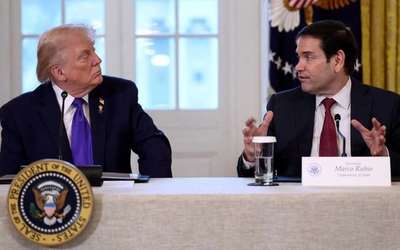
During the uprising, support from US President Donald Trump drew significant attention.
For some Iranians, it mattered because memories of the 2009 Green Movement — the mass protest movement that erupted after disputed elections under President Barack Obama — still run deep. Many from that era felt the world did not do enough.
A few days after the January 8–9 massacre of protesters, Trump publicly backed demonstrators, writing: “Iranian patriots… KEEP PROTESTING… HELP IS ON ITS WAY.” He urged them to “take over your institutions” and warned the US was “locked and loaded.”
Despite mixed views on the effectiveness of a military campaign to topple the Islamic Republic, many Iranians felt so desperate that they wanted Trump to begin strikes as soon as possible.
He did so nearly 50 days after the massacre.
40-day war hits regime hard
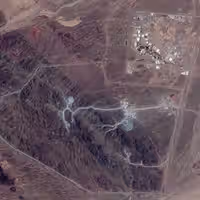
On February 28, the United States and Israel launched a coordinated military campaign targeting the Islamic Republic’s leadership, nuclear infrastructure, missile systems, air defenses and internal security apparatus.
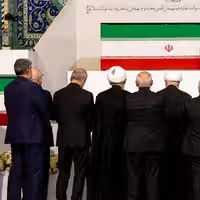
The operation included tens of thousands of strikes on military and strategic sites across Iran. Senior regime figures were killed, including Supreme Leader Ali Khamenei, in the most dramatic leadership blow since the 1979 revolution.
Other targets included IRGC commanders, Basij infrastructure, military production centers and strategic compounds tied to regime control. Iranian missile launchers and parts of the country’s strike capability were also heavily degraded.
For many Iranians who blamed these institutions for repression, torture and killings, the campaign was seen not simply as war, but as the first time the machinery used against them had itself come under sustained attack.
Videos reviewed by Iran International showed some Iranians thanking US President Donald Trump and Israeli Prime Minister Benjamin Netanyahu for the strikes. Others celebrated in homes and streets, with some dancing to YMCA — the song closely associated with Trump rallies — seeing the moment as symbolic justice after years of suffering.
Others hoped the weakening of the regime’s coercive apparatus could create space for future protest and political change, as promised by both Trump and Israeli Prime Minister Benjamin Netanyahu.
Yet even as parts of the repressive apparatus were hit, executions of prisoners and dissidents continued. Human rights groups say Iran carried out a record number of executions last year and warn the death penalty may be used even more aggressively after the war.
Diplomacy returns, questions remain?
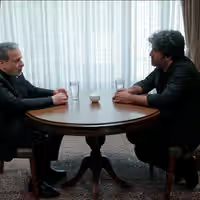
The military campaign paused with the announcement of a two-week ceasefire on April 8, and the rhetoric has since shifted toward diplomacy: talk of deals, sanctions relief, frozen assets, and uranium transfers.
Iranian civil society groups have urged negotiators to include the release of political prisoners and prisoners of conscience in any agreement, arguing peace without human rights would leave thousands behind.
For many Iranians, the central question remains unchanged: where are the Iranian people in these negotiations?
Those killed in the streets, in detention and in hospitals did not die for another nuclear arrangement, many argue, nor to see one insider replaced by another such as Mohammad Bagher Ghalibaf.
One hundred days later, Iran remains suspended between grief and uncertainty.
Some feel partially avenged by the killing of Khamenei and his commanders, and by the weakening of the regime. Others still hold out hope that change may come. But many say they fear the world has moved on without them.
Iran’s deputy foreign minister Saeed Khatibzadeh told The Associated Press on Saturday that no enriched material will be sent to the United States. He said the issue is “not up for discussion.”
Khatibzadeh added that messages have been exchanged between Tehran and Washington, but the sides are still not at the stage of holding direct talks.
"New guidelines for the Strait of Hormuz will be set as part of the negotiations, and the waterway will remain open and safe for all civilian traffic," he said.
Iran’s foreign ministry spokesperson Esmaeil Baqaei said on Saturday that Tehran is entitled under international law to take measures in the Strait of Hormuz, accusing European countries of “hypocrisy” over what he described as support for US and Israeli actions against Iran.
"No rule of international law forbids Iran, the coastal State, from taking necessary measures to stop the Strait of Hormuz being used for waging military aggression against Iran," Baghaei posted on X. "And 'unconditional transit passage' in Hormuz? That fiction sailed the moment U.S./Israeli aggression brought U.S. military assets into the strait’s backyard."
The United Arab Emirates said on Saturday that Foreign Minister Sheikh Abdullah bin Zayed met Britain’s Foreign Minister Yvette Cooper.
They discussed what the UAE described as “terrorist” Iranian missile attacks on the UAE and other countries, as well as regional developments following a two-week ceasefire between the United States and Iran.