Iran child recruitment amounts to war crime, Amnesty says

Amnesty International said on Thursday that Iran’s recruitment of children as young as 12 for roles linked to the Islamic Revolutionary Guard Corps amounts to a war crime.

Amnesty International said on Thursday that Iran’s recruitment of children as young as 12 for roles linked to the Islamic Revolutionary Guard Corps amounts to a war crime.
The statement follows remarks aired on state media by IRGC official Rahim Nadali, who said the minimum age for participation in support roles such as patrols, checkpoints and logistics had been lowered to 12 under a campaign encouraging volunteers.
“Given that the age of those coming forward has dropped … we lowered the minimum age to 12,” Nadali said, adding that 12- and 13-year-olds could take part if they wished.
“The Iranian authorities are shamelessly encouraging children as young as 12 to join an IRGC-run military campaign,” Amnesty said, adding that “recruiting children under 15 into the armed forces constitutes a war crime.”
The group cited video and eyewitness accounts which it said showed minors deployed at checkpoints and patrols, some carrying weapons, exposing them to risk as US and Israeli strikes target IRGC-linked sites across the country.
The development has revived concerns over the use of minors in security roles in Iran, including during the 2022 protests triggered by the death of Mahsa Amini, when images appeared to show children and teenagers in military-style gear.
Human rights groups have also accused Iranian authorities of killing child protesters during past crackdowns, with the Center for Human Rights in Iran saying more than 200 children were killed during unrest earlier this year.
Amnesty said the recruitment comes despite Iran’s commitments under the Convention on the Rights of the Child, which prohibits the use of children in military activities, and called on authorities to immediately stop enlisting anyone under 18.
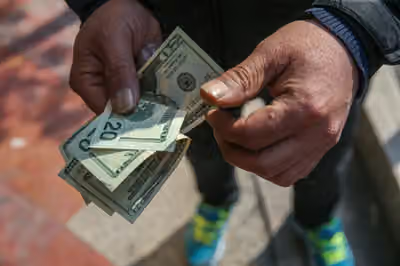




Residents told Iran International that severe shortages and soaring prices for key medicines, including insulin and blood thinners, have persisted over the past month, with some insulin brands reaching seventy million rials (≈$46.7).
Several citizens said the price of Ryzodeg insulin jumped from 12 million rials (≈$8) to 76 million rials (≈$51). Five-dose packs of NovoRapid and Lantus now sell for 15–18 million rials (≈$10–$12).
A resident reported that the blood thinner Plavix, crucial to preventing strokes and heart attacks, rose from 7.5 million rials (≈$5) to 27 million rials (≈$18) in recent weeks.
An ordinary Iranian citizen earns approximately $100–$150 per month.
Shortages leave patients struggling
Before the war and US-Israeli attacks, insulin was already limited, with insurance covering only one dose per week. Residents say the scarcity has now reached crisis levels.
One citizen in Parand near Tehran said: “I couldn’t find my diabetes medications for a month, even without a prescription. Two types, Lantus and Apidra, usually last a week each, but I ran out completely.”
Another said his mother had to travel from Karaj to Qazvin (over 110 km) to obtain essential medicines. Tehran residents report difficulty finding Asentra (sertraline) for depression and Iran-made blood thinner Osvix.
Supply chain disruptions deepen crisis
Residents link shortages to halted imports from Turkey and Dubai. A transit driver said fewer registered shipments have reduced cargo flow. Local distributors have paused sales, while pharmacies face delayed deliveries and payments.
“Our city has more pharmacies than any other shop, but even acetaminophen is unavailable,” a Sari resident in northern Iran said.
The shortages coincide with rising food prices and widespread business closures, adding to economic strain.
However, Mohammad Reza Aref, First Vice President, said on Wednesday that strategic drug reserves are in good condition and ordered “immediate import” of essential medicines. Residents, however, continue to report high prices and irregular availability.
Global healthcare impact
NHS England chief executive Sir Jim Mackey warned that the Iran war could disrupt healthcare supplies internationally. Speaking to LBC Radio on Wednesday, Mackey said syringes, gloves, and intravenous bags may become scarce due to the closure of the Strait of Hormuz.
“A team has been set up across the NHS to assess risks through the supply chains. Almost everything may be at risk, as Britain relies heavily on imports for medicines and healthcare equipment,” Mackey said.
Medicines UK chief executive Mark Samuels said Britain could face further shortages if the conflict prolongs, noting that 85 percent of NHS medicines are generic and largely sourced from India.
The Paris offices of Goldman Sachs were placed under police surveillance after a bomb threat believed to be linked to an Iranian group, Le Parisien reported.
Prosecutors in Paris said on Thursday no suspicious items had been found.
Goldman told staff they could work remotely on Thursday, a source familiar with the matter said, while employees at Citigroup in Paris and Frankfurt also worked from home as a precaution. Citigroup said the move was a precautionary measure.
The heightened alert followed a foiled bomb attack near the Paris offices of Bank of America last week.
French anti-terrorism prosecutors said a man and three teenagers aged 16 and 17 had been placed under formal investigation and held in pre-trial detention on suspicion of manufacturing, transporting and handling an explosive device and attempting to destroy property as part of a terrorist organization.
They said the device, made from a five-litre petrol can attached to a large pyrotechnic charge containing a 650-gram active-material cylinder, was the most powerful of its kind identified in France and could have generated a fireball several meters wide.
Investigators said the adult suspect recruited the teenagers, paying them between 500 and 1,000 euros to plant and film the device. All four denied terrorist intent.
Authorities said the plot may be linked to a pro-Iranian group known as HAYI, which had posted a video naming Bank of America’s Paris headquarters, though prosecutors said the link had not been formally established.
Iran’s judiciary said on Thursday it had carried out the execution of Amirhossein Hatami, a protest detainee convicted in a case linked to a fire at a Basij base in Tehran during January protests.
Hatami was among a group of detainees held responsible for the events at the “185 Mahmoud Kaveh” Basij base on January 8. Families of the detainees told Iran International that Hatami and others were pushed into the building by unidentified armed individuals, after which the base caught fire. Witnesses said the protesters were trapped inside, with the blaze putting their lives at risk.
Mizan, the judiciary news outlet, wrote that Hatami was “convicted of actions that targeted national security and involved attempting to access weapons and ammunition in a classified military site” and that his trial followed the presentation of confessions and investigative reports. The outlet added that the Supreme Court had reviewed and upheld the ruling.
The other detainees named in the report were Mohammadamin Biglari, Shahin Vahedparast, Abolfazl Salehi and Ali Fahim.
Their case was heard at Branch 15 of Tehran’s Revolutionary Court, presided over by Judge Abolqasem Salavati, and death sentences were issued in February, according to the report.
Court documents cited in the report said Hatami’s presence at the base coincided with efforts to breach military restrictions, although family accounts and independent reporting suggest he did not set the fire nor voluntarily enter the premises.
Eyewitnesses told Iran International that a large crowd had gathered outside the base on the evening of January 8 during nationwide protests, and several motorbikes in the street were set on fire. Some armed and unidentified individuals pushed protesters into the base and locked the doors, filling the building with smoke and putting those inside at immediate risk.
Detainees caught in prearranged scenario
Based on witnesses’ reports, the seven detainees were victims of a prearranged scenario by security and Basij forces intended to make them appear culpable for the fire. After the plan failed, five of them were referred for execution on charges including “enmity against God, corruption on earth, and conspiracy against national security.”
Hatami was one of five prisoners removed from Ghezalhesar prison for execution on Tuesday. Families reported that detainees, including Hatami, were transferred to undisclosed locations shortly before the execution. The prisoners, aged between 19 and 25, had limited access to legal counsel during a trial concluded within 30 days of their arrest.
Iran’s judiciary also announced that other political prisoners, including Pouya Ghobadi Bistouni and Babak Alipour, were executed earlier this week, along with Akbar (Shahrokh) Daneshvarkar and Mohammad Taghavi Sangdehi. Two additional prisoners, Vahid Baniamrian and Abolhassan Montazer, had been sentenced to death in December 2024.
Human rights groups warn of rushed executions
Families and human rights groups have repeatedly warned against executing prisoners under such circumstances and called for an immediate halt to the sentences. The cases have drawn international attention, highlighting the dangers of issuing death penalties without guaranteeing basic legal rights.
Amid heightened security tensions and restricted internet access, the rapid pace of executions in politically sensitive cases has increased, leaving detainees exposed to unpredictable and direct threats to their lives. Human rights organizations have warned that the acceleration of these executions could lead to a humanitarian crisis.
Iranian filmmaker Jafar Panahi has returned to Iran, informed sources told Iran International, after traveling abroad for an international awards campaign.
Panahi entered the country on Tuesday by land via Turkey due to flight restrictions, the sources said.
He had been outside Iran to promote his film It Was Just an Accident, which won the Palme d’Or at the Cannes Film Festival and was shortlisted for the Academy Awards.
Panahi had previously said he would return to Iran after the Oscar campaign despite potential risks. “As soon as the campaign ends, I will return to Iran,” he said in a February interview.
The director has faced years of legal pressure in Iran, including a one-year prison sentence issued in absentia on charges of propaganda against the state, along with a two-year travel ban and other restrictions.
Panahi had faced a long-standing travel ban before being able to travel for the film’s international release. His work, often made despite official restrictions, has focused on social and political issues and drawn on his own experiences of detention and surveillance.
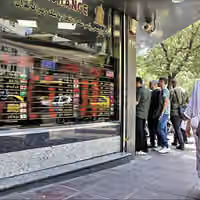
The arrest of dozens of IRGC-linked money changers in the United Arab Emirates is one of the most serious blows yet to Tehran’s sanctions-evasion network, laying bare how heavily the Islamic Republic has depended on Dubai as an economic lifeline.
Sources familiar with the matter told Iran International that UAE authorities detained dozens of money changers tied to financial entities linked to Iran’s Revolutionary Guards, shut down associated companies and closed their offices.
The crackdown follows days of mounting regional tensions and comes after other measures targeting Iranian nationals, including visa revocations and tighter travel restrictions through Dubai.
For years, Dubai has served as Iran’s main offshore financial artery, where oil proceeds, petrochemical revenues and rial conversions were turned into dollars, dirhams and euros beyond the reach of the country’s battered domestic banking system.
“This is going to be a real problem for Tehran because Dubai was an economic lung for the Iranian regime,” Jason Brodsky of United Against Nuclear Iran told Iran International.
“That is economic pressure and diplomatic isolation in a way that the UAE is able to employ against the Iranian regime, and it will have a very considerable impact.”
'Most critical hub'
According to Miad Maleki, a former senior US Treasury sanctions strategist and now a senior fellow at FDD, the UAE is not just one sanctions-evasion hub among many.
“The UAE is the single most critical jurisdiction in the Iranian regime’s sanctions-evasion architecture,” Maleki said.
Dubai’s exchange houses have long given the IRGC and the Quds Force access to the hard currency needed to finance proxy groups including Hezbollah, Hamas, the Houthis and militias in Iraq.
The detention of trusted IRGC-linked money changers threatens networks that took years to build.
“These trust-based sarraf (money changer) relationships, bank accounts and corporate structures are not quickly replaceable,” Maleki said.
He added that even exchange houses untouched by the crackdown were now likely to think twice before processing Iran-linked transactions, sharply raising both the cost and the risk of doing business with the Guards.
The pressure comes as Iran’s domestic economy is already under severe strain.
Foreign reserves, once estimated at around $120 billion in 2018, had fallen below $9 billion by 2020, leaving Iran increasingly reliant on offshore currency channels.
Dubai as ‘washing machine’
Mohammad Machine-Chian, a senior economic journalist at Iran International, said the UAE remains Iran’s most important economic conduit after China.
“The UAE is Iran’s most critical economic lifeline after China,” he said.
He said Dubai’s free zones host hundreds of Iranian-linked shell companies used to mask oil and petrochemical sales, launder proceeds and channel hard currency back to Tehran.
Bilateral trade has hovered between $16 billion and $28 billion in recent years, with Iranian non-oil exports alone reaching roughly $6 billion to $7 billion annually, according to Machine-Chian.
A sustained crackdown could cost Tehran tens of billions of dollars in revenue streams while severing what he described as Iran’s “USD cash lifeline.”
Dubai has also functioned as a transit point for illicit Iranian funds moving onward to North America, including transfers routed to the United States and Canada through correspondent banking and hawala networks.
As Maleki put it, “Dubai is the washing machine: Iranian oil proceeds and rial conversions go in, sanitized dirham and dollar transactions come out.”
From diplomacy to backlash
Beyond the financial damage, analysts say the crackdown reflects a broader political rupture between Tehran and the Persian Gulf states.
Brodsky said Iran’s attacks on neighboring countries had transformed the strategic environment in the region.
“The relationship between Iran and the GCC countries is not going to go back to the way it was before Operation Epic Fury,” he said.
Where Persian Gulf states had once pushed for diplomacy, Iran’s retaliation has instead driven them closer to Washington and Israel.
For years, Tehran sought to encircle Israel in what it called a “ring of fire” through regional proxies.
Now, Brodsky said, the Islamic Republic has reversed that dynamic.
“They wanted to encircle Israel in a ring of fire,” he said. “Now they are basically encircling themselves in a ring of fire because they’ve been angering their neighbors with all of their attacks.”
He said that reversal could carry long-term consequences, including deeper Persian Gulf-Israel security coordination and new openings for the Abraham Accords.
“The missile threat and drone threat have become paramount in this conflict,” Brodsky said. “That could drive these countries even closer to the US and Israel.”
'Collapse within weeks'
The UAE crackdown comes as signs of mounting economic distress are mounting inside Iran.
Sources previously told Iran International that President Masoud Pezeshkian had warned senior officials that without a ceasefire, the economy could face collapse within weeks.
Across major cities, ATMs have been running short of cash, banking services have faced intermittent disruptions and government workers have reported months of delayed salary payments.
With inflation in essential goods already above 100 percent before the war, the loss of Dubai’s financial channels could deepen the regime’s crisis.
For Tehran, the arrests in the UAE are more than a financial disruption.
They may signal that one of Iran’s most dependable external pressure valves is starting to close.