• العربية
  • فارسی
Brand
  • Iran Insight
  • Politics
  • Economy
  • Analysis
  • Special Report
  • Opinion
  • Podcast
  • Iran Insight
  • Politics
  • Economy
  • Analysis
  • Special Report
  • Opinion
  • Podcast
  • Theme
  • Language
    • العربية
    • فارسی
  • Iran Insight
  • Politics
  • Economy
  • Analysis
  • Special Report
  • Opinion
  • Podcast
All rights reserved for Volant Media UK Limited
volant media logo
VOICES FROM IRAN

Drug shortages push essential medicines in Iran to record prices

Apr 2, 2026, 13:52 GMT+1

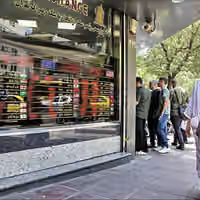
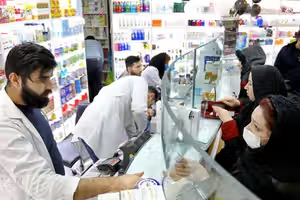
Residents told Iran International that severe shortages and soaring prices for key medicines, including insulin and blood thinners, have persisted over the past month, with some insulin brands reaching seventy million rials (≈$46.7).

Several citizens said the price of Ryzodeg insulin jumped from 12 million rials (≈$8) to 76 million rials (≈$51). Five-dose packs of NovoRapid and Lantus now sell for 15–18 million rials (≈$10–$12).

A resident reported that the blood thinner Plavix, crucial to preventing strokes and heart attacks, rose from 7.5 million rials (≈$5) to 27 million rials (≈$18) in recent weeks.

An ordinary Iranian citizen earns approximately $100–$150 per month.

Shortages leave patients struggling

Before the war and US-Israeli attacks, insulin was already limited, with insurance covering only one dose per week. Residents say the scarcity has now reached crisis levels.

One citizen in Parand near Tehran said: “I couldn’t find my diabetes medications for a month, even without a prescription. Two types, Lantus and Apidra, usually last a week each, but I ran out completely.”

Another said his mother had to travel from Karaj to Qazvin (over 110 km) to obtain essential medicines. Tehran residents report difficulty finding Asentra (sertraline) for depression and Iran-made blood thinner Osvix.

Supply chain disruptions deepen crisis

Residents link shortages to halted imports from Turkey and Dubai. A transit driver said fewer registered shipments have reduced cargo flow. Local distributors have paused sales, while pharmacies face delayed deliveries and payments.

“Our city has more pharmacies than any other shop, but even acetaminophen is unavailable,” a Sari resident in northern Iran said.

The shortages coincide with rising food prices and widespread business closures, adding to economic strain.

However, Mohammad Reza Aref, First Vice President, said on Wednesday that strategic drug reserves are in good condition and ordered “immediate import” of essential medicines. Residents, however, continue to report high prices and irregular availability.

Global healthcare impact

NHS England chief executive Sir Jim Mackey warned that the Iran war could disrupt healthcare supplies internationally. Speaking to LBC Radio on Wednesday, Mackey said syringes, gloves, and intravenous bags may become scarce due to the closure of the Strait of Hormuz.

“A team has been set up across the NHS to assess risks through the supply chains. Almost everything may be at risk, as Britain relies heavily on imports for medicines and healthcare equipment,” Mackey said.

Medicines UK chief executive Mark Samuels said Britain could face further shortages if the conflict prolongs, noting that 85 percent of NHS medicines are generic and largely sourced from India.

Most Viewed

IRGC takes de facto control of Iran government amid deepening power struggle
1
EXCLUSIVE

IRGC takes de facto control of Iran government amid deepening power struggle

2
ANALYSIS

Khameneism after Khamenei- why Mojtaba represents continuity, not change

3

Dubai crackdown hits Iran’s economic lifeline, squeezes IRGC networks

4
INSIGHT

War and inflation batter Iran’s workforce

5
INSIGHT

When Iran’s war images become a battle of belief

Banner
Banner

Spotlight

  • War follows us Iranian scientists far from home
    OPINION

    War follows us Iranian scientists far from home

  • War tests Iran’s Dubai trade lifeline
    ANALYSIS

    War tests Iran’s Dubai trade lifeline

  • War and inflation batter Iran’s workforce
    INSIGHT

    War and inflation batter Iran’s workforce

  • When Iran’s war images become a battle of belief
    INSIGHT

    When Iran’s war images become a battle of belief

  • Dubai crackdown hits Iran’s economic lifeline, squeezes IRGC networks

    Dubai crackdown hits Iran’s economic lifeline, squeezes IRGC networks

  • Khameneism after Khamenei- why Mojtaba represents continuity, not change
    ANALYSIS

    Khameneism after Khamenei- why Mojtaba represents continuity, not change

  • Iran drug stocks under two months, 800 medicines at risk as FX delays bite

    Iran drug stocks under two months, 800 medicines at risk as FX delays bite

  • Iran faces looming medicine shortages as UN sanctions strain drug supply chains

    Iran faces looming medicine shortages as UN sanctions strain drug supply chains

•
•
•

More Stories

Goldman Paris under police watch after bomb threat linked to Iran group

Apr 2, 2026, 11:45 GMT+1

The Paris offices of Goldman Sachs were placed under police surveillance after a bomb threat believed to be linked to an Iranian group, Le Parisien reported.

Prosecutors in Paris said on Thursday no suspicious items had been found.

Goldman told staff they could work remotely on Thursday, a source familiar with the matter said, while employees at Citigroup in Paris and Frankfurt also worked from home as a precaution. Citigroup said the move was a precautionary measure.

The heightened alert followed a foiled bomb attack near the Paris offices of Bank of America last week.

French anti-terrorism prosecutors said a man and three teenagers aged 16 and 17 had been placed under formal investigation and held in pre-trial detention on suspicion of manufacturing, transporting and handling an explosive device and attempting to destroy property as part of a terrorist organization.

They said the device, made from a five-litre petrol can attached to a large pyrotechnic charge containing a 650-gram active-material cylinder, was the most powerful of its kind identified in France and could have generated a fireball several meters wide.

Investigators said the adult suspect recruited the teenagers, paying them between 500 and 1,000 euros to plant and film the device. All four denied terrorist intent.

Authorities said the plot may be linked to a pro-Iranian group known as HAYI, which had posted a video naming Bank of America’s Paris headquarters, though prosecutors said the link had not been formally established.

Iran executes protest detainee over Basij base fire case

Apr 2, 2026, 09:59 GMT+1

Iran’s judiciary said on Thursday it had carried out the execution of Amirhossein Hatami, a protest detainee convicted in a case linked to a fire at a Basij base in Tehran during January protests.

Hatami was among a group of detainees held responsible for the events at the “185 Mahmoud Kaveh” Basij base on January 8. Families of the detainees told Iran International that Hatami and others were pushed into the building by unidentified armed individuals, after which the base caught fire. Witnesses said the protesters were trapped inside, with the blaze putting their lives at risk.

Mizan, the judiciary news outlet, wrote that Hatami was “convicted of actions that targeted national security and involved attempting to access weapons and ammunition in a classified military site” and that his trial followed the presentation of confessions and investigative reports. The outlet added that the Supreme Court had reviewed and upheld the ruling.

The other detainees named in the report were Mohammadamin Biglari, Shahin Vahedparast, Abolfazl Salehi and Ali Fahim.

Their case was heard at Branch 15 of Tehran’s Revolutionary Court, presided over by Judge Abolqasem Salavati, and death sentences were issued in February, according to the report.

  • No leniency for January protesters, Iran judiciary warns

    No leniency for January protesters, Iran judiciary warns

Court documents cited in the report said Hatami’s presence at the base coincided with efforts to breach military restrictions, although family accounts and independent reporting suggest he did not set the fire nor voluntarily enter the premises.

Eyewitnesses told Iran International that a large crowd had gathered outside the base on the evening of January 8 during nationwide protests, and several motorbikes in the street were set on fire. Some armed and unidentified individuals pushed protesters into the base and locked the doors, filling the building with smoke and putting those inside at immediate risk.

Detainees caught in prearranged scenario

Based on witnesses’ reports, the seven detainees were victims of a prearranged scenario by security and Basij forces intended to make them appear culpable for the fire. After the plan failed, five of them were referred for execution on charges including “enmity against God, corruption on earth, and conspiracy against national security.”

Hatami was one of five prisoners removed from Ghezalhesar prison for execution on Tuesday. Families reported that detainees, including Hatami, were transferred to undisclosed locations shortly before the execution. The prisoners, aged between 19 and 25, had limited access to legal counsel during a trial concluded within 30 days of their arrest.

  • Wrestler’s execution raises fears for detained athletes in Iran

    Wrestler’s execution raises fears for detained athletes in Iran

Iran’s judiciary also announced that other political prisoners, including Pouya Ghobadi Bistouni and Babak Alipour, were executed earlier this week, along with Akbar (Shahrokh) Daneshvarkar and Mohammad Taghavi Sangdehi. Two additional prisoners, Vahid Baniamrian and Abolhassan Montazer, had been sentenced to death in December 2024.

Human rights groups warn of rushed executions

Families and human rights groups have repeatedly warned against executing prisoners under such circumstances and called for an immediate halt to the sentences. The cases have drawn international attention, highlighting the dangers of issuing death penalties without guaranteeing basic legal rights.

Amid heightened security tensions and restricted internet access, the rapid pace of executions in politically sensitive cases has increased, leaving detainees exposed to unpredictable and direct threats to their lives. Human rights organizations have warned that the acceleration of these executions could lead to a humanitarian crisis.

War follows us Iranian scientists far from home

Apr 2, 2026, 04:46 GMT+1
•
Ebrahim Karimi

I have learned as an Iranian-American scientist that war and politics rarely remain outside the laboratory for scholars from the Middle East, following us into our visas, our collaborations and even our ability to concentrate on our work.

To be born a scientist in the Middle East, and particularly in Iran, is to inherit constraints that shape your education, your mobility and often your sense of belonging long before you publish your first paper.

For many students, the obstacles begin early. Access to higher education can depend on geography, religion, ethnicity or family background. Certain research topics are restricted. Background checks are routine. Resources are uneven.

These constraints do not extinguish ambition. Many of the most driven students I have met from the region have worked relentlessly to overcome barriers that would discourage others. A significant number succeed in gaining admission to leading universities abroad, often ranking among the strongest in their cohorts.

But leaving does not mean leaving politics behind.

Students from Iran and other parts of the Middle East frequently undergo additional security screening when applying for visas or research permits in Western countries. Even when governments recognise the vulnerability of marginalised groups, the bureaucratic process can be prolonged and uncertain. Delays disrupt research timelines, funding and family life.

For a graduate student on a fixed stipend, uncertainty is not an abstraction. It is rent, tuition and the ticking clock of a degree.

Once abroad, the challenges evolve rather than disappear entirely. Family, friends and history bind students to their countries of origin. Political upheaval, internet shutdowns, military escalation or widespread protests reverberate across continents.

During periods of unrest, many students feel a moral obligation to support loved ones financially and emotionally. They spend hours each day checking the news, supporting movements on social media, translating information, sending money and making calls at odd hours.

Research suffers. Sleep suffers. Concentration suffers. The entire laboratory feels the impact when one member is under acute stress.

Political manipulation and disinformation can deepen divisions within diaspora communities, leading to heated disputes that further isolate students already under strain.

I have lived through several such cycles as a graduate student and now as a professor. Today I receive daily messages from students—via email, on social media or during meetings—asking for advice. My guidance is simple, though not easy to follow: help where you can, avoid corrosive debates and focus on your research and your long-term goals.

This tension between civic conscience and scientific focus is what I think of as a form of geographic discrimination. Events far beyond one’s control can disrupt internet access, travel, funding and collaboration, affecting thousands of scientists across the globe simply because of where they were born.

The current conflict involving Iran, Israel and the United States illustrates this clearly. Universities and schools have closed. Conferences and workshops have been postponed or cancelled. Laboratories face interruptions, whether from direct damage, security restrictions or the displacement of staff and students.

Even when military actions are described as targeted, research institutes and surrounding civilian infrastructure are not immune to the shock.

Recent strike damage near civilian educational facilities in Iran, which cost the lives of 160 students, and the previous attack on the Weizmann Institute of Science in Israel are reminders that scientific ecosystems are fragile. Rebuilding infrastructure takes years. Rebuilding trust and a sense of safety can take longer.

The long-term cost is not measured only in damaged buildings or delayed experiments. It is measured in lost collaborations, abandoned projects and the quiet departure of talented young people who decide that stability matters more than prestige.

Science thrives on openness, mobility and sustained concentration. War undermines all three.

When we speak about geopolitical conflict, we often focus on borders, strategy and power. We speak less about research teams fractured by forces entirely outside their control.

If we value scientific progress, we must recognise how deeply it depends on the human beings who carry it forward. For many scientists from the Middle East, war is not a distant headline. It is an interruption that follows them into the laboratory and into the quiet hours when research demands clarity of mind.

Protecting science, in times of conflict, means protecting them as well.

When Iran’s war images become a battle of belief

Apr 1, 2026, 17:21 GMT+1
•
Maryam Sinaiee

A heated online dispute over photographs showing civilian victims of strikes in Iranian cities has exposed both the deep mistrust many Iranians feel toward official information and a widening rift among the public itself over how to interpret images emerging from the war.

As photos of wounded civilians circulated widely on social media, some users accused photographers and authorities of staging scenes for propaganda, claiming that individuals depicted in widely shared images were actors and that injuries, dust and distress visible in the photos had been artificially created using makeup and staged scenes.

The accusations spread quickly across Persian-language social media, with skeptics pointing to perceived similarities between people appearing in images linked to separate incidents as supposed evidence.

Even the Persian-language account of Israel’s foreign ministry weighed in on the controversy by reposting one of the disputed images and writing: “If they call the Gaza filmmaking industry ‘Pallywood’, what do they call this?”

But the claims were soon challenged by fact-checkers and other users, and in some cases the accusations were later withdrawn.

Iran’s independent fact-checking platform Factnameh said a review of several of the controversial images found no evidence supporting claims that they had been staged or taken at different times and locations as alleged.

“Given the presence of debris and victims, the idea that actors were staged in such a scene is highly unlikely,” the platform said, noting that the individuals in the images show clear differences in facial features and body structure despite some similarities.

Mehdi Ghasemi, one of the photographers whose work came under scrutiny, rejected the allegations and defended his work.

“I’m 47 years old, and it’s been 33 years since I received my first documentary photography award, and I haven’t taken a single reconstructed or manipulated frame,” he wrote on X.

One user who had asserted that a woman in a widely circulated photograph was an actress later deleted the post and issued an apology after acquaintances identified the woman and her husband as real individuals whose home had been destroyed in the strikes.

The controversy has unfolded amid tight wartime restrictions on reporting and photography in Iran.

Critics argue that permits to document sensitive scenes are tightly controlled and often granted only to photographers seen as aligned with the authorities, making independent documentation of chaotic strike sites difficult.

Combined with broader limits on information flow during the conflict, those restrictions have left social media as one of the primary arenas for competing narratives about events on the ground.

The dispute reflects how deeply distrust of official narratives has taken root in Iranian society after decades of censorship and propaganda. In such an environment, even genuine documentation can quickly become the subject of suspicion.

“The issue is exactly like the story of the boy who cried wolf,” one user wrote online.

“When a government lacks legitimacy to this extent and has always chosen to lie at every step, eventually no one believes the truth either. Now factor in cutting off communication channels on top of that, and you end up with the situation we are in.”

For others, however, the rush to dismiss images of civilian suffering as staged propaganda risks deepening divisions at a moment when the war itself is already reshaping daily life across the country.

Acclaimed filmmaker Jafar Panahi returns to Iran

Apr 1, 2026, 13:37 GMT+1

Iranian filmmaker Jafar Panahi has returned to Iran, informed sources told Iran International, after traveling abroad for an international awards campaign.

Panahi entered the country on Tuesday by land via Turkey due to flight restrictions, the sources said.

He had been outside Iran to promote his film It Was Just an Accident, which won the Palme d’Or at the Cannes Film Festival and was shortlisted for the Academy Awards.

Panahi had previously said he would return to Iran after the Oscar campaign despite potential risks. “As soon as the campaign ends, I will return to Iran,” he said in a February interview.

The director has faced years of legal pressure in Iran, including a one-year prison sentence issued in absentia on charges of propaganda against the state, along with a two-year travel ban and other restrictions.

Panahi had faced a long-standing travel ban before being able to travel for the film’s international release. His work, often made despite official restrictions, has focused on social and political issues and drawn on his own experiences of detention and surveillance.