Amnesty says Iran deploying children amounts to war crime
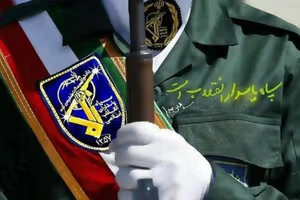
Amnesty International said on Thursday that Iran’s recruitment of children as young as 12 for roles linked to the Islamic Revolutionary Guard Corps amounts to a war crime.
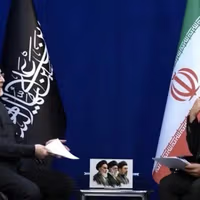
The statement follows remarks aired on state media by IRGC official Rahim Nadali, who said the minimum age for participation in support roles such as patrols, checkpoints and logistics had been lowered to 12 under a campaign encouraging volunteers.
“Given that the age of those coming forward has dropped … we lowered the minimum age to 12,” Nadali said, adding that 12- and 13-year-olds could take part if they wished.






The statement follows remarks aired on state media by IRGC official Rahim Nadali, who said the minimum age for participation in support roles such as patrols, checkpoints and logistics had been lowered to 12 under a campaign encouraging volunteers.
“Given that the age of those coming forward has dropped … we lowered the minimum age to 12,” Nadali said, adding that 12- and 13-year-olds could take part if they wished.
“The Iranian authorities are shamelessly encouraging children as young as 12 to join an IRGC-run military campaign,” Amnesty said, adding that “recruiting children under 15 into the armed forces constitutes a war crime.”
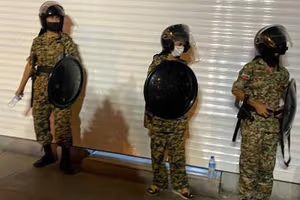
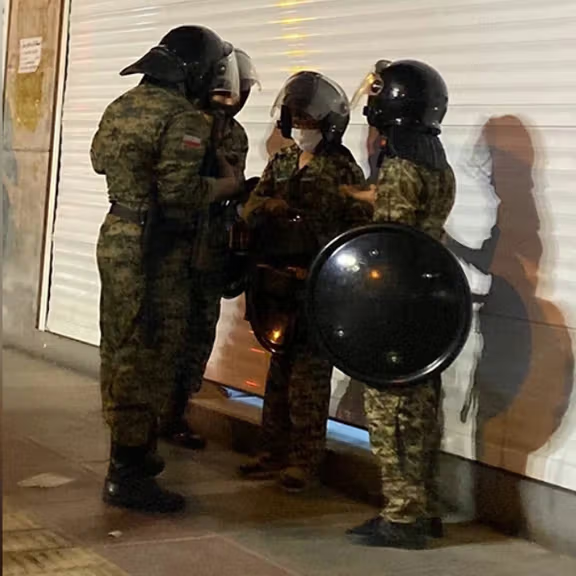
The group cited video and eyewitness accounts which it said showed minors deployed at checkpoints and patrols, some carrying weapons, exposing them to risk as US and Israeli strikes target IRGC-linked sites across the country.
The development has revived concerns over the use of minors in security roles in Iran, including during the 2022 protests triggered by the death of Mahsa Amini, when images appeared to show children and teenagers in military-style gear.
Human rights groups have also accused Iranian authorities of killing child protesters during past crackdowns, with the Center for Human Rights in Iran saying more than 200 children were killed during unrest earlier this year.
Amnesty said the recruitment comes despite Iran’s commitments under the Convention on the Rights of the Child, which prohibits the use of children in military activities, and called on authorities to immediately stop enlisting anyone under 18.
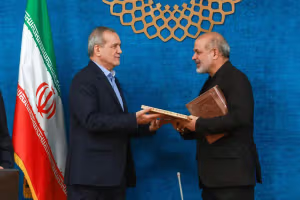
In a phone call on Tuesday with European Council President Antonio Costa, Pezeshkian said Iran has the “necessary will” to bring the conflict to an end - provided that “essential conditions, especially guarantees to prevent renewed aggression, are met.”
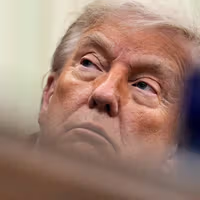
Following Pezeshkian’s remarks, US President Donald Trump wrote on Truth Social that the “president of the new Iranian regime” had requested a ceasefire. Oil prices dipped slightly after the comments.
Iranian officials swiftly rejected Trump’s characterization. Mehdi Tabatabaei, the deputy for communications and information at the president’s office, responded on X:
“The position of the Islamic Republic of Iran regarding the defense of the nation against the aggression of evildoers and the conditions for ending the imposed war has not changed, and there is no regard for the delusions and lies of criminals.”
In a letter addressed to the American public published on Wednesday, Pezeshkian reiterated that Iran’s military actions were “purely a response and defense, not the initiation of war and aggression.” He described continued confrontation as “costly and fruitless,” signaling a more pragmatic tone from parts of the political establishment.
Hardliners and figures aligned with the security establishment have set stricter conditions for ending the war. Mohsen Rezaei, now a military adviser to Mojtaba Khamenei, has said the conflict should only end with reparations and guarantees, including the removal of US bases from the region.
Hardliner backlash intensifies
Pezeshkian’s comments triggered strong criticism from conservative and hardline figures. Lawmaker Hamid Rasaei described the remarks as evidence of a “wavering personality” and “passivity in the face of the enemy,” arguing that such positions could embolden further attacks.
Rasaei has previously compared Pezeshkian to Iran’s first president, Abolhassan Banisadr, who was removed from office by parliament for “political incompetence”. Similar comparisons have circulated widely on social media in recent days.
Some critics framed the conflict as a struggle between “truth and falsehood” and opposed any negotiated settlement short of total victory.
Calls for deterrence over diplomacy
In an open letter published on X, hardline activist Mohammad Shirakvand criticized Pezeshkian’s appeal for European guarantees, writing: “When you yourself state that the United States does not believe in diplomacy, what does speaking of guarantees for ending the war mean other than repeating a costly mistake?”
“This war is a battle of truth against falsehood and an arena of clashing wills. The government must play on this field, not on promises that have repeatedly proven unreliable,” he added.
Shirakvand argued that “real guarantees are not built through diplomacy, but through power and deterrence on the battlefield.”
Another widely shared post by a conservative account, Rah-e Dialameh, described Pezeshkian’s remarks as “sending a signal of weakness to the enemy,” linking them to the drop in oil prices and warning that such a strategy “must be stopped before it causes further damage.”
Some hardline users accused Pezeshkian of “sending ceasefire signals” and weakening Iran’s military posture, demanding that security authorities “control” him.
One user appeared to issue an implicit threat, suggesting authorities should restrict his public appearances “to protect his life,” claiming the country “is better managed on autopilot.”
Son defends the president’s stance
Amid escalating criticism, Pezeshkian’s son and adviser, Yousef Pezeshkian, publicly defended his father. He challenged critics’ logic, asking: “I do not understand the meaning of these criticisms; are we not seeking to meet conditions and obtain guarantees? Or are we seeking war until the complete destruction of America and Israel?”
He framed the president’s position as a realistic attempt at conditional de-escalation, contrasting it with what he implied were unrealistic or maximalist goals.
He also defended his father’s earlier apology to neighboring countries affected by Iranian strikes, calling it an “ethical duty” and highlighting efforts to maintain regional relations despite the conflict.