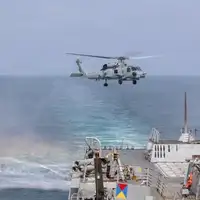
US embassy urges American citizens to leave Iraq
The US Embassy in Baghdad said on Thursday that Iran-aligned militia groups could carry out attacks in central Baghdad within the next 24 to 48 hours, urging American citizens to leave Iraq.





New pipelines may be the only way to reduce the Persian Gulf countries’ enduring vulnerability to disruption in the Strait of Hormuz, the Financial Times reported on Thursday, citing officials and industry executives.
Such projects would be expensive, politically complex and take years to complete, according to the report.
Any new pipelines would, over the longer term, likely form part of broader trade routes through which a wider range of goods beyond oil and gas could flow, read the report.
I have learned as an Iranian-American scientist that war and politics rarely remain outside the laboratory for scholars from the Middle East, following us into our visas, our collaborations and even our ability to concentrate on our work.
To be born a scientist in the Middle East, and particularly in Iran, is to inherit constraints that shape your education, your mobility and often your sense of belonging long before you publish your first paper.
For many students, the obstacles begin early. Access to higher education can depend on geography, religion, ethnicity or family background. Certain research topics are restricted. Background checks are routine. Resources are uneven.
These constraints do not extinguish ambition. Many of the most driven students I have met from the region have worked relentlessly to overcome barriers that would discourage others. A significant number succeed in gaining admission to leading universities abroad, often ranking among the strongest in their cohorts.
But leaving does not mean leaving politics behind.
Students from Iran and other parts of the Middle East frequently undergo additional security screening when applying for visas or research permits in Western countries. Even when governments recognise the vulnerability of marginalised groups, the bureaucratic process can be prolonged and uncertain. Delays disrupt research timelines, funding and family life.
For a graduate student on a fixed stipend, uncertainty is not an abstraction. It is rent, tuition and the ticking clock of a degree.
Once abroad, the challenges evolve rather than disappear entirely. Family, friends and history bind students to their countries of origin. Political upheaval, internet shutdowns, military escalation or widespread protests reverberate across continents.
During periods of unrest, many students feel a moral obligation to support loved ones financially and emotionally. They spend hours each day checking the news, supporting movements on social media, translating information, sending money and making calls at odd hours.
Research suffers. Sleep suffers. Concentration suffers. The entire laboratory feels the impact when one member is under acute stress.
Political manipulation and disinformation can deepen divisions within diaspora communities, leading to heated disputes that further isolate students already under strain.
I have lived through several such cycles as a graduate student and now as a professor. Today I receive daily messages from students—via email, on social media or during meetings—asking for advice. My guidance is simple, though not easy to follow: help where you can, avoid corrosive debates and focus on your research and your long-term goals.
This tension between civic conscience and scientific focus is what I think of as a form of geographic discrimination. Events far beyond one’s control can disrupt internet access, travel, funding and collaboration, affecting thousands of scientists across the globe simply because of where they were born.
The current conflict involving Iran, Israel and the United States illustrates this clearly. Universities and schools have closed. Conferences and workshops have been postponed or cancelled. Laboratories face interruptions, whether from direct damage, security restrictions or the displacement of staff and students.
Even when military actions are described as targeted, research institutes and surrounding civilian infrastructure are not immune to the shock.
Recent strike damage near civilian educational facilities in Iran, which cost the lives of 160 students, and the previous attack on the Weizmann Institute of Science in Israel are reminders that scientific ecosystems are fragile. Rebuilding infrastructure takes years. Rebuilding trust and a sense of safety can take longer.
The long-term cost is not measured only in damaged buildings or delayed experiments. It is measured in lost collaborations, abandoned projects and the quiet departure of talented young people who decide that stability matters more than prestige.
Science thrives on openness, mobility and sustained concentration. War undermines all three.
When we speak about geopolitical conflict, we often focus on borders, strategy and power. We speak less about research teams fractured by forces entirely outside their control.
If we value scientific progress, we must recognise how deeply it depends on the human beings who carry it forward. For many scientists from the Middle East, war is not a distant headline. It is an interruption that follows them into the laboratory and into the quiet hours when research demands clarity of mind.
Protecting science, in times of conflict, means protecting them as well.
US congresswoman Yassamin Ansari sharply criticized President Trump’s comments about Iran following his speech on the war.
Quoting Trump’s remark that the United States could bring Iran “back to the stone ages where they belong,” Ansari wrote on X: “He’s talking about a country of 90 million people. Vile, horrifying, evil.”
Ansari is the first Democratic lawmaker of Iranian origin who represents Arizona in the US House of Representatives.
Global markets fell on Thursday after US president Donald Trump’ offered no clear indication of when the war against Iran might end, instead warning to bomb the country "back to the stone ages."
Stocks dropped while oil prices climbed and the US dollar strengthened in the immediate aftermath of the speech.
US stock futures fell around 1%, while European futures dropped more than 1.5%. Asian markets were also hit, with Japan’s Nikkei index down 1.8% and South Korea’s Kospi sliding 3.6%.
US Senate Democratic leader Chuck Schumer sharply criticized Donald Trump’s address on the war with Iran, describing the speech as “rambling, disjointed, and pathetic.”
In a post on X, Schumer accused the president of ignoring the economic concerns facing ordinary Americans.
He added that Trump’s actions in Iran could be remembered as “one of the greatest policy blunders" in the history of the United States.