Iran’s state broadcaster is facing criticism after airing programs in which presenters and government supporters handled rifles and other weapons on camera, with critics saying the displays blurred wartime messaging with intimidation at home.
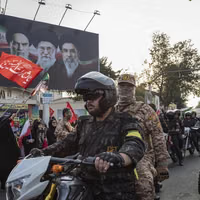
Iranian state television channels have in recent days broadcast multiple programs featuring members of the Revolutionary Guards (IRGC), often with their faces covered, demonstrating the use of light and heavier weapons.
The televised demonstrations included Kalashnikov rifles, PK machine guns and shoulder-fired RPG launchers.
The channels also showed footage of women, men, teenagers and young people learning how to use and disassemble weapons in mosques and nighttime gatherings organized by government supporters.
Participants shown in the broadcasts said they had volunteered “to defend the country” and “the system.”
One of the most criticized broadcasts aired on Ofogh TV under the title “War Headquarters.”
In the program, after receiving instruction from an IRGC member, the presenter pointed a weapon toward an image displaying the flag of the United Arab Emirates and fired at it.
Relations between Iran and the UAE, long one of Iran’s largest trading partners, have sharply deteriorated following the recent regional conflict.
Reports indicate that the UAE has expelled many Iranian nationals in recent months.
The reformist newspaper Sazandegi wrote: “Shooting at the flag of a neighboring country has left public opinion shocked and astonished.”
A reader commenting on the Rouydad24 news website wrote: “Television presenters firing at the UAE flag on state TV have handed Iran’s enemies a perfect excuse for Iranophobia. Perhaps the shooting segment itself was orchestrated by infiltrators or a fifth column.”
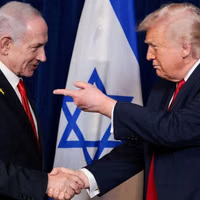
In another televised segment, an IRGC member demonstrated shooting techniques using an unloaded Kalashnikov while aiming at an image of Israeli Prime Minister Benjamin Netanyahu displayed on a studio wall.
After him, the presenter pointed the weapon toward the forehead of US President Donald Trump and said: “I hope these bullets will one day hit their target.”
State broadcaster defends the programs
Officials from Iran’s state broadcasting organization, IRIB, defended the scenes.
Mohsen Bormahani, deputy head of IRIB, told the IRGC-affiliated Tasnim News Agency: “In wartime conditions, and in a country simultaneously engaged in struggle against all the powers and oppression in the world, it is natural for the national media to adopt a wartime posture.”
Bormahani said familiarizing young people and the general public with weapons helped them “become acquainted with the concepts of jihad, resistance, and defense, and strengthen their sense of responsibility and readiness within the framework of religious, cultural, Iranian, and Islamic values.”
He said the appearance of television hosts carrying weapons served as “a reminder of these teachings to the public.”
Hassan Abedini, political deputy of IRIB, separately told Mehr News Agency that the displays were symbolic and intended to project military readiness among government-backed war volunteers.
Media criticism and public anxiety
Several Iranian media outlets sharply criticized the broadcasts and warned that they could create widespread feelings of insecurity.
Rouydad24 wrote: “Broadcasting weapons training on television, in a country that already has an army, the IRGC, security forces, the Basij, and millions of men with mandatory military training, raises a troubling question more than it demonstrates ‘strength’: who exactly are these training programs intended for, and what situation are people being prepared for?”
The outlet added: “If the country’s official television suddenly starts teaching the general public how to use weapons, the question arises whether such an action unintentionally conveys the message that the official guarantors of security are no longer sufficient.”
Rouydad24 warned that the broadcasts presented “a future in which ordinary citizens must prepare themselves for the collapse of order – a situation where weapons have left the barracks and people are forced to defend their homes and streets themselves. This is precisely the image governments usually try never to convey to society.”
The conservative news website Khabar Online also criticized the broadcaster, writing that IRIB may have intended to signal to foreign enemies that “all segments of the nation are ready for battle,” or to project unity at home.
But it said media experts viewed the approach as poor judgment.
Warnings about psychological harm
Khabar Online warned that the broadcasts reproduced “guerrilla and paramilitary imagery that belongs in barracks, not on national television.”
It added: “Seeing a television presenter holding an assault rifle not only fails to create a sense of security, but also intensifies feelings of insecurity, anxiety, and war trauma among the public, especially children and vulnerable groups.”
The reformist newspaper Sazandegi also warned that the episode had raised serious concerns for the psychological security of society and the country’s international image.
It wrote: “Promoting militarism in general television programming creates a tense and anxious atmosphere in society. The proper place for displays of military power is training grounds and official parades, not the live studio of a nationwide television channel with a cultural and social mission.”
Critics see message to opponents
Some critics said the televised weapons displays appeared aimed less at a foreign enemy than at political opponents inside the country, amid growing public frustration and economic strain.
Iranian sociologist Hossein Ghazian told Iran International that the broadcasts symbolized political repression and were intended to pressure critics into silence while also justifying economic hardships through a wartime atmosphere.
One commenter on Rouydad24, referring to the deadly crackdown on protests in January, wrote: “This criminal cult is preparing for the massacre of defenseless and unarmed ordinary people, just like before, and dark days are certainly ahead. Otherwise, with these worn-out Kalashnikovs, against whom are they planning to fight? Are they going to fight F-35s, F-18s, and F-22s with these?”
An illustration showing an ancient Iranian soldier and a Revolutionary Guard member holding a weapon together, displayed during a November 7 ceremony in Tehran where a statue of pre-Islamic Persian King Shapur I was unveiled.
Tehran’s unveiling of a towering statue depicting the Roman Emperor Valerian kneeling before pre-Islamic Persian King Shapur I has renewed criticism of the Islamic Republic’s appeal to nationalist sentiment following the June war with Israel.
For over forty years, the theocracy purged ancient Persian history from schoolbooks, replacing it with post-Islamic narratives. But after the 12-day conflict with Israel, officials have turned to the distant pre-Islamic past to rally a divided society.
From murals of ancient kings and soldiers to patriotic songs added to Shi’ite mourning ceremonies performed before Supreme Leader Ali Khamenei, Tehran now embraces imagery once deemed heretical by its own revolutionary ethos.
The statue unveiled in Tehran's Revolution Square
'Kneel before Iran' campaign
Tehran’s Revolution (Enghelab) Square was the scene of an unusual spectacle on Friday as officials unveiled a massive bronze statue depicting Roman Emperor Valerian kneeling in submission before Sassanid King Shapur I, commemorating Iran’s victory at the Battle of Edessa (260 AD).
The event was held under the slogan “Kneel before Iran,” part of what authorities describe as a campaign to project “national unity and historical pride” following the June war with Israel.
Tehran Mayor Alireza Zakani, a staunch ultraconservative, said on X: “Enmity with Great Iran can only end in kneeling before this historic nation.”
Municipal official Davood Goodarzi said the installation would be accompanied by visual displays depicting “other victories of Iranians over foreign aggressors,” including the defeat of British forces by local commander Rais-Ali Delvari, Mirza Kuchak Khan’s resistance against Russian troops, and Surena’s triumph over Rome at the Battle of Carrhae in 53 BCE.
The goal, Goodarzi said, is “strengthening concepts such as national dignity, social unity, and Iranian identity.”
The statue, he said, would remain temporarily at Revolution Square before being moved to a city gateway “where it will stand as the first emblem of Iran before diplomats and foreign visitors.”
Unveiled women were allowed to attend the unveiling ceremony—an uncommon scene at events organized by Tehran’s ultra-hardline municipality.
The turn to the pre-Islamic past
The sharp reversal also recalls remarks once made by Khamenei. In a 2011 speech, he asserted that “all the great military victories of this nation came after Islam,” dismissing pre-Islamic accounts as “things that are not documented.”
In 1987, he had said that prophets triumphed over kings such as Cyrus and that “nothing remains of these monarchs in history but names remembered with derision.”
Nevertheless, pro-government social media accounts have now gone so far as to circulate posters equating Khamenei himself with Shapur, showing him standing with a staff as Benjamin Netanyahu and Donald Trump kneel before him. The caption reads: “You will kneel before Iran.”
Image circulating by hardliners on social media
'Hypocrisy'
Pro-government figures have hailed the move as a patriotic success. Conservative political reporter Hossein Saremi posted: “Today’s grand Iranian gathering showed that people and the state share one essence: Iran itself. Nothing can take our homeland away.”
Others, however, called the spectacle “hypocrisy.” Journalist Gholamhossein Pashaei wrote on X: “Every year you close Pasargadae to stop people from celebrating Cyrus Day, yet you unveil Shapur’s statue in Enghelab Square with drums and fireworks during Fatimiyya (mourning period)!”
Dissident commentator Hamid Asafi called the ceremony “a perfect snapshot of the Islamic Republic’s contradictions.”
On Telegram he wrote: “A week ago they closed Cyrus’s tomb out of fear of the crowds, and now they glorify Shapur in the same breath. The Islamic Republic fears living history but poses for selfies with its corpse.”
He added: “They know people no longer respond to rosaries and sermons. That’s why they’ve brought history back to the stage—in a controlled costume. If they can’t erase the past, they’ll try to own it.”
The irony deepened as UNESCO formally recognized Cyrus’s Charter as one of the earliest human-rights documents.
President Masoud Pezeshkian wrote on X: “Iran, the cradle of dialogue, justice, and coexistence, can still inspire peace today.”
Users swiftly replied, questioning how such pride could coexist with a government that blocks access to Cyrus’s tomb each year to those wishing to visit it on his birthday.