UAE says it is confronting Iranian missile and drone attacks
The United Arab Emirates' defense ministry says its air defenses are confronting Iranian missile and drone strikes.
The United Arab Emirates' defense ministry says its air defenses are confronting Iranian missile and drone strikes.



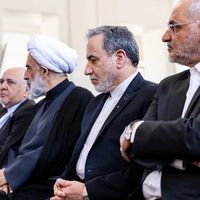




Revolutionary Guard Aerospace Force commander Majid Mousavi has come under criticism from senior IRGC officials for being absent during ongoing clashes and leaving his forces without leadership, sources with knowledge of the matter told Iran International.
The main criticism, according to the sources speaking to Iran International on condition of anonymity, centers on the commander’s lack of presence on the ground at a time when operational pressure has significantly intensified since the start of the war in late February.
Sources say that as casualties have mounted within the Aerospace Force—responsible for missile and drone launches—Mousavi’s absence has been cited as a key factor contributing to the deteriorating situation.
Aerospace Force operators have described the operational conditions as highly dangerous, with each missile launch mission carrying extreme risk and, in some cases, likened to near-suicidal operations, according to the informed sources.
At the same time, sources say families of some personnel have filed complaints with senior IRGC authorities, saying that the commander did not maintain an effective presence under dangerous conditions and that forces were effectively left without adequate support.
Revolutionary Guard Aerospace Force commander Majid Mousavi has come under criticism from senior IRGC officials for being absent during ongoing clashes and leaving his forces without leadership, sources with knowledge of the matter told Iran International.
The main criticism, according to the sources speaking to Iran International on condition of anonymity, centers on the commander’s lack of presence on the ground at a time when operational pressure has significantly intensified since the start of the war in late February.
Sources say that as casualties have mounted within the Aerospace Force—responsible for missile and drone launches—Mousavi’s absence has been cited as a key factor contributing to the deteriorating situation.
Aerospace Force operators have described the operational conditions as highly dangerous, with each missile launch mission carrying extreme risk and, in some cases, likened to near-suicidal operations, according to the informed sources.
At the same time, sources say families of some personnel have filed complaints with senior IRGC authorities, saying that the commander did not maintain an effective presence under dangerous conditions and that forces were effectively left without adequate support.
Additional allegations have also surfaced, including claims of mismanagement and the provision of inaccurate data regarding missile strikes and launch figures by the force.
Seyyed Hossein Mousavi Eftekhari, known as Majid Mousavi, is a brigadier general in the IRGC. He was appointed commander of the Aerospace Force on June 13, 2025, following the killing of his predecessor, Amir-Ali Hajizadeh, in an Israeli strike.
Prior to his appointment, Mousavi served from 2009 to 2025 as deputy commander of the Aerospace Force, where he played a key role in the development and management of Iran’s missile and drone programs.
The IRGC Aerospace Force is considered one of the Islamic Republic’s most important military branches, overseeing the country’s ballistic missile program, offensive drone capabilities, and parts of its air defense systems.
Mousavi is under US sanctions. On December 18, 2024, the US State Department announced sanctions against him over his role in the development of Iran’s ballistic missile and drone programs.
His appointment came at a time when the Aerospace Force was already under intense operational and security pressure. The force continues to play the most important role in the ongoing conflict.
Any US military action against Iran’s Kharg Island could trigger a sweeping escalation, including disruption of security at the Red Sea and the Bab al-Mandeb Strait as well as further attacks on regional energy facilities, the IRGC-affiliated Tasnim News said citing a military source.
The source said that if Washington follows through on threats to invade the strategic oil hub, Iran would respond with measures “unprecedented” compared to developments over the past three weeks of conflict.
The source warned that targeting other critical waterways, including the Bab al-Mandab Strait and the Red Sea, is among the options under consideration by Iran and its allied forces, suggesting the confrontation could expand well beyond the Strait of Hormuz.
The source said an attack on Kharg could temporarily disrupt Iran’s oil production and trigger retaliatory actions against energy infrastructure across the region, escalating risks for global markets.
He also said that US forces would be unable to secure the island in the event of an attack and could face losses “unprecedented since World War II,” underscoring the potential scale of escalation.
Iranian President Masoud Pezeshkian proposed creating a regional security framework made up of West Asian countries to preserve peace and stability without foreign interference, Iran’s embassy in India said on Saturday.
The proposal came in a phone call with Indian Prime Minister Narendra Modi, according to a statement posted by the embassy on X. The statement said Pezeshkian also told Modi that ending the war required an immediate halt to US and Israeli attacks and guarantees they would not be repeated.
The embassy said Pezeshkian urged BRICS, under India’s rotating presidency, to play an independent role in stopping what he described as “aggression against Iran.”
Israel’s military said on Saturday that it carried out overnight strikes in Tehran targeting facilities tied to Iran’s ballistic missile production and several air defense systems.
The targets included a central IRGC compound used for the production and development of missile components, a storage site for missile production parts, a defense ministry facility responsible for missile fuel production and another site producing ballistic missile components, the Israel Defense Forces said in a statement.
The strikes significantly damaged Iran’s ability to keep producing key ballistic missile components at those sites, according to the statement.
It said the attacks were part of a broader phase aimed at expanding damage to Iran’s military capabilities and that strikes on weapons production facilities would continue.