EU sanctions Iranian firm over cyber-attacks against member states
The European Union on Monday imposed sanctions on an Iranian company over cyber-attacks targeting EU member states and partners, the Council of the EU said.
The company, Emennet Pasargad, unlawfully accessed a French subscriber database and offered the data for sale on the dark web, the Council said in a statement.
It also said the firm compromised advertising billboards to spread disinformation during the 2024 Paris Olympic Games and breached a Swedish SMS service affecting a large number of EU citizens.
Under the sanctions, the company is subject to an asset freeze and EU citizens and companies are banned from providing funds or economic resources to it.
The EU also sanctioned two Chinese individuals and two China-based companies over cyber-attacks against member states and critical infrastructure.
Iran has asked India to release three tankers seized in February as part of talks aimed at securing safe passage for Indian-flagged or India-bound vessels through the Strait of Hormuz, three sources familiar with the matter told Reuters.
Indian authorities seized the vessels near Indian waters, alleging they had concealed or altered their identities and were involved in illegal ship-to-ship transfers.
Iran’s ambassador to New Delhi met officials at India’s foreign ministry on Monday to discuss the issue, one source said, adding Tehran had also sought supplies of some medicines and medical equipment.
India’s foreign ministry spokesperson Randhir Jaiswal said recent ship movements reflected a history of engagement between the two countries and said nothing was being exchanged.
India said at least 22 Indian-flagged vessels and 611 Indian seafarers remain in the Persian Gulf as shipping through the Strait of Hormuz has slowed sharply since the start of the conflict involving Iran.
Indian authorities seized the tankers Asphalt Star, Al Jafzia and Stellar Ruby, which are currently anchored off Mumbai.
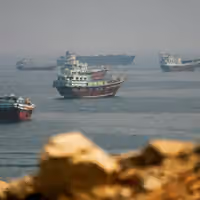
A Pakistan-flagged oil tanker has transited the Strait of Hormuz and is sailing toward Pakistan after traveling close to Iran's coastline, Bloomberg News reported on Monday, citing ship-tracking data.
The Aframax tanker Karachi, operated by Pakistan National Shipping Corp., cleared the strait on Sunday and was later seen near Sohar in Oman, according to the report.
The vessel loaded crude inside the Persian Gulf after leaving Fujairah in the United Arab Emirates last month and is expected to arrive in Pakistan on March 18, Bloomberg reported, citing a company spokesperson.
Shipping through the Strait of Hormuz has largely halted since US and Israeli strikes on Iran began last month, with traders closely watching the few vessels that still pass through the key oil chokepoint.
Israel's military said on Monday it had destroyed a facility in central Tehran that it said was used to develop capabilities to attack satellites in space.
The Israeli air force struck what it described as a center linked to Iran's military space program that was used to develop offensive systems capable of damaging satellites, the military said in a statement.
It said the facility was involved in programs including the development of the Chamran-1 satellite, which it said was built by Iran's defense ministry electronics industries and launched by the Revolutionary Guards in September 2024.
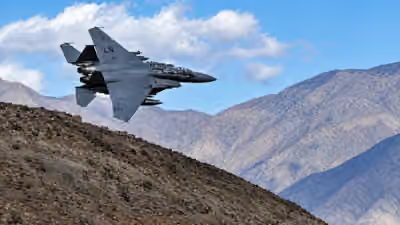
The commander of the United States Central Command said on Monday that US forces carried out a large-scale precision strike on Iran's Kharg Island last week, hitting more than 90 military targets including storage sites for naval mines and missiles.
Admiral Brad Cooper said in a video briefing that US and partner forces had flown more than 6,000 combat flights over the past 16 days and were maintaining air superiority over Iranian skies.
He said the strikes were aimed at eliminating Iran's ballistic missiles, drones and naval threats and dismantling what he described as the country's defense industrial base.
Cooper said US and partner forces had also destroyed more than 100 Iranian naval vessels and were working to reduce Iran's ability to threaten shipping in and around the Strait of Hormuz.
He also said Iran had launched more than 300 attacks across the region over the past two weeks, targeting civilian areas.
Australian club Brisbane Roar said on Monday it had welcomed Iranian players Fatemeh Pasandideh and Atefeh Ramezanisadeh to train with its A-League Women squad after the two applied for asylum in Australia.
The players had been part of Iran’s women’s national team delegation competing abroad before leaving the team and seeking protection in Australia.
In a statement posted on social media, chief executive Kaz Patafta said Brisbane Roar was committed to providing a supportive environment for the players while they considered their next steps.
The crisis surrounding the team began earlier in the month when the players refused to sing the Iranian national anthem before their opening match against South Korea in AFC Women's Asian Cup.
The silent protest came shortly after the escalation of war involving Iran and the killing of Supreme Leader Ali Khamenei, and was quickly condemned by state media in Tehran as an act of “wartime treason.”
In the days that followed, several members of the Iranian delegation sought asylum in Australia. But according to informed sources, pressure from Iranian authorities soon intensified, with messages relayed to the players through members of the team’s own staff urging them to abandon asylum plans and return to Iran.
One member of the technical staff, Zahra Meshkinkar, who had also sought asylum, has been relaying messages from Iranian football officials to players, encouraging them to withdraw their requests and rejoin the team.
Remaining members of the squad were later moved to Kuala Lumpur, where sources say the players have been kept under tight supervision in a hotel.
Journalists and outside visitors have been barred from entering, and some players have had their mobile phones confiscated or are allowed to use them only under the supervision of officials linked to the Iranian Football Federation.
Members of the Iranian women's national soccer team stand at Kuala Lumpur International Airport as they prepare to leave Malaysia on March 16, 2026.
Despite the earlier asylum requests, several players have now withdrawn their applications and are en route to return to Iran, after what sources described as sustained pressure on the team and warnings that their families could face consequences if they refused to go back.
Human rights groups have warned that athletes involved in the anthem protest could face punishment upon their return.