Saudi defense ministry intercepts one drone in eastern region
A Saudi Ministry of Defense spokesman said on Saturday that a drone was successfully intercepted and destroyed in the Eastern Province.
A Saudi Ministry of Defense spokesman said on Saturday that a drone was successfully intercepted and destroyed in the Eastern Province.



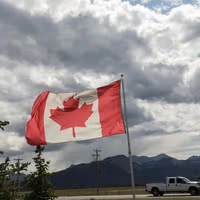
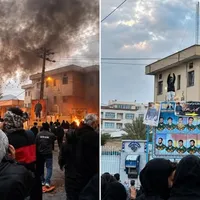

A growing trend across Persian-language social media has turned timelines into a collective archive of national trauma, with users posting photos and videos of disasters they link to the Islamic Republic’s governance over the past four decades.
The campaign, organized loosely around the hashtag #ThisIsNotAWarPhoto, responds to comments circulating online that the current conflict is destroying Iran and harming ordinary people. Participants counter that the country has already endured decades of devastation under its own rulers.
Posts often show photographs of earlier catastrophes, from building collapses and industrial explosions to environmental destruction and violent crackdowns. Many users have assembled threads or collages showing multiple disasters together.
The result is an informal digital archive documenting events that participants say demonstrate how ordinary Iranians have long faced the consequences of corruption, poor oversight and repression.
Industrial disasters and safety failures
Among the most widely shared images are photos from the explosion at Shahid Rajaei port near Bandar Abbas. The blast killed 57 people and injured more than 1,000, according to Iranian state media.
International coverage later connected the incident to chemicals used in missile fuel production. The Associated Press cited maritime security firm Ambrey as saying the port had recently received ammonium perchlorate from China, a compound commonly used in solid rocket propellant.
Iranian authorities denied that military materials were stored at the commercial port and said the cause of the explosion remained under investigation.
Another image frequently circulating online shows the collapsed Metropol building in Abadan. The ten-story residential and commercial structure fell on May 23, 2022 while under construction, killing at least 41 people and injuring dozens.
The disaster triggered protests in Khuzestan province and elsewhere as residents blamed corruption, construction violations and inadequate oversight.
Photos from the Zemestan-Yurt coal mine explosion in Golestan province in 2017 also appear widely in the campaign. The blast trapped miners deep underground in tunnels filled with methane and carbon monoxide, killing 43 workers and injuring more than 70.
Another post recalls the Plasco building collapse in Tehran in January 2017, when a fire engulfed the commercial tower before it collapsed. Around 20 firefighters were killed and dozens injured in the disaster.
Images of the Neyshabur train explosion in northeastern Iran also circulate online. In February 2004, runaway freight wagons carrying sulfur, gasoline, fertilizer and cotton derailed near the village of Khayyam before a massive explosion killed at least 295 people and injured more than 460.
The blast was so powerful that Iranian seismologists recorded it as a small earthquake.
Environmental destruction and water crises
Environmental decline features prominently in some posts. Users share images showing the dramatic shrinkage of Lake Urmia, once one of the Middle East’s largest salt lakes. Years of dam construction, water diversion and heavy agricultural use across the basin caused the lake to recede drastically, turning vast areas into salt flats.
The drying of the Hawizeh Marshes on the Iran-Iraq border also appears in many threads. Environmental experts say oil exploration and water diversion projects have reduced water flow into the wetlands, damaging ecosystems that supported communities for thousands of years.
Water shortages have also driven protests in cities such as Khorramshahr. Photos from demonstrations in 2018 show residents protesting over the lack of safe drinking water during extreme summer heat. Security forces responded with arrests and gunfire, according to activists and local reports.
Another widely shared disaster is the 2019 Shiraz flash flood, which struck during the Nowruz holiday travel period. Floodwaters swept through a road leading into the city, killing at least 19 people and injuring more than 200.
Critics later linked the severity of the disaster to blocked historic flood channels and poor drainage infrastructure.
Repression and political violence
Many posts also recall episodes of state violence. Images referencing the July 1999 student protests show the aftermath of a raid on dormitories at the University of Tehran. Security forces and vigilante groups stormed the dorms after demonstrations against the closure of the reformist newspaper Salam.
At least one student was killed and hundreds were injured. Several detainees disappeared during the crackdown whose fate remains unknown.
Photos from Zahedan’s Bloody Friday in September 2022 are also widely shared. Security forces opened fire on protesters, worshippers and bystanders near the Makki prayer site during demonstrations linked to the Woman, Life, Freedom movement.
Human rights groups documented at least 96 deaths in the single-day crackdown.
Some users also shared photos of victims from the Mahsa Amini protests, which erupted across Iran in September 2022 after the death of Mahsa (Jina) Amini while in the custody of the country’s morality police.
The demonstrations quickly spread to dozens of cities and university campuses, becoming one of the most widespread anti-government movements in the country in recent decades. Security forces – including the Islamic Revolutionary Guard Corps, the Basij militia and police – used live ammunition, shotguns, tear gas and mass arrests to suppress the protests.
Human rights organizations including Human Rights Activists in Iran (HRANA) documented more than 500 deaths during the crackdown, including dozens of children, while tens of thousands of people were arrested.
Images of victims from those protests circulate widely in the #ThisIsNotAWarPhoto campaign, where users present them as part of a broader record of violence carried out by the state against its own citizens.
Other posts refer to the nationwide anti-government protests in January 2026, which users say were met with one of the most severe crackdowns in the country’s recent history. According to figures circulated widely on social media and by activist groups, more than 36,500 people were killed during the suppression of demonstrations across Iran.
A post references the Rasht bazaar killings during the January protests. Witnesses described security forces surrounding protesters in the historic marketplace and opening fire before parts of the bazaar caught fire.
Participants in the campaign say the images serve as reminders that many of the country’s deadliest moments have come not from foreign wars, but from confrontations between the state and its own population.
Disasters tied to negligence
Several posts highlight tragedies tied to safety failures. Images of the Shinabad school fire in December 2012 show a classroom where a faulty oil-burning heater exploded in the village of Shinabad in West Azarbaijan province. Two girls died and more than two dozen students suffered severe burns, many of them permanent.
Another widely shared image refers to the 2020 explosion at Tehran’s At’har medical clinic, where a gas blast killed 19 people.
The Sanchi oil tanker disaster in January 2018 also appears frequently in the campaign. The Iranian-owned tanker collided with another vessel off China’s coast and burned for days before sinking, killing all 32 crew members.
Documents later obtained by media outlets suggested Iranian authorities overlooked evidence that some crew members may have survived the initial collision.
Aviation tragedy and public health crisis
One of the most widely circulated images shows the wreckage of Ukraine International Airlines Flight 752.
The passenger plane was shot down by the Islamic Revolutionary Guards Corps shortly after taking off from Tehran in January 2020, killing all 176 people aboard. Iranian officials initially blamed a technical failure before acknowledging that air defense units had fired the missiles.
Another set of posts references the ban by the slain Supreme Leader Ali Khamenei on importing the Pfizer COVID-19 vaccine during the pandemic. Critics argue that the decision slowed vaccination efforts at a time when official figures showed daily deaths reaching around 1,200.
Poverty and social hardship
Some images highlight living conditions rather than single disasters. Photos of homeless people sleeping inside empty graves in Shahriar near Tehran in 2016 became a symbol of poverty and inequality in the country.
Other posts show neighborhoods where residents live in conditions that users compare to war-damaged areas, reinforcing the campaign’s central message that destruction in Iran did not begin with the current conflict.
A collective memory of crisis
Participants say the images circulating online represent only a fraction of the tragedies they associate with over four decades of rule by the Islamic Republic.
By gathering them in a single digital space, users are constructing a visual timeline of events that many Iranians remember but rarely see documented together.
The posts argue that the country’s hardship did not begin with foreign strikes or military escalation.
For many participants in the campaign, the images serve as a reminder that long before the latest war, Iran had already endured decades of crises at home.