Iranians catalog tragedies blamed on the regime to counter antiwar narrative
Iranians across social media are sharing images of past tragedies tied to state mismanagement, repression and neglect, building a crowdsourced archive under a hashtag in recent days to argue the country’s suffering long predates the current war.
A growing trend across Persian-language social media has turned timelines into a collective archive of national trauma, with users posting photos and videos of disasters they link to the Islamic Republic’s governance over the past four decades.
The campaign, organized loosely around the hashtag #ThisIsNotAWarPhoto, responds to comments circulating online that the current conflict is destroying Iran and harming ordinary people. Participants counter that the country has already endured decades of devastation under its own rulers.
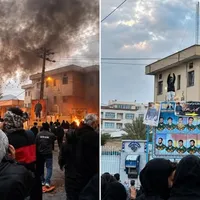
The debris of Metropol building in the southwestern city of Abadan
Iranians across social media are sharing images of past tragedies tied to state mismanagement, repression and neglect, building a crowdsourced archive under a hashtag in recent days to argue the country’s suffering long predates the current war.
A growing trend across Persian-language social media has turned timelines into a collective archive of national trauma, with users posting photos and videos of disasters they link to the Islamic Republic’s governance over the past four decades.
The campaign, organized loosely around the hashtag #ThisIsNotAWarPhoto, responds to comments circulating online that the current conflict is destroying Iran and harming ordinary people. Participants counter that the country has already endured decades of devastation under its own rulers.
Posts often show photographs of earlier catastrophes, from building collapses and industrial explosions to environmental destruction and violent crackdowns. Many users have assembled threads or collages showing multiple disasters together.
The result is an informal digital archive documenting events that participants say demonstrate how ordinary Iranians have long faced the consequences of corruption, poor oversight and repression.
Industrial disasters and safety failures
Among the most widely shared images are photos from the explosion at Shahid Rajaei port near Bandar Abbas. The blast killed 57 people and injured more than 1,000, according to Iranian state media.
International coverage later connected the incident to chemicals used in missile fuel production. The Associated Press cited maritime security firm Ambrey as saying the port had recently received ammonium perchlorate from China, a compound commonly used in solid rocket propellant.
Iranian authorities denied that military materials were stored at the commercial port and said the cause of the explosion remained under investigation.
Smoke rises following an explosion at the Shahid Rajaee port in Bandar Abbas, Iran, April 26, 2025.
Another image frequently circulating online shows the collapsed Metropol building in Abadan. The ten-story residential and commercial structure fell on May 23, 2022 while under construction, killing at least 41 people and injuring dozens.
The disaster triggered protests in Khuzestan province and elsewhere as residents blamed corruption, construction violations and inadequate oversight.
The chaotic scene two days after the Metropol collapse. May 25, 2022
Photos from the Zemestan-Yurt coal mine explosion in Golestan province in 2017 also appear widely in the campaign. The blast trapped miners deep underground in tunnels filled with methane and carbon monoxide, killing 43 workers and injuring more than 70.
Another post recalls the Plasco building collapse in Tehran in January 2017, when a fire engulfed the commercial tower before it collapsed. Around 20 firefighters were killed and dozens injured in the disaster.
Images of the Neyshabur train explosion in northeastern Iran also circulate online. In February 2004, runaway freight wagons carrying sulfur, gasoline, fertilizer and cotton derailed near the village of Khayyam before a massive explosion killed at least 295 people and injured more than 460.
The blast was so powerful that Iranian seismologists recorded it as a small earthquake.
Environmental destruction and water crises
Environmental decline features prominently in some posts. Users share images showing the dramatic shrinkage of Lake Urmia, once one of the Middle East’s largest salt lakes. Years of dam construction, water diversion and heavy agricultural use across the basin caused the lake to recede drastically, turning vast areas into salt flats.
The drying of the Hawizeh Marshes on the Iran-Iraq border also appears in many threads. Environmental experts say oil exploration and water diversion projects have reduced water flow into the wetlands, damaging ecosystems that supported communities for thousands of years.
Water shortages have also driven protests in cities such as Khorramshahr. Photos from demonstrations in 2018 show residents protesting over the lack of safe drinking water during extreme summer heat. Security forces responded with arrests and gunfire, according to activists and local reports.
Another widely shared disaster is the 2019 Shiraz flash flood, which struck during the Nowruz holiday travel period. Floodwaters swept through a road leading into the city, killing at least 19 people and injuring more than 200.
Critics later linked the severity of the disaster to blocked historic flood channels and poor drainage infrastructure.
Repression and political violence
Many posts also recall episodes of state violence. Images referencing the July 1999 student protests show the aftermath of a raid on dormitories at the University of Tehran. Security forces and vigilante groups stormed the dorms after demonstrations against the closure of the reformist newspaper Salam.
At least one student was killed and hundreds were injured. Several detainees disappeared during the crackdown whose fate remains unknown.
Photos from Zahedan’s Bloody Friday in September 2022 are also widely shared. Security forces opened fire on protesters, worshippers and bystanders near the Makki prayer site during demonstrations linked to the Woman, Life, Freedom movement.
Human rights groups documented at least 96 deaths in the single-day crackdown.
Some users also shared photos of victims from the Mahsa Amini protests, which erupted across Iran in September 2022 after the death of Mahsa (Jina) Amini while in the custody of the country’s morality police.
The demonstrations quickly spread to dozens of cities and university campuses, becoming one of the most widespread anti-government movements in the country in recent decades. Security forces – including the Islamic Revolutionary Guard Corps, the Basij militia and police – used live ammunition, shotguns, tear gas and mass arrests to suppress the protests.
Human rights organizations including Human Rights Activists in Iran (HRANA) documented more than 500 deaths during the crackdown, including dozens of children, while tens of thousands of people were arrested.
Images of victims from those protests circulate widely in the #ThisIsNotAWarPhoto campaign, where users present them as part of a broader record of violence carried out by the state against its own citizens.
Other posts refer to the nationwide anti-government protests in January 2026, which users say were met with one of the most severe crackdowns in the country’s recent history. According to figures circulated widely on social media and by activist groups, more than 36,500 people were killed during the suppression of demonstrations across Iran.
A post references the Rasht bazaar killings during the January protests. Witnesses described security forces surrounding protesters in the historic marketplace and opening fire before parts of the bazaar caught fire.
Participants in the campaign say the images serve as reminders that many of the country’s deadliest moments have come not from foreign wars, but from confrontations between the state and its own population.
Disasters tied to negligence
Several posts highlight tragedies tied to safety failures. Images of the Shinabad school fire in December 2012 show a classroom where a faulty oil-burning heater exploded in the village of Shinabad in West Azarbaijan province. Two girls died and more than two dozen students suffered severe burns, many of them permanent.
Another widely shared image refers to the 2020 explosion at Tehran’s At’har medical clinic, where a gas blast killed 19 people.
The Sanchi oil tanker disaster in January 2018 also appears frequently in the campaign. The Iranian-owned tanker collided with another vessel off China’s coast and burned for days before sinking, killing all 32 crew members.
Documents later obtained by media outlets suggested Iranian authorities overlooked evidence that some crew members may have survived the initial collision.
Aviation tragedy and public health crisis
One of the most widely circulated images shows the wreckage of Ukraine International Airlines Flight 752.
The passenger plane was shot down by the Islamic Revolutionary Guards Corps shortly after taking off from Tehran in January 2020, killing all 176 people aboard. Iranian officials initially blamed a technical failure before acknowledging that air defense units had fired the missiles.
Another set of posts references the ban by the slain Supreme Leader Ali Khamenei on importing the Pfizer COVID-19 vaccine during the pandemic. Critics argue that the decision slowed vaccination efforts at a time when official figures showed daily deaths reaching around 1,200.
Poverty and social hardship
Some images highlight living conditions rather than single disasters. Photos of homeless people sleeping inside empty graves in Shahriar near Tehran in 2016 became a symbol of poverty and inequality in the country.
Other posts show neighborhoods where residents live in conditions that users compare to war-damaged areas, reinforcing the campaign’s central message that destruction in Iran did not begin with the current conflict.
A collective memory of crisis
Participants say the images circulating online represent only a fraction of the tragedies they associate with over four decades of rule by the Islamic Republic.
By gathering them in a single digital space, users are constructing a visual timeline of events that many Iranians remember but rarely see documented together.
The posts argue that the country’s hardship did not begin with foreign strikes or military escalation.
For many participants in the campaign, the images serve as a reminder that long before the latest war, Iran had already endured decades of crises at home.
Kharg Island, a narrow coral outcrop in the northern Persian Gulf, has emerged as one of the most strategically important locations in the confrontation involving Iran, the United States and Israel, given its role in Iran’s oil exports and the security of the Strait of Hormuz.
Despite being only about five miles long, the island serves as the main hub for Iran’s crude oil exports and hosts military assets around the Strait of Hormuz.
Recent US strikes targeting military infrastructure on the island – while deliberately sparing its oil facilities – have underscored Kharg’s importance at the intersection of energy markets, maritime security and regional military strategy.
Kharg Island, a narrow coral outcrop in the northern Persian Gulf, has emerged as one of the most strategically important locations in the confrontation involving Iran, the United States and Israel.
Despite being only about five miles long, the island serves as the main hub for Iran’s crude oil exports and hosts military assets around the Strait of Hormuz.
Recent US strikes targeting military infrastructure on the island – while deliberately sparing its oil facilities – have underscored Kharg’s importance at the intersection of energy markets, maritime security and regional military strategy.
Iran’s oil lifeline
Kharg Island is the backbone of Iran’s crude oil export system. Energy analysts estimate that roughly 90% of the country’s crude exports pass through terminals on the island, making it one of the most critical pieces of economic infrastructure for the Islamic Republic.
Tanker tracking data shows that in 2025 the island handled about 96% of Iran’s crude exports, equivalent to roughly 1.54 million barrels per day out of a national total of about 1.6 million barrels per day.
The scale of Kharg’s infrastructure dwarfs other Iranian export facilities. The island’s loading terminals were originally designed to handle up to seven million barrels per day and can service eight or nine supertankers at once. More than 50 crude storage tanks on the island can hold over 34 million barrels.
Most of the crude shipped from Kharg arrives via pipelines from mainland oil fields in southern Iran rather than being produced on the island itself.
Other export facilities operate on a far smaller scale. Lavan Island can process roughly 200,000 barrels per day, with storage capacity of about 5.5 million barrels. Sirri Island provides around 4.5 million barrels of storage. The energy hub at Assaluyeh handles gas condensate rather than crude oil, meaning it does not function as a major oil export terminal.
Iran has also attempted to create alternative export routes outside the Persian Gulf. A terminal under development at Jask, on the Gulf of Oman, has a projected capacity of about one million barrels per day, but storage capacity there is only about two million barrels, far below the scale of Kharg.
For this reason, Kharg is widely considered to be the centerpiece of Iran’s crude export system. Much of the infrastructure and export data referenced here has also been highlighted in recent analysis by sanctions and financial analyst Miad Maleki on X.
A military hub in the Persian Gulf
Kharg Island is not only an economic asset but also an important military location.
Access to the island is tightly restricted and guarded by Iran’s Islamic Revolutionary Guards Corps (IRGC). The IRGC Navy maintains a presence there, including the 112th Zolfaghar Surface Combat Brigade, a unit operating fast-attack boats designed for asymmetric naval warfare in the Persian Gulf.
These vessels are typically equipped with anti-ship missiles, rockets and naval mines, allowing them to threaten commercial shipping or larger naval vessels operating nearby.
Military infrastructure around the island includes coastal missile launchers, radar systems, surveillance networks and drone facilities used to monitor activity across the northern Persian Gulf.
Iran’s regular navy, known as the Army Navy, also operates in the broader Bushehr–Kharg region, using helicopters and boats for maritime patrols and potential mine-laying operations.
Together, the IRGC Navy and the conventional navy maintain a presence that could pose risks to shipping lanes during periods of conflict.
The Strait of Hormuz factor
Kharg’s strategic importance is closely tied to the Strait of Hormuz, located southeast of the island.
The narrow maritime passage connects the Persian Gulf to the Gulf of Oman and the wider Indian Ocean. About 20% of the world’s oil supply passes through this chokepoint every day.
Tankers carrying crude from Saudi Arabia, Iraq, Kuwait, Qatar and the United Arab Emirates all transit the strait before reaching global markets.
Although Iran itself contributes only 3–4% of global oil supply, its geographic position along the Strait of Hormuz gives it the ability to threaten a far larger portion of global energy flows.
Iran’s naval doctrine emphasizes the use of asymmetric tactics, including naval mines, fast-attack boats and anti-ship missiles.
Iran is believed to possess between 2,000 and 6,000 naval mines. Even a limited number could disrupt maritime traffic in the narrow waterway. Military analysts note that clearing mines is a slow and complex process requiring specialized ships, drones and helicopters.
Why the US struck Kharg
The United States early Saturday targeted military assets on Kharg Island as part of a broader campaign aimed at protecting maritime traffic in the Strait of Hormuz.
US President Donald Trump said American forces struck military targets on the island while deliberately avoiding its oil infrastructure.
“Moments ago, at my direction, the United States Central Command executed one of the most powerful bombing raids in the history of the Middle East and totally obliterated every military target in Iran’s crown jewel, Kharg Island,” Trump wrote in a post on Truth Social.
Trump said the operation specifically avoided damaging oil facilities.
“Our weapons are the most powerful and sophisticated that the world has ever known but, for reasons of decency, I have chosen not to wipe out the oil infrastructure on the island,” he wrote.
The strikes targeted military equipment including missile boats, speedboats, launchers, drones and coastal batteries associated with Iranian forces stationed there.
The strategy appears aimed at removing threats to minesweeping operations rather than disrupting global oil supply.
Commercial tankers cannot be safely escorted through the Strait of Hormuz while facing missile, drone and mine threats from nearby Iranian bases. Neutralizing these capabilities allows specialized naval vessels and drones to begin clearing mines from shipping lanes.
Trump warned that the decision to spare Kharg’s oil facilities could change if Iran interferes with maritime traffic.
“Should Iran, or anyone else, do anything to interfere with the free and safe passage of ships through the Strait of Hormuz, I will immediately reconsider this decision,” he wrote.
Oil exports continue despite strikes
Despite the military strikes, oil operations on Kharg appear to have continued.
Shipping data indicates that tankers have continued loading crude from the island’s terminals. One very large crude carrier (VLCC) was reported to have completed a two-million-barrel loading shortly after the strikes.
Satellite imagery showing flames on the island does not necessarily indicate damage to oil facilities. Gas flaring, a routine process used in oil operations, occurs regularly on Kharg and can appear as fires in satellite images.
Kharg has also demonstrated resilience in past conflicts. During the Iran-Iraq War in the 1980s, Iraqi forces repeatedly bombed the island and destroyed several storage tanks. Despite the damage, Iran continued exporting more than 1.5 million barrels of oil per day.
More than six decades after exports began there in 1960, Kharg Island remains both Iran’s primary energy gateway and a key strategic point in the security architecture of the Persian Gulf.
As long as a large share of the world’s oil continues to pass through the Strait of Hormuz, the small island will remain one of the most consequential pieces of infrastructure in the region.
A man walks by a large banner depicting Iran's three Supreme Leaders with an Arabic verse, "victory's is God's and conquest is imminent", in Tehran, Iran, March 10, 2026
As Mojtaba Khamenei’s first public message was delivered Thursday following days of absence, Iranian newspapers and semi-independent websites moved to reinforce his image as a wartime leader.
The statement, read aloud by a state television anchor over a still photograph of the new leader, called for continued military resistance and said the Strait of Hormuz should remain a tool of pressure.
“The demand of the masses of the people is the continuation of effective and regret-inducing defense,” the message said. Khamenei has remained largely absent from public view amid persistent questions about his health and whereabouts and unconfirmed reports he was hospitalized with injuries.
In their Wednesday, March 11 editions, newspapers and websites had already begun shifting their focus from the mechanics of succession to projecting authority during an active conflict. The pivot came despite the information blackout inside Iran and Mojtaba’s continued silence at the time.
In the first two days after Ali Khamenei’s death on February 28, coverage largely emphasized Mojtaba’s religious credentials and lineage. By midweek, however, newspapers and websites had turned toward portraying him primarily as a wartime commander.
Continuity and defiance
Kayhan, closely linked to the former leader’s office, referred to him as “the general of the revolution,” highlighting his long-standing but largely hidden ties to the IRGC.
Conservative outlets and several mainstream websites dropped the respectful title ‘Agha’ (sir/master) traditionally used for the son of an ayatollah. Some instead adopted ‘Imam’ or ‘Ayatollah’, reflecting his rapid elevation to the highest clerical and political rank.
Front pages were dominated by pledges of allegiance from military commanders, clerics, bureaucrats and cultural figures.
The Tehran Times reinforced the continuity narrative with its headline, “Trump is gone, Khamenei remains,” responding to Donald Trump’s earlier remark that the new leader “would not last long.”
Moderate and reformist outlets such as Etemad offered cautious backing, framing the hereditary succession as a stabilizing step that prevented a dangerous power vacuum during wartime.
Mentions of dissent or possible unrest were absent, with coverage unfolding inside a tightly controlled information environment.
Manufactured unity
Hardline outlets such as Kayhan and Tasnim framed the succession as a strategic defeat for the United States and Israel, arguing that Ali Khamenei’s killing was meant to trigger systemic collapse and that Mojtaba’s swift appointment demonstrated the system’s resilience.
Some columnists also sought to recast Mojtaba as a capable executive, describing him as a “silent reformer” suited to confront corruption inside the state.
Official websites and IRGC-affiliated Telegram channels amplified the message with pledges of loyalty from generals, clerics and even former political rivals such as Ali Larijani.
Wartime iconography—including posters merging the faces of Khomeini, Ali Khamenei and Mojtaba—reinforced a narrative of continuity and unity.
State media repeatedly warned that public skepticism at this stage could amount to collaboration with the “Zionist enemy,” underscoring the narrow space for dissent as the new leadership consolidates power.
The Chehel Sotun (40 Columns), a 17th century pavilion and garden in Iran's historic city of Isfahan, was damaged in US-Israeli strikes, March 9, 2026
Airstrikes in Iran have damaged several historic landmarks, including UNESCO-listed sites, raising concern among cultural experts and officials about the protection of heritage during the conflict.
UNESCO’s World Heritage Centre has confirmed damage to several sites on its global heritage list, though the full extent remains unclear, its director Lazare Eloundou Assomo said.
Several of the affected buildings carried the Blue Shield emblem, an international symbol used to identify protected cultural heritage sites under international law and often described as the “Red Cross for cultural heritage.”
Iran’s Foreign Minister Abbas Araghchi later criticized UNESCO’s response. “It's natural that a regime that won't last a century hates nations with ancient pasts. But where's UNESCO? Its silence is unacceptable,” he wrote on X.
Among the sites affected is the historic Golestan Palace, a Qajar-era complex in central Tehran added to the UNESCO list in 2013.
According to Afarin Emami, director of the Golestan Palace World Heritage complex, blast waves from airstrikes on March 1 shattered windows and damaged delicate mirrorwork in several halls.
Debris spread around in a hall at Tehran's historic Golestan Palace, after a US-Israeli strike, March 1, 2026
Images published by Iranian media show damaged crystal chandeliers and wooden doors and windows torn from their frames.
Emami said museum objects inside the palace were not harmed because they had been moved to secure storage after earlier tensions raised concerns about possible escalation.
The nearby Grand Bazaar of Tehran, a vast network of corridors forming a key part of the capital’s historic fabric, also sustained damage. Other buildings affected in Tehran include the former Senate Palace and the historic former Police Headquarters.
Several days later, further blast waves reportedly caused damage in Isfahan, one of Iran’s most important historic cities.
Images circulating online show shattered windows, cracked walls and fallen mirrorwork at multiple sites, including the Safavid-era Chehel Sotoun Palace and the Ali Qapu Palace in the Naqsh-e Jahan area.
The primary target appeared to be the provincial governor’s office building in the nearby Rashk-e Jahan complex, which was reportedly directly bombed. Ashraf Hall, a Safavid structure known for its gold-decorated ceilings, sustained significant damage, with photographs showing fallen tiles scattered among office furniture.
Governor's office (Rashk-e Janan Palace) in Isfahan after bombing
Elsewhere, Iranian media reported damage in Sanandaj, where several historic mansions lost sections of plaster decoration, mirrorwork and wooden doors. In northern Iran, reports suggest the Safavid-era Safi Abad Palace in Behshahr may have been affected by nearby strikes targeting a military radar facility, though no confirmed photographs have been released.
Near the historic Falak-ol-Aflak Castle in western Iran, the provincial cultural heritage office located within the castle’s protected zone was destroyed and five staff members and heritage protection personnel were reportedly injured. The fortress itself was not damaged.
The incidents have triggered heated debate among Iranian social media users, with some criticizing the government’s own handling of cultural heritage protection.
One user wrote on X: “At least write that the Islamic Republic should not build military bases next to heritage sites when you write that a historic monument was damaged by Israeli or US attacks.”
Others argued the destruction must be viewed in the broader context of the conflict. “We can rebuild buildings,” one commenter wrote. “Save your tears for the 40,000 people who were killed.”
Some groups, including the Jurists’ Council for a Democratic Iran, have called on all sides to respect international conventions protecting cultural heritage during armed conflict.