• Iran Insight
  • Politics
  • Economy
  • Analysis
  • Special Report
  • Opinion
  • Podcast
All rights reserved for Volant Media UK Limited
volant media logo
  • العربية
  • فارسی
Brand
  • Iran Insight
  • Politics
  • Economy
  • Analysis
  • Special Report
  • Opinion
  • Podcast
  • Iran Insight
  • Politics
  • Economy
  • Analysis
  • Special Report
  • Opinion
  • Podcast
  • Theme
  • Language
    • العربية
    • فارسی

Trump says US bombing raid destroyed military targets on Kharg Island

Mar 13, 2026, 22:59 GMT
US President Donald Trump waves as he boards Air Force One for travel to Florida, at Joint Base Andrews, Maryland, US, March 13, 2026

President Donald Trump said on Friday US Central Command carried out a major bombing raid on Iran’s Kharg Island, adding American forces destroyed all military targets on the island while deliberately avoiding oil infrastructure.

"Moments ago, at my direction, the United States Central Command executed one of the most powerful bombing raids in the History of the Middle East, and totally obliterated every MILITARY target in Iran’s crown jewel, Kharg Island. Our Weapons are the most powerful and sophisticated that the World has ever known but, for reasons of decency, I have chosen NOT to wipe out the Oil Infrastructure on the Island. However, should Iran, or anyone else, do anything to interfere with the Free and Safe Passage of Ships through the Strait of Hormuz, I will immediately reconsider this decision," Trump posted on Truth Social.

"During my First Term, and currently, I rebuilt our Military into the Most Lethal, Powerful, and Effective Force, by far, anywhere in the World. Iran has NO ability to defend anything that we want to attack — There is nothing they can do about it! Iran will NEVER have a nuclear weapon, nor will it have the ability to threaten the United States of America, the Middle East or, for that matter, the World! Iran’s Military, and all others involved with this Terrorist Regime, would be wise to lay down their arms, and save what’s left of their country, which isn’t much!' he added.

Most Viewed

Iran keeps oil flowing to China as Hormuz pressure forces reserve release
1
INSIGHT

Iran keeps oil flowing to China as Hormuz pressure forces reserve release

2
EXCLUSIVE

Desertions, shortages and army-IRGC rift strain Iran’s military

3
INSIGHT

Checkpoint attacks open new front in Iran war

4

Iran’s unseen new leader issues first message in writing

5

Trump says regime change in Iran will happen but not ‘immediately’

Banner
Banner

Spotlight

  • Iran raises ‘human shield’ fears by rallying supporters to the streets
    ANALYSIS

    Iran raises ‘human shield’ fears by rallying supporters to the streets

  • Russia gains from Iran war but risks more if it drags on
    OPINION

    Russia gains from Iran war but risks more if it drags on

  • Allies rally, rivals brace after Mojtaba Khamenei’s rise
    INSIGHT

    Allies rally, rivals brace after Mojtaba Khamenei’s rise

  • Checkpoint attacks open new front in Iran war
    INSIGHT

    Checkpoint attacks open new front in Iran war

  • Power vs piety: Khamenei Jr inherits legitimacy dilemma of Iran's theocracy
    ANALYSIS

    Power vs piety: Khamenei Jr inherits legitimacy dilemma of Iran's theocracy

  • Can widening the war save Iran’s rulers?
    ANALYSIS

    Can widening the war save Iran’s rulers?

•
•
•

More Stories

The unseen leader: What Khamenei Jr’s absence reveals about IRGC’s role

Mar 13, 2026, 21:40 GMT
•
Negar Mojtahedi

The mystery surrounding Iran’s new supreme leader may reveal more about the Islamic Republic’s power structure and the role of the Revolutionary Guards than Mojtaba Khamenei himself, analysts said on the Eye for Iran podcast, as Khamenei Jr remains unseen.

When Mojtaba Khamenei was officially announced as Iran's new supreme leader on March 8, the moment that followed was unusual.

There was no televised address to the nation. No appearance before officials or supporters. Instead, a message attributed to Mojtaba Khamenei was read aloud.

Five days after being declared Iran’s new supreme leader, Khamenei still has not appeared publicly or delivered a video message — an absence that has fueled speculation about his condition and about who is actually exercising power inside the Islamic Republic.

But for some analysts, the mystery surrounding Mojtaba Khamenei is less important than what it reveals about how the Iranian system actually functions.

“I suppose we can say Mojtaba Khamenei has become something like Schrödinger’s cat,” historian Dr. Shahram Kholdi said during a panel discussion on Eye for Iran, suggesting the new leader appears simultaneously present and absent.

The lack of any public appearance has triggered a range of theories — that he may be injured, that he is being kept hidden for security reasons, or that others are effectively running the system in his name.

Yet regardless of which theory proves correct, analysts say the moment highlights a deeper shift: power inside Iran increasingly appears to rest with the security apparatus.

“This is a textbook case of the tail wagging the dog,” Kholdi said. “The IRGC used to be the tail. Now it’s the one wagging the dog.”

For decades the Islamic Republic has functioned through overlapping networks of clerical authority, political institutions and security forces. But Iranian political analyst Shayan Samii says the balance within that system has steadily shifted toward the Revolutionary Guards.

“In reality, the IRGC is running the show,” Samii said. “These figures who appear in front of the cameras are often the face presented to the public, but the real decisions are made within the security apparatus.”

Samii argues that Mojtaba Khamenei himself has long been closely tied to that structure, acting as a conduit between the office of the supreme leader and the Revolutionary Guards. His sudden elevation to Iran’s highest position — combined with his continued absence from public view — has only made that power dynamic more visible.

“If you are elevated to the highest position in the land, normally you would appear on television,” Samii said. “You would address the nation. The fact that we have not seen that raises serious questions.”

At the same time, developments on the ground may be testing the very institutions that sustain the regime.

Phase Two of the war

Israeli strikes have targeted security checkpoints in Tehran linked to the Basij militia — the paramilitary force responsible for suppressing protests and maintaining internal control.

For former US national security official John Hannah, that shift could prove significant.

“The question is whether this begins to catalyze fractures within the security services,” Hannah said in an interview on Eye for Iran. “Will Basij members begin not showing up to their posts? Will the regime manage to maintain cohesion?”

For authoritarian systems, he noted, the loyalty of the security forces is often decisive.

“One of the crucial elements in bringing down a regime like this is fractures among the people who hold the guns,” Hannah said.

Still, Hannah cautioned that predicting the outcome remains difficult. Authoritarian regimes can appear stable for years before suddenly unraveling.

“It happens slowly, slowly — and then suddenly,” he said.

Israeli analyst Avi Melamed argues that what is unfolding inside Iran may ultimately represent a broader restructuring of power rather than an immediate collapse.

“What we are seeing,” he said, “is a reconfiguration of power.”

That reconfiguration, analysts say, could reshape not only Iran’s internal politics but the strategic balance across the Middle East.

For now, however, the central mystery remains unresolved.

Iran’s new supreme leader has yet to appear publicly.

And as pressure mounts on the regime’s security apparatus, the question facing Iran may be less about where Mojtaba Khamenei is — and more about who truly governs behind him.

You can watch Eye for Iran on YouTube or listen on any podcast platform of your choosing.

US deploys 5,000 Marines, sailors to Mideast to expand options in Iran war

Mar 13, 2026, 20:45 GMT

About 2,500 additional US Marines and 2,500 sailors are deploying to the Middle East as the war in Iran continues, NBC reported citing three US officials, in a move aimed at expanding military options for commanders in the region.

“Part of the plan for this war was to have marines available to provide options for use,” a US official was quoted as saying.

The personnel form an Amphibious Ready Group and Marine Expeditionary Unit, known as an ARG/MEU, the report said.

The Marines belong to the 31st Marine Expeditionary Unit, based in Japan and the Marine Corps’ only permanently forward-deployed MEU.

These units are trained for rapid crisis response operations, including evacuating civilians from dangerous areas and protecting US embassies. They are also designed to be among the first forces on the ground, capable of securing areas and preparing them for follow-on missions by other military units such as special operations forces.

The sailors are assigned to the Tripoli Amphibious Ready Group, which includes the USS San Diego, USS Tripoli and USS New Orleans. The ships had recently been operating in the Philippine Sea but are now moving west toward the Middle East.

According to one US official, the deployment was requested by US Central Command to ensure Marines are available as commanders weigh potential next steps in the conflict.

US knows Mojtaba Khamenei hurt in airstrikes, Vance says

Mar 13, 2026, 20:42 GMT

The United States knows that Iran's new supreme Leader Mojtaba Khamenei was hurt in the airstrikes, Vice-President JD Vance said on Friday.

"We don't know exactly how bad, but we know that he's hurt."

Iran raises ‘human shield’ fears by rallying supporters to the streets

Mar 13, 2026, 20:29 GMT

Iranian officials are urging citizens to fill the streets as Israeli strikes hit security sites, while opposition figures warn the calls aim to create civilian “human shields” around security forces under attack.

Critics argue that such calls expose civilians to danger. The diaspora-based Dadban volunteer lawyers group warned against encouraging civilians to gather near security installations.

“Encouraging civilians to gather near security centers or checkpoints that may become targets effectively turns them into human shields,” the group wrote in a statement. “Such actions knowingly expose civilians to danger and place direct responsibility on those issuing the calls.”

Continue reading

Iran raises ‘human shield’ fears by rallying supporters to the streets

Mar 13, 2026, 20:23 GMT
•
Maryam Sinaiee

Iranian officials are urging citizens to fill the streets as Israeli strikes hit security sites, while opposition figures warn the calls aim to create civilian “human shields” around security forces under attack.

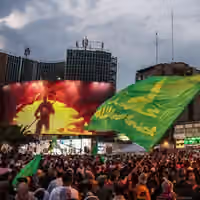
On Friday, several Iranian officials including the judiciary chief, the top security official, the foreign minister and many others demonstrated alongside Islamic Republic supporters in anti-Israel Quds Day rallies.

In one video from the rallies, Judiciary Chief Gholamhossein Mohseni Ejei was seen surrounded by a large number of bodyguards and participants forming what critics call a human shield as an airstrike hit an area nearby.

In an apparent move to avoid airstrikes, Ejei decided not to sit on the officials’ podium during Friday prayers, instead sitting among ordinary worshippers.

Before the Quds Day rallies, Iranian authorities had urged supporters of the Islamic Republic to pour into the streets despite the threat of airstrikes.

“This smallest soldier of yours has three requests from you: street, street, street,” parliament speaker Mohammad-Bagher Ghalibaf posted on X on Wednesday. “Your children in the armed forces have put their lives in their hands to defend Iran. Strengthen them by keeping the streets.”

A video circulating on social media also shows pro-government religious singer Meysam Motiee, speaking after several checkpoints were targeted in Tehran the same night, urging civilians to help protect security forces. “The US and Zionists have serious plans to take back the streets from the faithful forces.”

However, critics argue that such calls expose civilians to danger. The diaspora-based Dadban volunteer lawyers group warned against encouraging civilians to gather near security installations.

“Encouraging civilians to gather near security centers or checkpoints that may become targets effectively turns them into human shields,” the group wrote in a statement. “Such actions knowingly expose civilians to danger and place direct responsibility on those issuing the calls.”

Online users say that after some of these strikes, checkpoint personnel have moved their positions to busier streets. Some posts allege that instead of conducting vehicle searches as thoroughly as before, members of the Basij militia now stop cars primarily to create congestion around these checkpoints.

People urged to stay home

In contrast to these calls for street presence, opposition figures and foreign leaders have urged Iranians to stay indoors for the time being.

Iran's exiled prince Reza Pahlavi, who has said he is prepared to lead a transitional period after the Islamic Republic, warned that the coming days would be decisive and that people need to stay home.

In a video message on Thursday, he urged citizens not to approach “government, military and law-enforcement centers, or housing complexes affiliated with the repression apparatus.”

“The Islamic Republic is using schools, mosques, and other public locations to hide its forces and create human shields,” he said.

Addressing state employees directly, Pahlavi urged them not to risk their lives for the survival of the government. Instead, he called on them to “use your access and capabilities to disrupt repression and help the people.”

Similar appeals have come from abroad. Israeli Prime Minister Benjamin Netanyahu addressed Iranians in a Persian-language message published by an official Israeli account.

“We are delivering heavy blows to the Revolutionary Guards and Basij forces, both in the streets and at checkpoints,” he said, promising that the attacks would continue.

“I say to the people of Iran: the moment you can begin a new path of freedom is getting closer every day. We stand with you, we help you, but ultimately everything depends on you.”

Police commander Ahmad-Reza Radan had warned in a televised interview earlier this week that anyone taking to the streets would be treated as an “enemy” and said security forces had their “fingers on the trigger” and were ready to shoot.

In a mass text message reportedly sent to mobile phones across the country on Thursday, the intelligence arm of the Revolutionary Guards (IRGC) also threatened harsh consequences for street protests.

The message warned that if those it described as “domestic traitors” or “neo-ISIS elements” attempted demonstrations, they would face a response “stronger than January 7.”

The IRGC's statement effectively acknowledged the Islamic Republic's role in the massacre of at least 36,500 protesters during the brutal crackdown in January.

"The IRGC intelligence organization forgot that before the war, they used to deny the killing of people and say it was the work of terrorists. Today, they threatened people that if they come out to the streets, we'll give you a harsher response than on January 7," one user posted on X.

A statement attributed to the new supreme leader Mojtaba Khamenei on Thursday signaled no change in the government’s approach. Many Iranians on social media widely interpreted the message as confirmation that the policy of suppressing dissent would continue.

The confrontation has spilled onto social media as well, where supporters of the establishment and critics exchange threats and mockery.

One pro-establishment user wrote on X: “This time we are waiting even more than the Prince and Netanyahu for you to come to the streets… If you really want an uprising, don’t delay. Come to the streets.”

Some critics responded to the visible participation of pro-establishment citizens in rallies, including the annual Quds Day rally, with historical comparisons. “Hitler, Mussolini, Saddam, and Gaddafi could bring crowds many times larger than this to the streets,” one user wrote. “We all know how that ended.”

Others used sarcasm to encourage militia members to remain at checkpoints despite the risk of Israeli drone strikes.

“We wish you well,” one user wrote mockingly. “Please do not leave your posts under any circumstances. Your strong presence at checkpoints lets millions of Iranians smile with relief. They can watch and wave to you from afar.”