• Iran Insight
  • Politics
  • Economy
  • Analysis
  • Special Report
  • Opinion
  • Podcast
All rights reserved for Volant Media UK Limited
volant media logo
  • العربية
  • فارسی
Brand
  • Iran Insight
  • Politics
  • Economy
  • Analysis
  • Special Report
  • Opinion
  • Podcast
  • Iran Insight
  • Politics
  • Economy
  • Analysis
  • Special Report
  • Opinion
  • Podcast
  • Theme
  • Language
    • العربية
    • فارسی

Iran says it will target US, Israeli economic centers and banks in region

Mar 11, 2026, 08:20 GMT

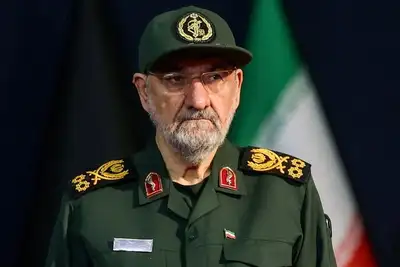
The spokesman for Iran’s Khatam al-Anbiya Central Headquarters said Iran would target economic centers and banks belonging to the United States and Israel in the region, state media reported.

Spokesman Ebrahim Zolfaghari said the warning came after what he said was a US and Israeli strike on one of Iran’s banks overnight.

He said the move opened the way for Iran to target economic centers and banks linked to the United States and Israel across the region.

“Americans should wait for our painful response,” Zolfaghari said.

He also warned people in the region not to remain within one kilometer of banks.

Most Viewed

A leader no one has seen: The unusual debut of Mojtaba Khamenei
1
ANALYSIS

A leader no one has seen: The unusual debut of Mojtaba Khamenei

2

Australia grants asylum to five players of Iran women’s football team

3
INSIGHT

Satire spreads online as Iranians await new leader unveiling

4
INSIGHT

The mood inside Iran as Khamenei's son takes power

5
ANALYSIS

Why some Iranians celebrate bombs: trauma experts explain

Banner
Banner
•
•
•

Spotlight

  • Can widening the war save Iran’s rulers?
    ANALYSIS

    Can widening the war save Iran’s rulers?

  • Hormuz disruption tests limits of global energy markets
    ANALYSIS

    Hormuz disruption tests limits of global energy markets

  • Inside the dramatic escape of Iranian women footballers seeking asylum
    INSIGHT

    Inside the dramatic escape of Iranian women footballers seeking asylum

  • A leader no one has seen: The unusual debut of Mojtaba Khamenei
    ANALYSIS

    A leader no one has seen: The unusual debut of Mojtaba Khamenei

  • Satire spreads online as Iranians await new leader unveiling
    INSIGHT

    Satire spreads online as Iranians await new leader unveiling

  • Inside Iran’s wartime information blackout
    INSIGHT

    Inside Iran’s wartime information blackout

More Stories

Can widening the war save Iran’s rulers?

Mar 11, 2026, 07:33 GMT
•
Reza Haji Hosseini

Tehran’s decision to widen the war is an attempt to project strength but may better be understood as a survival strategy—one rooted in deliberate escalation and shaped by a logic akin to mutually assured destruction.

Following US and Israeli attacks on the killing of Supreme Leader Ali Khamenei, Iran’s leadership followed through with a long-standing threat: expanding the conflict beyond its borders and drawing neighboring states into the confrontation.

One notable example came on February 1, roughly a month before Khamenei was killed in a joint US–Israeli missile strike on February 28, when he said that if the United States attacked Iran militarily, the conflict would become “regional.”

Today, the armed forces of the Islamic Republic—led by the Islamic Revolutionary Guard Corps—appear to be implementing that doctrine by expanding hostilities beyond Iran’s borders.

The logic is to link the fate of the Islamic Republic to the stability of the wider region: as the state faces mounting internal and external pressures, it seeks to entangle neighboring countries in the crisis, raising the costs of continued confrontation.

This approach resembles elements of Nixon’s “madman theory” and Israel’s “Samson option,” reflecting a strategic logic akin to mutually assured destruction. Whether such a strategy can deter adversaries—or instead isolate Tehran further—remains uncertain.

Several neighboring countries have now been drawn into the conflict. States along the Persian Gulf have been targeted, and missile and drone strikes have also been directed toward Azerbaijan and Turkey.

In some cases, countries that previously maintained relatively cooperative relations with Tehran, including Qatar, have found themselves on the receiving end of these attacks.

The responses of neighboring governments suggest that widening the conflict could ultimately produce stronger regional opposition rather than easing pressure on Tehran. From their perspective, the concern is precedent: if such attacks occur once, what guarantees exist that they will not happen again?

This concern increases the likelihood of coordinated responses designed to prevent further escalation.

The strategy also reflects long-running domestic pressures on the system. Over the course of its existence, the Islamic Republic occasionally managed to regain some degree of public support at critical moments—including the elections of Mohammad Khatami in 1997 and 2001, the high participation in the 2009 election, and the victories of Hassan Rouhani in 2013 and 2017.

But the broader trajectory has been one of declining engagement and growing disillusionment. By the time of the 2024 presidential election—officially won by Masoud Pezeshkian—turnout had fallen sharply, reflecting wider frustration shaped by years of repression and repeated cycles of protest.

Demonstrations in 1999, 2009, 2019 and 2022 were met with force, while the downing of the Ukrainian passenger plane and the large-scale crackdown in January 2026 further deepened mistrust between the state and society.

At the same time, nearly five decades of governance have left Iran confronting multiple structural crises, including environmental degradation, water scarcity, energy shortages, mounting economic pressure on households, systemic corruption and widening inequality.

Together, these pressures have steadily eroded confidence in the system and narrowed expectations for reform from within.

Against this backdrop, widening the conflict may appear to the leadership less a choice than a calculation: that survival at home increasingly depends on raising the stakes abroad. Yet this logic carries obvious risks.

Attempts to regionalize the confrontation could deepen Iran’s isolation and accelerate pressures already bearing down on the system.

Taking into account both long-term domestic trends and the current military situation—including damage to Iran’s military capabilities and the widening of hostilities—the future of the Islamic Republic remains uncertain.

International politics rarely unfolds along a single predictable path, and multiple outcomes remain conceivable. Still, history suggests that political systems under sustained internal strain and external pressure often appear stable until they do not.

As Iran confronts war with the United States and Israel abroad while continuing to face mistrust and periodic unrest at home, the strategy of widening the conflict may prove less a path to survival than a reflection of the system’s mounting vulnerability.

Pahlavi tells Iranians to await final call, says time running out for security forces

Mar 11, 2026, 06:59 GMT

Exiled Prince Reza Pahlavi urged Iranians on Wednesday to stay in their homes and continue strike action, while waiting for his final call.

“We have now reached a very sensitive stage of the final struggle. I ask you to secure the necessary supplies as soon as possible and, for your safety, leave the streets and remain in your homes,” he said in an address to Iranians as US-Israeli airstrikes continue.

He also called for nightly rooftop chants to continue as a sign of unity.

Addressing Iran’s police and military forces, he said this was their last chance to separate themselves from the forces carrying out the crackdown and join the people.

Iran-linked Quds Day march banned in London

Mar 11, 2026, 06:26 GMT

Britain banned the annual Quds Day march planned for Sunday in London after authorities cited concerns of serious public disorder, with the event drawing criticism over support voiced by its organizers for Iran’s late Supreme Leader Ali Khamenei.

Home Secretary Shabana Mahmood approved the Metropolitan Police request for a ban, saying the scale of the planned march and multiple counter-protests, against the backdrop of the Middle East conflict, made the move necessary, British media reported.

The annual Quds Day event has long been controversial in Britain because of accusations of pro-Islamic Republic messaging and support for extremist groups.
The term Quds Day was first coined in Iran immediately after the 1979 Revolution.

It gained significance after Ruhollah Khomeini, the founder of Iran’s Islamic Republic, called on Muslims everywhere to mark the day by holding rallies against Israel.

Cargo vessel catches fire in Strait of Hormuz after projectile hit, UKMTO says

Mar 11, 2026, 06:00 GMT

A cargo vessel was hit by an unidentified projectile in the Strait of Hormuz, causing a fire on board and prompting the crew to evacuate, the United Kingdom Maritime Trade Operations agency said on Wednesday.

The vessel requested assistance after the strike, UKMTO said.

The agency said earlier in the day that it had received a report of an incident 25 nautical miles northwest of Ras Al Khaimah in the United Arab Emirates. The master of a container vessel said the ship had sustained damage from a suspected but unidentified projectile.

UKMTO said the extent of the damage was under investigation and that all crew members were safe.

IEA proposes record oil reserve release amid Iran war - WSJ

Mar 11, 2026, 05:34 GMT

The International Energy Agency has proposed the largest release of oil reserves in its history to curb surging crude prices amid the Iran war, the Wall Street Journal reported, citing officials familiar with the matter.

The proposed release would exceed the 182 million barrels that IEA member countries put on the market in two rounds in 2022 after Russia launched its full-scale invasion of Ukraine.

The IEA called an extraordinary meeting of member countries on Tuesday and they are expected to decide on the proposal the following day.