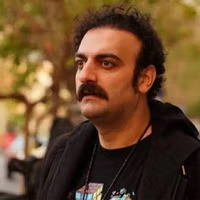
Saliwan Boxing, is owned by Salar Gholami, an Iranian-Canadian political activist and Canadian cruiserweight boxing champion. He vows to continue operations.
A boxing gym owned by an Iranian-Canadian political activist and vocal critic of the Islamic Republic was struck by gunfire early Sunday morning near Toronto, raising concerns within the community about possible intimidation targeting dissidents in Canada.
York Regional Police said officers responded shortly after 3 a.m. on March 1 to reports of gunfire at a commercial plaza north of Toronto, where investigators found damage consistent with multiple rounds fired at a business. The building was unoccupied at the time and no injuries were reported.
Surveillance footage shows a suspect dressed in dark clothing exiting a dark-colored sport utility vehicle before fleeing the scene, police said.
The targeted business, Saliwan Boxing, is owned by Salar Gholami, an Iranian-Canadian political activist and Canadian cruiserweight boxing champion who has organized demonstrations against the Islamic Republic across the Greater Toronto Area in recent months.
The shooting came hours after supporters gathered at the gym and elsewhere in Toronto following US and Israeli military strikes that killed Iran’s Supreme Leader, events that drew large crowds waving Iran’s Lion and Sun flag.
“Seventeen bullets in the middle of Toronto,” Gholami told Iran International. “This is not just about the Iranian community anymore. It’s about Canadians.”
Gholami said the gym is used by families, teenagers and children and could have been occupied when the shots were fired.
“Our gym is just a regular gym. Girls, teenagers, kids,” he said. “The shooting at the gym... is so dangerous.”
He said he believes the attack may have been intended as a warning linked to his activism, though police said no motive has been confirmed.
York Regional Police acknowledged concerns within the community that the incident could be connected to broader geopolitical tensions in the Middle East.
Investigators said they are working with policing and intelligence partners and reviewing all available evidence, including the possibility of politically motivated or transnational elements.
Canadian intelligence officials have previously warned that Iranian state actors and their proxies have targeted dissidents abroad, including individuals living in Canada. The Canadian Security Intelligence Service has said it has disrupted potentially lethal threats linked to foreign interference operations in past cases.
Former Canadian Justice minister Irwin Cotler, for example, was previously the subject of an alleged Iranian plot to kill him on Canadian soil.
Gholami said he has remained in contact with police following the shooting but expressed concern about security arrangements, saying he was told additional protection would need to be arranged privately.
“We came here for freedom,” he said. “Canada must protect its citizens. I’m Canadian too.”
Despite the attack, he said he intends to continue organizing demonstrations.
“I will not give up,” Gholami said. “They may be able to take my life, but they cannot take our honor.”
Iran International contacted Public Safety Canada to ask whether additional protections are being considered for Iranian-Canadian activists amid concerns about transnational repression. The department did not respond before publication.
Iran’s clerical body, the Assembly of Experts, has elected Mojtaba Khamenei, the son of the late Ali Khamenei, as the Islamic Republic’s new Supreme Leader, according to his informed sources who spoke to Iran International on condition of anonymity.
The decision marks one of the most consequential moments in the history of the Islamic Republic, effectively transferring power within the same family for the first time since the 1979 revolution.
But who exactly is Mojtaba Khamenei?
A powerful figure behind the scenes
Mojtaba Khamenei, 55, has long been considered one of the most influential figures inside Iran’s ruling system despite rarely appearing in public or holding formal political office.
For years he operated from within the Office of the Supreme Leader, serving as a gatekeeper and power broker around his father. His position has often been compared to the role played by Ahmad Khomeini, the son of Islamic Republic’s founder Ruhollah Khomeini, who served as a key aide and confidant during the early years of the revolutionary state.
Analysts say Mojtaba gradually built influence across the regime’s political, security and clerical institutions.
Dr. Eric Mandel, director of the Middle East Political and Information Network (MEPIN), told Iran International that Mojtaba has long been a central but opaque figure in Tehran’s power structure.
“Mojtaba Khamenei, the son of former Supreme Leader Ali Khamenei, has long operated behind the scenes in Tehran, building deep ties with the Islamic Revolutionary Guard Corps and consolidating influence within the regime’s power structure. He is widely viewed as one of the architects of the regime’s repression," Mandel said.
Author and Iran analyst Arash Azizi told Iran International Mojtaba is viewed with deep suspicion. "This is why he has been a bete noire of democratic movements at least since 2009 when he was rumored to have helped orchestrate the repression. He is also known to be a favorite of some sections of the establishment such as those close to Mohammad-Bagher Ghalibaf who has ambitions of becoming Iran’s strongman."
Ties to Iran’s security establishment
A key source of Mojtaba’s influence lies in his close connections to the Islamic Revolutionary Guard Corps (IRGC).
During the Iran-Iraq War in the 1980s, Mojtaba served in the Habib Battalion, a unit made up largely of volunteers connected to the Islamic Republic’s emerging revolutionary networks. The battalion operated under forces linked to the IRGC and took part in several major battles of the war.
Service in the Habib Battalion proved significant for Mojtaba. Many of the men who fought alongside him later rose to senior positions in Iran’s security and intelligence apparatus, including figures who would go on to lead parts of the IRGC’s intelligence organization and security commands responsible for protecting the regime.
Those wartime relationships are widely believed to have helped Mojtaba build lasting connections inside Iran’s powerful security establishment.
Over the years, opposition figures and political rivals have accused Mojtaba of playing a role in shaping election outcomes and coordinating crackdowns on dissent.
Questions over religious credentials
Iran’s constitution requires the Supreme Leader to possess deep knowledge of Islamic jurisprudence and be recognized as a senior religious authority.
Mojtaba, however, is not widely considered to be among the highest-ranking clerics in Iran. He studied in the seminaries of Qom under several prominent conservative scholars but does not hold the rank of ayatollah and is not a Mujtahid.
He also lacks any executive and administrative experiences which are required by the Constitution.
Despite that, Iran’s political system has historically shown flexibility when elite consensus forms around a candidate.
A controversial succession
Mojtaba’s elevation is likely to intensify criticism that the Islamic Republic founded as a revolutionary Islamic system is evolving toward dynastic rule.
For years speculation about his succession drew comparisons to hereditary monarchies.
For a man who has spent decades operating largely in the shadows of Iran’s power structure, Mojtaba Khamenei now finds himself at the center of one of the most consequential periods in the country’s modern history.
A Supreme Leader has been killed. A son has been chosen. And the Revolutionary Guards are driving the process.
Ayatollah Ali Khamenei was killed on Saturday morning in US and Israeli air strikes. On Tuesday, according to exclusive information obtained by Iran International, Iran’s Assembly of Experts, under pressure from the Islamic Revolutionary Guard Corps (IRGC), chose his son, Mojtaba Khamenei, as the next Supreme Leader. The decision has not been made public and is expected to be announced after Ali Khamenei is buried.
This is not a routine succession. It is a wartime decision shaped by the security state, and it raises serious questions about constitutional procedure. The priority appears to be speed and control, as the Islamic Republic faces attacks from outside and a leadership vacuum at the top.
Why the IRGC pushed Mojtaba
The IRGC needed two things at the same time: control and legitimacy.
Control means keeping the chain of command intact, preventing splits at the top, keeping the security forces coordinated, and stopping a scramble for power. In this crisis, the IRGC’s first priority is internal stability.
Legitimacy matters too, but not in a broad national sense. It means legitimacy inside the regime’s core base: hard-line politicians, the security institutions, and the loyal networks that still see the Islamic Republic as “their” state. In that narrow world, Mojtaba has something others do not. He can claim direct continuity with Khamenei, and the core base can accept him without feeling the system has broken.
That combination is why the IRGC chose him.
Mojtaba also has long-standing ties to the IRGC, going back decades, and deep relationships across its command networks. For years, he has been a key channel between his father and the Guard’s leadership. That gives him a rare position. He is close to the security core, but also linked to the civilian and clerical leadership that depends on it.
He has also effectively run the Supreme Leader’s office, the Beit, for at least the past two decades, and is widely seen as Ali Khamenei’s closest confidant. The Beit is not just a state within the state. It is the core of the state itself. In practice, Iran’s elected government and president are often a façade, with little real power. Real authority has long sat in the Beit, which controls key security, political and financial levers. That is why this apparatus is now protecting itself, and why it does not want an outsider coming in and taking control.
The Islamic Republic at a fork in the road
The Islamic Republic now faces two broad directions.
One is to keep fighting, stay defiant, absorb more damage, and try to outlast the attacks. That would likely mean tighter internal control, the dispersal of forces and assets, and heavier reliance on asymmetric pressure, including missiles, drones, proxies, and covert operations, while signalling that the state will not negotiate under fire.
The other is to step back and accept major concessions to stop the war and reduce pressure. That would mean giving up key pillars of Iran’s regional and military posture in return for a halt to attacks and some easing of pressure.
Mojtaba is well placed to pursue either path.
If the system chooses a bitter deal, it needs someone who can own it and stop the hardcore from turning on the leadership. If it chooses to fight on, it needs someone who can keep the IRGC united and keep the security state functioning under sustained attack. That is the political function of this succession.
The main question now is whether Israel and the US will target him immediately or give him time to make that choice. If they strike him straight away, it will be hard to avoid one conclusion: the campaign is no longer about pressure or deterrence. It is about regime change. If they hold back, the focus shifts to Mojtaba’s next move, and whether he chooses escalation or a climbdown.
Ghassem Soleimani (Left) with Mojtaba Khamenei - File photo
The problem of blood and revenge
Any agreement with Donald Trump was always difficult for Ali Khamenei. In Tehran’s narrative, Trump sought Iran’s “surrender” and had the blood of Qasem Soleimani on his hands. Khamenei repeatedly ruled out reconciliation and called for qisas, a concept in Islamic law meaning retribution, often understood as “life for life.”
For his successor, the burden is heavier. Trump now carries not only Soleimani’s blood, but also Ali Khamenei’s. That makes any compromise far harder to sell, and it also raises the domestic stakes for any decision to escalate.
Mojtaba has one advantage inside the system. He can present himself as the person entitled to decide what comes next. If the leadership chooses to fight on, he can frame it as continuity, duty, and retaliation. If it chooses to pause revenge and prioritise survival, he can frame it as a decision made by the heir and the family, not as a humiliation forced from the outside.
Ruhollah Khomeini, the founder and first Supreme Leader of the Islamic Republic, set the guiding rule in a line that has the force of a fatwa in Shia political doctrine: “Preserving the system is the highest duty.” In plain terms, it means the survival of the Islamic Republic comes before almost everything else. As vali-e dam, the next of kin with the right to demand retribution, Mojtaba can argue that he also has the right to set it aside if the state’s survival requires it. That is how he can ask the regime’s core base to accept restraint, and present it not as retreat, but as obedience to a higher obligation.
What stepping back would mean in practice
If Mojtaba chooses regime survival over confrontation, the price will be high. A serious de-escalation would likely mean accepting Trump’s demands, including:
Ending enrichment as a national project, not just pausing it
Accepting long-term, enforceable limits on missile range
Reducing or abandoning the proxy network, not just rebranding it
Ending the policy of confrontation with Israel
For Mojtaba, accepting these would not just be a policy shift. It would mean dismantling his father’s 37-year legacy in a single afternoon.
Without real and verifiable change in these areas, the US and Israel would have little reason to stop.
Even then, a deal would not solve the regime’s deeper problem at home. Legitimacy inside Iranian society is badly damaged, especially after the January massacre, and the state is widely seen as corrupt, incompetent, and violent. A ceasefire might stop the bombs, but it would not stop the political decay.
Mojtaba Khamenei - File photo
Where this leaves the Islamic Republic
If Mojtaba keeps the hard line while the world’s most powerful military is striking alongside the region’s most capable one, the window for a new leader to consolidate may be measured in days, not months.
If he chooses a climbdown, the war may stop, but the inheritance remains bleak. He would be taking ownership of painful concessions that undo much of his father’s legacy, while inheriting a state that is badly broken. The Islamic Republic is facing something close to a failed-state reality: an economy in severe distress, hollowed-out institutions, and public hostility so high that normal governance becomes hard to sustain. A halt in attacks would not restore capacity, trust, or authority.
Either way, Mojtaba Khamenei begins in the ruins of his father’s world. The Islamic Republic’s options are all expensive, its survival is no longer guaranteed, and for the first time in forty years, time is the one thing Tehran cannot buy.
US President Donald Trump says American munitions stockpiles remain robust while Iran is running out of key weapons and missile launchers amid continued US-Israeli airstrikes and Tehran's retaliatory attacks targeting regional countries.
“The United States Munitions Stockpiles have, at the medium and upper medium grade, never been higher or better,” Trump wrote on Truth Social.
The US, he wrote, has “a virtually unlimited supply of these weapons” and that “Wars can be fought ‘forever,’ and very successfully, using just these supplies.”
His remarks came after CNN and The Wall Street Journal reported concerns about the pace at which key US munitions are being consumed in the escalating war with Iran.
Meanwhile, Washington sustains both offensive strikes and defensive intercept operations across the region. US systems, including Patriot and THAAD batteries deployed in Israel and neighboring states, have been heavily engaged in countering Iranian ballistic missile and drone attacks.
CNN reported on Monday that US reserves of certain missile systems – including Tomahawk land-attack missiles and SM-3 interceptors – are under strain amid sustained operations.
The Wall Street Journal also wrote Sunday that as the US planned operations against Iran, the military’s top general raised concerns about munitions stockpiles, particularly air defense interceptors needed to counter Iranian ballistic missiles and drones targeting regional sites hosting US forces.
Trump, in a separate post on Tuesday, called The Wall Street Journal report a “disgrace” on Truth Social, saying the United States has “unlimited mid to upper tier Weaponry – Brutal ‘stuff.’”
Iran’s arsenal under pressure
Trump told Politico on Tuesday that Iran was running out of crucial armaments.
“They’re running out and they’re running out of areas to shoot them, because they’re being decimated,” Trump said. “They’re running out of launchers.”
The New York Times reported Sunday, citing Israeli military officials, that Israeli airstrikes carried out since June last year have destroyed roughly 200 Iranian ballistic missile launchers and disabled dozens more – amounting to about half of Iran’s operational launcher fleet.
Israeli strikes, according to the report, during both the current offensive and last summer’s 12-day campaign also hit Iran’s primary explosives production facility. That complex provides key components for missile warheads and supports weapons programs including rockets, drones and cruise missiles.
Before last year’s assault, Israeli intelligence had assessed that Iran possessed approximately 3,000 ballistic missiles and was seeking to dramatically expand output, potentially reaching 8,000 missiles by 2027.
A Defense Express analysis on Tuesday said that as of Monday, Iran had launched at least 771 ballistic missiles at neighboring countries and Israel since the start of the conflict.
The figure is not definitive, as totals vary by reporting country and strikes remain ongoing. Defense Express noted that different states have published their own counts while Iran continues firing missiles, and Tehran has not released an official tally of launches.
Despite damage inflicted during the earlier campaign, The New York Times reported that Iran has attempted to rebuild its missile manufacturing capacity, with recent estimates suggesting output of dozens of missiles per month. The newspaper added that Iran has also sought components from abroad to restore its surface-to-surface missile arsenal.
China is pressing Iran to avoid disrupting shipping through the Strait of Hormuz, particularly energy exports from Qatar, as conflict in the region threatens global supplies, Bloomberg reported.
According to senior executives at Chinese state-owned gas firms briefed by government officials, Beijing had urged Iranian counterparts not to target oil and liquefied natural gas tankers transiting the narrow waterway and to refrain from striking key export hubs such as Qatar.
China buys the vast majority of Iran’s oil, providing Tehran with a crucial economic lifeline. But the world’s largest energy importer depends more broadly on Persian Gulf supplies, with both crude and LNG cargoes passing through Hormuz.
Qatar accounts for roughly a fifth of global LNG supply and provides about 30% of China’s LNG imports, the executives said. The country is the world’s second-largest LNG producer after the United States.
Asian buyers take more than 80% of Qatar’s LNG shipments, according to data from analytics firm Kpler.
Reuters reported on Tuesday that India began rationing natural gas as countries across Asia moved to secure alternative supplies after conflict in the Middle East disrupted shipping and halted Qatari output.
Officials and executives in Japan, Taiwan, Bangladesh and Pakistan said they did not expect an immediate impact because some cargoes due this month had already arrived, but would diversify imports and buy spot LNG if the war drags on.
The Turkish government also plans to implement a fuel scheme to reduce the impact of rising global oil prices on inflation, according to Reuters on Tuesday.
Tanker traffic through the strait has largely stalled since US and Israeli strikes over the weekend and Iran’s subsequent missile attacks across the region.
According to US Central Command, the Strait of Hormuz is not closed despite statements by Iranian officials.
On Monday, Qatar halted production at Ras Laffan, the world’s largest LNG export facility, after an Iranian drone attack, marking the first full shutdown in nearly three decades of operations.
Chinese energy importers have been told Beijing is seeking to ensure vessels continue moving through Hormuz, the executives told Bloomberg.
Publicly, China has made limited comment. Foreign Minister Wang Yi told his Iranian counterpart Abbas Araghchi on Monday that while Beijing supports efforts to safeguard national security, Tehran should heed the “reasonable concerns” of its neighbors, according to a Chinese Foreign Ministry statement.
At a regular briefing, a ministry spokesperson said China was “deeply concerned” about the widening conflict.
Analysts say the immediate economic impact on China may be manageable, though higher oil prices could add to inflationary pressures.
The killing of Iran’s Supreme Leader Ali Khamenei has triggered celebrations among many Iranians, but analysts say the moment marks not an endpoint but the beginning of a new and highly consequential chapter for the Islamic Republic.
Despite the historic symbolism of his death, the system Khamenei built was designed to withstand precisely this kind of shock.
Power in Iran was never concentrated solely in one man, but embedded across military, political and security institutions capable of functioning even in the absence of a supreme leader.
“The Islamic Republic is not a one-bullet state,” Behnam Ben Taleblu told Iran International, arguing that one of Khamenei’s lasting achievements was institutionalizing authority across the regime.
Iran’s defense and repression capabilities remain dispersed across the country’s provinces, allowing missile launches, drone operations and internal security functions to continue despite leadership losses.
The Islamic Republic has continued firing missiles and drones despite the elimination of senior figures, showing the Islamic Revolutionary Guard Corps can sustain operations through a decentralized chain of command.
Decentralized power
Behind the scenes, however, the question of succession is fast becoming the Islamic Republic’s central uncertainty.
Jason Brodsky of United Against Nuclear Iran said power has become “diffuse,” now resting formally with a three-person interim leadership council while multiple political and clerical figures compete for influence.
“There used to be a centralized address for the final decision-making. Now there’s a wider array of people. So it’s flatter," said Brodsky.
Potential candidates, he said, include members of the interim leadership structure such as Alireza Arafi and Chief Justice Gholam Hossein Mohseni Ejei, as well as other clerical figures outside the council.
Brodsky pointed to Hassan Khomeini – grandson of the Islamic Republic’s founder – alongside conservative clerics including Mohammad Mahdi Mirbagheri, Mohsen Araki and Mohsen Qomi as individuals to watch.
At the same time, senior political figures such as Ali Larijani and Parliament Speaker Mohammad Bagher Ghalibaf remain influential actors shaping decision-making during the transition.
“With Khamenei and his family gone, that really leaves the succession race wide open,” Brodsky said.
Analysts say Tehran may delay formally appointing a new supreme leader during wartime, as any successor would immediately become a high-value military target.
On Tuesday, a member of Iran’s Assembly of Experts said choosing a new supreme leader would not take long, adding the body would make its decision based on religious criteria and its own judgment rather than individual preferences or political factions. Ali Moalemi added the body would select a person similar to Khamenei.
Attacking neighbors: Why?
Externally, Iran appears determined to widen the confrontation rather than retreat. Alex Vatanka of the Middle East Institute said Islamic Republic leaders are likely to regionalize the conflict in an effort to increase pressure on Washington and its partners.
“They will stay in this fight as long as they can,” Vatanka said, adding that Tehran is attempting to “put pressure on Trump” by expanding instability beyond its borders.
Events across the Persian Gulf suggest that escalation is already underway. Iranian officials have threatened to target shipping through the Strait of Hormuz, while an oil tanker was reportedly struck and forced to halt transit.
US-allied Persian Gulf states are bearing the brunt of retaliatory strikes.
In the United Arab Emirates, missiles and falling debris struck civilian areas in Dubai and Abu Dhabi, damaging luxury hotels, high-rise apartment towers and airport infrastructure – locations never designed to withstand ballistic missile or drone attacks.
Similar attacks and interceptions were reported in Bahrain and near Doha, as Iran targeted countries hosting US military forces, signaling a shift from purely military targets to economic and civilian centers across the Persian Gulf.
Attacks on regional energy infrastructure forced shutdowns at major Saudi and regional oil and gas facilities, sending global oil prices sharply higher.
US Central Command confirmed four American service members were killed following Iranian attacks in the region, while US forces struck Iranian naval and missile assets.
Speaking at the White House on Monday, US President Donald Trump signaled Washington is preparing for a longer campaign than initially anticipated.
“From the beginning, we projected four to five weeks, but we have capability to go far longer than that, we’ll do it,” Trump said, dismissing suggestions the United States might seek a quick exit.
“I don’t get bored.”
He framed the operation as a decisive effort to eliminate what he called “the intolerable threats posed by this sick and sinister regime,” insisting the United States would continue operations “whatever it takes.”
If Tehran had hoped escalation would shorten the war, early signals from Washington, Brodsky said, suggest the opposite may be unfolding.
Brodsky said much of Iran’s response is continuing through pre-planned wartime contingencies.
“A lot of the decision-making right now is essentially on autopilot,” he said, adding that the Revolutionary Guards’ decentralized structure allows operations to continue even amid leadership losses.
Even so, analysts say the balance of military power remains heavily tilted against Tehran, raising questions about how long the Islamic Republic can sustain simultaneous external confrontation and internal strain.
While scenes of celebration followed news of Khamenei’s death inside Iran, many Iranians recognize that removing one leader does not automatically dismantle a system built over more than four decades on repression.
"The bravery of the Iranian people and the sacrifice of the Iranian people. Too much blood has been spilled for historical opportunities to be missed. And I think no one knows that better than the Iranian people," said Taleblu.
“The question now is whether there is a plan for the day after,” said Vatanka.