As President Trump weighs options against Iran, he faces a legacy‑defining choice that could reshape the century, with the Islamic Republic at its most precarious moment since 1979 after years of US pressure and a determined popular uprising.
The emergence of Iran’s exiled Crown Prince Reza Pahlavi as the clear leader of the democratic opposition, should offer reassurance to President Trump, who is weary of protracted military entanglements. During the January uprising in Iran, Pahlavi’s name was the only one consistently chanted on Iran’s streets, even as the regime’s brutal crackdown claimed over 30,000 lives.
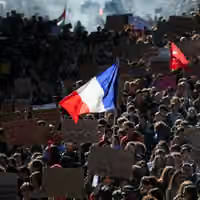
The Prince’s domestic support is matched by the massive backing of the Iranian diaspora, demonstrated last weekend in the “Global Day of Action,” with over a million people rallying in Munich, Toronto, Los Angeles, and other cities worldwide. That grassroots support is now translating into international recognition, underscored by Pahlavi’s momentous weekend in Munich.
This year’s Munich Security Conference (MSC) reflected a meaningful shift. In a departure from past gatherings, officials from the Islamic Republic—including Foreign Minister Abbas Araghchi—were disinvited. Instead, organizers invited Pahlavi, signaling that the international debate on Iran is shifting from regime normalization toward recognition of the Prince as a viable alternative.
At a press conference in Munich, the Crown Prince outlined a roadmap to democracy: drafting a new constitution, ratifying it via national referendum, and holding free elections under international oversight. On this global stage, he emerged as the architect of a credible, orderly transition—one the Trump administration and other governments could confidently support. Asked about his political ambitions, he called himself a bridge to free elections, not the final destination.
Pahlavi’s vision rests on four core pillars for a post-clerical Iran: the country’s territorial integrity; individual liberties and equality for all citizens; the separation of religion and state; and the Iranian people’s right to choose their version of a democratic form of government—whether a republic or a constitutional monarchy, like in the UK, Spain, or Sweden. These principles form the political foundation of his broader approach to national renewal.
That strategy also includes a detailed economic plan called the Iran Prosperity Project (IPP), which outlines the first 100 days following the regime’s collapse and the longer-term reconstruction of a free Iran. As Washington Post’s David Ignatius observed, IPP is a “superb transition blueprint” that is “smarter than anything the U.S. government or Iraqi exiles produced before the 2003 invasion.”
The plan is deliberate in its scope: “agency by agency, it details how to rebuild a cohesive Iran. It lists 34 military, intelligence and police organizations and describes the approach that should be taken to each—dissolving a few, retaining and vetting the others.”
IPP is supported by prominent business leaders. At the initiative’s rollout event, Uber’s Iranian-American CEO, Dara Khosrowshahi, indicated that Uber—and other major companies—would “invest aggressively” in Iran within the first 100 days, adding, “The sky is the limit.”
Economic vision aside, Pahlavi has also proposed six ways the international community can help Iranians to liberate themselves: degrade regime repressive capacity by targeting IRGC leadership; deliver maximum economic pressure by blocking assets and dismantling ghost tankers; break information blockades with Starlink; hold the regime accountable by expelling Iranian diplomats and pursuing legal action; demand immediate release of political prisoners; and prepare for democratic transition by recognizing a legitimate transitional government.
That recognition of the inevitable regime change in Iran has gained momentum over the last month and was unmistakable in Munich. German Chancellor Friedrich Merz declared, “A regime that can only hold onto power through sheer violence and terror: its days are numbered.” European Parliament President Roberta Metsola said, “The world is witnessing a wave of change in Iran. Now is the time to double down on support for liberty.” Canadian Foreign Minister Anita Anand was unequivocal: “We will not open diplomatic relationships with Iran unless there is regime change. Period.” U.S. Senator Lindsey Graham, waving the Lion and Sun flag at a Munich rally, proclaimed, “Liberation is at hand.”
International acknowledgement of Pahlavi’s leadership was further underscored by his meeting with Ukraine’s President Volodymyr Zelenskyy in a setting typically reserved for heads of state. Zelenskyy, whose country has been terrorized by Iranian Shahed drones, warned bluntly: “Regimes like the one in Iran must not be given time. When they have time, they only kill more.” Weeks earlier in Davos, he cautioned that rewarding brutality with survival sends a dangerous message: “Kill enough people and you stay in power.”
For his part, President Trump has said just days ago that regime change in Iran “would be the best thing that could happen.” During the height of what has become known as the Lion and Sun Revolution, he pledged support for protesters, posting that “help is on its way.” As his armada heads toward Iran, a rare moment in history is taking shape when a resolute leader of the free world can save lives, protect America from a regime that has sought “Death to America,” and cement his legacy as one of history’s greatest peacemakers.
At this Munich moment, all eyes are once again on Donald J. Trump. His decision, undoubtedly, hinges on the answer to “what happens next?” Reza Pahlavi’s emergence as a credible leader could tilt the scales toward regime change. History—and the Iranian people—await the President’s call.