Russia and Iran held joint naval drills in Gulf of Oman


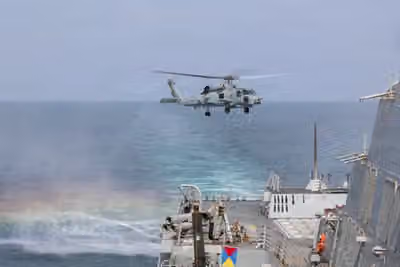
Russia and Iran conducted joint naval exercises on Thursday in the Gulf of Oman and the northern Indian Ocean, as tensions rise over Tehran’s nuclear program and the United States deploys warships near Iran.
Rear Admiral Hassan Maghsoodloo, spokesman for the drills, said the exercises aimed to promote security and sustainable maritime interaction.
The Kremlin said earlier on Thursday it was seeing an unprecedented rise in tension around Iran and urged Tehran and other parties to exercise prudence and restraint.
Russia and Iran have a strategic partnership treaty, but it does not include a mutual defense clause.

The European Union added Iran’s Islamic Revolutionary Guard Corps to its terrorist list on Thursday, after a political agreement by EU foreign ministers last month.
The decision means the IRGC will face asset freezes in EU member states and a ban on EU individuals and companies making funds or economic resources available to the group.
The move falls under the bloc’s counterterrorism sanctions regime. Following the decision, 13 individuals and 23 groups and entities are now subject to measures under the EU terrorist list.
The EU terrorist list is separate from the bloc’s regime that implements UN Security Council sanctions targeting Al-Qaida and ISIL.

Republican Senator Lindsey Graham told Sky News Arabia that the presence of US naval forces near Iran “is not here because it’s nice this time of year,” as military capability builds up and a decision on next steps approaches.
“All these ships are not coming here because it’s nice this time of year,” Graham said, adding: “We need military action, probably,” and that planning was under way for possible joint US-Israel efforts to weaken the Iranian leadership’s ability to harm its people.
He said “the military capability is being built up as I speak. The inflection point is weeks away, not months away,” and warned that the next 30 days could be decisive.
Graham quoted President Donald Trump telling Iranians “keep protesting, help is on the way,” and said “the best way to make Iran great again is for the people to take over from the Ayatollahs.”
The head of the International Atomic Energy Agency told LCI television on Wednesday there is urgency to reach an agreement on Iran’s nuclear program to avoid new military action, after talks this week between the United States and Iran in Geneva.
Rafael Grossi said most of the nuclear material Iran had stockpiled before bombings in June 2025 remains in place, despite damage to some facilities.
He said he saw a willingness on both sides to move toward a deal, though disagreements remain and time is short.

Polish Prime Minister Donald Tusk urged Polish citizens in Iran to leave immediately on Thursday, warning there could soon be no way to evacuate them as the security situation deteriorates amid rising US-Iran tensions.
“In a few hours there may be no more possibility to evacuate Poles from Iran,” Tusk said, calling on “all Poles in Iran” to depart without delay.
Poland has previously mounted evacuations from the region during spikes in Middle East tensions, including flights that brought home Polish citizens who exited Iran via neighboring countries, according to Polish state media and the foreign ministry.
scalating tensions between the United States and Iran sent oil prices sharply higher and kept gold near record levels on Thursday, as investors weighed the risk of a prolonged conflict in the Middle East and its impact on global markets.
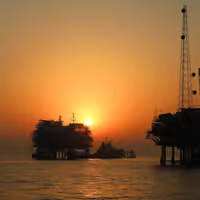
Brent crude rose to around $70.50 a barrel after surging more than 4% in the previous session, while US crude climbed above $65, as traders priced in the possibility of supply disruptions from the oil-producing region.
“The balance of risks now tilts to a US strike after market close Friday,” said Michael Every, senior global strategist at Rabobank, adding that any military action could last weeks rather than ending quickly.
European shares also edged 0.1% lower on Thursday after a mixed set of corporate results, with energy stocks rising alongside firmer oil prices as US-Iran tensions kept investors cautious.
Increased US military activity in the region has left markets on edge, despite diplomatic efforts in Geneva this week aimed at narrowing differences over Iran’s nuclear program.