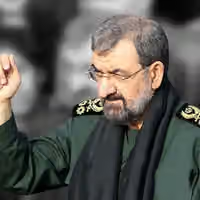
US ships near Iran not there 'because it’s nice this time of year,' Graham says


Republican Senator Lindsey Graham told Sky News Arabia that the presence of US naval forces near Iran “is not here because it’s nice this time of year,” as military capability builds up and a decision on next steps approaches.
“All these ships are not coming here because it’s nice this time of year,” Graham said, adding: “We need military action, probably,” and that planning was under way for possible joint US-Israel efforts to weaken the Iranian leadership’s ability to harm its people.
He said “the military capability is being built up as I speak. The inflection point is weeks away, not months away,” and warned that the next 30 days could be decisive.
Graham quoted President Donald Trump telling Iranians “keep protesting, help is on the way,” and said “the best way to make Iran great again is for the people to take over from the Ayatollahs.”






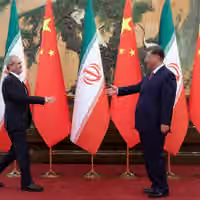
The head of the International Atomic Energy Agency told LCI television on Wednesday there is urgency to reach an agreement on Iran’s nuclear program to avoid new military action, after talks this week between the United States and Iran in Geneva.
Rafael Grossi said most of the nuclear material Iran had stockpiled before bombings in June 2025 remains in place, despite damage to some facilities.
He said he saw a willingness on both sides to move toward a deal, though disagreements remain and time is short.
Polish Prime Minister Donald Tusk urged Polish citizens in Iran to leave immediately on Thursday, warning there could soon be no way to evacuate them as the security situation deteriorates amid rising US-Iran tensions.
“In a few hours there may be no more possibility to evacuate Poles from Iran,” Tusk said, calling on “all Poles in Iran” to depart without delay.
Poland has previously mounted evacuations from the region during spikes in Middle East tensions, including flights that brought home Polish citizens who exited Iran via neighboring countries, according to Polish state media and the foreign ministry.
scalating tensions between the United States and Iran sent oil prices sharply higher and kept gold near record levels on Thursday, as investors weighed the risk of a prolonged conflict in the Middle East and its impact on global markets.
Brent crude rose to around $70.50 a barrel after surging more than 4% in the previous session, while US crude climbed above $65, as traders priced in the possibility of supply disruptions from the oil-producing region.
“The balance of risks now tilts to a US strike after market close Friday,” said Michael Every, senior global strategist at Rabobank, adding that any military action could last weeks rather than ending quickly.
European shares also edged 0.1% lower on Thursday after a mixed set of corporate results, with energy stocks rising alongside firmer oil prices as US-Iran tensions kept investors cautious.
Increased US military activity in the region has left markets on edge, despite diplomatic efforts in Geneva this week aimed at narrowing differences over Iran’s nuclear program.
Iran’s Supreme Leader Ali Khamenei had only one option: to leave power, US Senator Ted Cruz said, dismissing prospects for a nuclear agreement with Tehran.
“His regime is in tatters. He wants time to rebuild. I don't think President Trump is going to fall for that. I think the only deal the ayatollah can make is to say, I'm out of here. Let me leave. Let me go to Russia. Let me go to somewhere else other than here,” Cruz said in a Fox News interview.
The US senator also voiced doubt about any outcome in talks between Tehran and Washington, whose latest round was held in Geneva on Tuesday.
“I believe there is no deal to be had in terms of the nuclear program,” Cruz said, adding that Iran had never agreed to “any place, anywhere, any time” inspections.
Cruz also said Trump was committed to US national security but ruled out a ground invasion of Iran, saying there would be no deployment of hundreds of thousands of American troops.
“In the next six months, we will see the regimes fall in Iran, in Venezuela, and in Cuba. And we could also see governments replace them that want to be friends with the United States of America."
Escalating tensions between the United States and Iran sent oil prices sharply higher and kept gold near record levels on Thursday, as investors weighed the risk of a prolonged conflict in the Middle East and its impact on global markets.
Brent crude rose to around $70.50 a barrel after surging more than 4% in the previous session, while US crude climbed above $65, as traders priced in the possibility of supply disruptions from the oil-producing region.
“The balance of risks now tilts to a US strike after market close Friday,” said Michael Every, senior global strategist at Rabobank, adding that any military action could last weeks rather than ending quickly.
European shares also edged 0.1% lower on Thursday after a mixed set of corporate results, with energy stocks rising alongside firmer oil prices as US-Iran tensions kept investors cautious.
Increased US military activity in the region has left markets on edge, despite diplomatic efforts in Geneva this week aimed at narrowing differences over Iran’s nuclear program.
Safe-haven demand pushed spot gold up 0.5% to around $5,004 per ounce, after a more than 2% jump the previous day. US gold futures also edged higher.
“If there’s anything fundamental you could point to that would be supporting gold prices, it’s the prospect of conflict in the Middle East and the kind of safe-haven demand that goes along with it,” said Kyle Rodda, senior market analyst at Capital.com.
Gold has also drawn support from expectations that US interest rates could ease later this year, though minutes from the Federal Reserve’s January meeting showed policymakers were in no rush to cut rates and some remained open to further hikes if inflation stays elevated.
Asian equities were mixed, with gains in technology stocks offsetting caution over geopolitics. MSCI’s broadest index of Asia-Pacific shares outside Japan rose 0.4%, while Japan’s Nikkei gained 0.7%. South Korea’s Kospi jumped more than 3% to a record high, buoyed by renewed optimism over artificial intelligence-related shares.
Still, analysts said geopolitical risk was capping broader risk appetite.
“The two nations have long been at loggerheads over Iranian nuclear activity,” one market participant in Asia told Reuters, adding that any disruption to shipping routes or energy infrastructure could ripple through global supply chains.
For now, traders say oil and gold are likely to remain sensitive to headlines from Washington and Tehran, with volatility expected to persist as the prospect of military action looms.