Iran leader’s only deal is to leave power, US senator says


Iran’s Supreme Leader Ali Khamenei had only one option: to leave power, US Senator Ted Cruz said, dismissing prospects for a nuclear agreement with Tehran.
“His regime is in tatters. He wants time to rebuild. I don't think President Trump is going to fall for that. I think the only deal the ayatollah can make is to say, I'm out of here. Let me leave. Let me go to Russia. Let me go to somewhere else other than here,” Cruz said in a Fox News interview.
The US senator also voiced doubt about any outcome in talks between Tehran and Washington, whose latest round was held in Geneva on Tuesday.
“I believe there is no deal to be had in terms of the nuclear program,” Cruz said, adding that Iran had never agreed to “any place, anywhere, any time” inspections.
Cruz also said Trump was committed to US national security but ruled out a ground invasion of Iran, saying there would be no deployment of hundreds of thousands of American troops.
“In the next six months, we will see the regimes fall in Iran, in Venezuela, and in Cuba. And we could also see governments replace them that want to be friends with the United States of America."


Escalating tensions between the United States and Iran sent oil prices sharply higher and kept gold near record levels on Thursday, as investors weighed the risk of a prolonged conflict in the Middle East and its impact on global markets.
Brent crude rose to around $70.50 a barrel after surging more than 4% in the previous session, while US crude climbed above $65, as traders priced in the possibility of supply disruptions from the oil-producing region.
“The balance of risks now tilts to a US strike after market close Friday,” said Michael Every, senior global strategist at Rabobank, adding that any military action could last weeks rather than ending quickly.
European shares also edged 0.1% lower on Thursday after a mixed set of corporate results, with energy stocks rising alongside firmer oil prices as US-Iran tensions kept investors cautious.
Increased US military activity in the region has left markets on edge, despite diplomatic efforts in Geneva this week aimed at narrowing differences over Iran’s nuclear program.
Safe-haven demand pushed spot gold up 0.5% to around $5,004 per ounce, after a more than 2% jump the previous day. US gold futures also edged higher.
“If there’s anything fundamental you could point to that would be supporting gold prices, it’s the prospect of conflict in the Middle East and the kind of safe-haven demand that goes along with it,” said Kyle Rodda, senior market analyst at Capital.com.
Gold has also drawn support from expectations that US interest rates could ease later this year, though minutes from the Federal Reserve’s January meeting showed policymakers were in no rush to cut rates and some remained open to further hikes if inflation stays elevated.
Asian equities were mixed, with gains in technology stocks offsetting caution over geopolitics. MSCI’s broadest index of Asia-Pacific shares outside Japan rose 0.4%, while Japan’s Nikkei gained 0.7%. South Korea’s Kospi jumped more than 3% to a record high, buoyed by renewed optimism over artificial intelligence-related shares.
Still, analysts said geopolitical risk was capping broader risk appetite.
“The two nations have long been at loggerheads over Iranian nuclear activity,” one market participant in Asia told Reuters, adding that any disruption to shipping routes or energy infrastructure could ripple through global supply chains.
For now, traders say oil and gold are likely to remain sensitive to headlines from Washington and Tehran, with volatility expected to persist as the prospect of military action looms.
The United States imposed visa restrictions on 18 Iranian officials and telecommunications industry leaders over their role in suppressing nationwide protests the State Department said on Tuesday.
The restrictions also apply to immediate family members, bringing the total number targeted under the policy to 58, Principal Deputy Spokesperson Tommy Pigott said.
“Even today, the regime continues to restrict the ability of Iranians to exercise their basic freedoms. As President Trump has made clear, the United States stands with the Iranian people,” read the statement.
The statement said those designated were complicit, or believed to be complicit, in serious human rights violations, including restricting Iranians’ rights to free expression and peaceful assembly during protests in December 2025 and January 2026.

A British couple detained in Iran have been sentenced to 10 years in prison on espionage charges, their family said on Thursday, prompting renewed calls on London to secure their release.
Lindsay and Craig Foreman, both in their 50s, were arrested in January 2025 while on a motorcycle trip through Iran. They deny the charges.
The couple were tried in October at Branch 15 of Tehran’s Revolutionary Court and were not allowed to present a defense, according to their son, Joe Bennett. A judge delivered the verdict in recent days, the family told BBC.
“We are deeply concerned about their welfare,” Bennett said, urging the British government to “act decisively and use every available avenue” to bring them home.
He said Iranian authorities had presented no evidence of espionage and that their lawyers had been told there was no legal basis for the case. Applications for bail were ignored, he added.
Foreign Secretary Yvette Cooper has decried their sentence as "completely appalling and totally unjustifiable".
"We will pursue this case relentlessly with the Iranian government until we see Craig and Lindsay Foreman safely returned to the UK and reunited with their family," she said.
Britain’s Foreign, Commonwealth and Development Office has previously said it was “deeply concerned” by the couple’s detention and that it continued to raise the case directly with Iranian authorities.
The Foremans are being held in separate wings of Tehran’s Evin prison, which rights groups have long criticized over alleged torture and inhumane conditions.
Bennett has said the couple endured 13 months in dire conditions, surrounded by “dirt, vermin, and violence,” and that they had been losing weight.
In November, Bennett said his mother had begun a hunger strike inside Evin, telling him during a brief phone call that “not eating was the only power she’s got.”
The couple were first detained in the southeastern city of Kerman, where they spent 30 days in solitary confinement before being transferred to Tehran, the family has said. They had entered Iran with valid visas, a licensed guide and a cleared itinerary, Bennett added.
Rights groups and Western governments have long accused Iran of engaging in so-called “hostage diplomacy” by detaining foreign nationals to gain political or economic concessions, an allegation Tehran rejects, saying it faces Western intelligence infiltration.
The United States is weighing options to target Iranian political and military leaders as well as nuclear and ballistic missile facilities, as it assembles its largest concentration of air power in the Middle East since the 2003 Iraq invasion, The Wall Street Journal reported on Wednesday.
US and foreign officials told the newspaper that options presented to President Donald Trump range from a broad campaign aimed at killing scores of Iranian leaders in a bid to topple the government, to a more limited air operation focused on nuclear and missile targets.
The military buildup includes F-35 and F-22 fighter jets, additional command-and-control aircraft, strengthened air defenses and a second aircraft carrier, the USS Gerald R. Ford, enabling what officials described as the capacity for a sustained, weeks-long campaign.
Both scenarios would likely involve a potentially weeks-long operation, the report said, underscoring the scale of the current US military posture in the region.

Satellite images published by Reuters on Wednesday show Iran repairing and reinforcing key military and nuclear‑linked sites amid stalled nuclear negotiations with the United States and an expanding US military presence in the region.
The imagery shows a new facility at the Parchin military complex covered with a concrete shield and soil, while tunnel entrances at the Isfahan nuclear site have been backfilled.
Tunnel access at Natanz and missile bases damaged during last June’s 12‑day conflict with Israel have also been strengthened.
The reconstruction appears designed to address weaknesses exposed during the brief war, when Israeli strikes targeted Iranian nuclear and military infrastructure and Tehran responded with missiles and drones.
The United States held five rounds of negotiations with Iran over its disputed nuclear program last year, for which Trump set a 60-day deadline.
When no agreement was reached by the 61st day on June 13, Israel launched a surprise military offensive, followed by US strikes on June 22 targeting key nuclear facilities in Isfahan, Natanz and Fordow.

The fortification work comes as indirect nuclear talks in Geneva remain unresolved. Iran is preparing a written proposal to address US concerns, while Washington has reinforced its regional military posture, including carrier strike groups and additional naval assets, amid concerns that diplomacy could stall.

The Reuters report said the combination of hardened facilities, ongoing military readiness, and persistent diplomatic negotiations reflects Tehran’s dual strategy of safeguarding strategic infrastructure while keeping open the possibility of a negotiated settlement.

The United States has long insisted that Iran must completely halt its uranium enrichment program, stop supporting its armed allies in the Middle East and accept restrictions on its ballistic missile program.
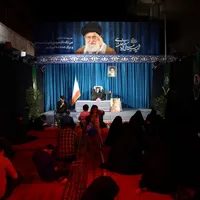
Iran’s Supreme Leader Ali Khamenei said on Monday the United States will never succeed in toppling the Islamic Republic and warned that even the world’s strongest military can suffer crippling blows.