US envoy Huckabee skeptical diplomacy can avert Iran military action


US Ambassador to Israel Mike Huckabee said he hopes a diplomatic accord with Iran can be reached but expressed skepticism that military action can ultimately be avoided, as US-Iran nuclear talks resume in Geneva on Tuesday.
“Will there be anything that can come from that that will bring peace? I honestly don’t know. I know there’s a lot of significant and legitimate doubt that the Iranians will ever agree to something that would cause them to lay down any ambitions of nuclear weaponry,” Huckabee said while speaking to Jewish leaders at a Conference of Presidents gathering in Jerusalem.
Huckabee said US President Donald Trump had made clear military action was “not his first choice.”
He added the president’s “absolute desire” was to ensure Iran does not continue to wreak havoc globally.
“At some point, the United States needs to say: enough is enough, we’re not going to continue to believe that they’re ever going to be different than they are. And it’s time for them to either make a radical change of their point of view and their direction, or for them to experience what we call in the south, the ‘second kick of a mule,’” he said.
Huckabee said Israel and the United States were “absolutely aligned in our understanding that Iran has to be dealt with and it cannot continue as it is.”
“They cannot remain a nuclear threat. They cannot continue to build extraordinary surpluses of ballistic missiles and aim them, not just at Israel, but also at the rest of the world,” he said.
Huckabee added it would be “miraculous if some deal could be reached that would thwart the need, the necessity, the absolute certainty of some military action.”
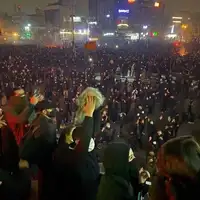
Iran’s exiled prince Reza Pahlavi praised protesters who chanted ant-government slogans from their homes in Iran and members of the Iranian diaspora who attended rallies abroad over the weekend.
“Your resounding cries within Iran on the nights of February 14th and 15th, and your remarkable presence in the rallies of the February 14th Global Day of Action were a clear manifestation of our national unity,” he said in a post on X.
“Our struggle to overthrow the Islamic Republic and establish a national and democratic government is irreversible… We will continue this struggle with strength until the overthrow of this criminal regime and the expulsion of the occupiers from our beloved Iran,” he added.

Rising bread prices have become a growing source of concern within Iran’s political establishment, with warnings that further increases could trigger unrest as inflation erodes living standards.
The hardline newspaper Kayhan, aligned with Supreme Leader Ali Khamenei, warned on Sunday that raising bread prices could have “catastrophic consequences,” cautioning that “Iranian society cannot tolerate a new shock.”
Kayhan urged the heads of Iran’s executive, legislative and judicial branches to intervene, calling the planned price increase “mysterious and suspicious” and accusing economic advisers to President Masoud Pezeshkian of “playing into the hands of Iran’s enemies.”
The warning came days after government spokesperson Fatemeh Mohajerani said bread prices would “most certainly” rise soon, signaling a politically sensitive move affecting a staple food relied upon by millions of low-income Iranians.
Iran’s Statistical Center reported inflation at about 60%, sharply reducing purchasing power and placing essential goods increasingly out of reach for poorer households.
Economists warn that price increases in staples such as bread can ripple across the economy, raising costs and accelerating inflation.
Blame game
Bread has long been a politically sensitive commodity in Iran, where subsidies have historically helped preserve social stability. Price increases or subsidy cuts affecting basic goods have previously triggered protests and unrest.
Kayhan linked the issue to recent protests, saying earlier subsidy cuts had already produced “heavy social and security consequences.” It said officials had “chosen the worst possible time” for further increases, given the country’s economic and political pressures.
The dispute reflects a broader pattern in Tehran, where competing factions often blame one another for economic hardship. Hardline outlets and political figures frequently accuse elected governments of mismanagement, while President Pezeshkian and his allies have said entrenched interests and powerful unelected institutions are obstructing efforts to stabilize the economy.
Rarely acknowledged in these public exchanges is the extent to which Iran’s economic trajectory is shaped by political and foreign policy decisions made at the highest levels of the system.
Under Iran’s constitution, Supreme Leader Ali Khamenei holds ultimate authority over key areas including foreign policy, defense and the nuclear program, decisions that have played a central role in triggering sanctions and shaping the country’s economic environment.
Cash payments
The newspaper also accused the government of disguising subsidy reductions through technical language, saying officials claim subsidies have merely been “shifted in the supply chain” rather than eliminated.
Such explanations, Kayhan said, “never convince the people and will certainly lead to crises.”
The government has said it plans to offset higher bread prices through cash payments to households.
But economic researcher Yaser Bagheri said the current monthly subsidy allows recipients to buy only three loaves of bread, highlighting the limited impact of compensation measures.
Iranian outlets including the moderate Rouydad24 reported last week that food prices rose by more than 13.7% in a single month, underscoring mounting pressure on household budgets.
Kayhan’s unusually blunt warning underscores growing concern within Iran’s political establishment that economic hardship—especially involving essential goods such as bread—could carry serious political consequences.

Security forces raided the village of Chenar in Asadabad county, Hamedan province, arresting hundreds of residents after surrounding the area early Monday, people familiar with the matter told Iran International.
The raid began at around 4:30 a.m., involving dozens of armored vehicles as well as several minibuses and vans, sources said. Forces also deployed four DShK heavy machine guns on the rooftops of some homes across the village.
Sources said detained residents were paraded through the city in vehicles fitted with cage bars before being transferred to the Asadabad police station.
Several villagers were injured during the mass arrests and some detainees were severely beaten by officers, sources said.
Residents who gathered outside the police station seeking information about those detained reported hearing shouting and cries from inside the building, sources added.
A source familiar with the matter said Chenar residents had been highly active during the nationwide protests in December and January and that the slogan “Khamenei the murderer — dream on” was first chanted in the village.
The source added that villagers had drawn attention during demonstrations by carrying Iran’s pre-1979 Lion and Sun flag.
According to the source, residents buried slain protesters without ritual washing, departing from Islamic burial rites, and recited passages from the Persian epic Shahnameh at their funerals.
Sources also said the area’s Friday prayer leader had told village elders they would be “disciplined” over their role in the protests.
Previous videos published by Iran International showed Chenar residents carrying Lion and Sun flags and chanting “Reza Shah, rest in peace,” as well as a chant directed at Iran’s Supreme Leader — roughly translates as “what a futile delusion” or “dream on” — at earlier protests.
The phrase “dream on” drew wider attention after Elon Musk used it in response to a post by Iran’s Supreme Leader Ali Khamenei on X about not surrendering.
The mass arrests and lack of clear information about the number and condition of detainees have sparked concern among families and residents, sources said.
The raid comes amid broader reports by rights groups of widespread arrests across Iran in recent weeks, with tens of thousands detained nationwide since the start of the protests in late December.

At least 24 children, including a three-year-old, were killed by direct fire from security forces during Iran’s nationwide protests, the HANA Human Rights Organization said on Monday.
The group said it had confirmed the identities of the children through on-the-ground research and cross-checking of multiple sources.
The group added the shooting of children was not an isolated incident but a systematic and ongoing pattern, with gunfire in many cases directed at vital parts of the body.

Reports from Tehran by a British Muslim commentator depicting normalcy and freedom after Iran’s violent crackdown on dissent have triggered a backlash, with critics accusing authorities of using foreign voices to legitimize their narrative.
Bushra Shaikh, who was in Tehran for the state-backed 22 Bahman rally marking the anniversary of the 1979 revolution, wrote on X that she walked through the gathering without wearing a headscarf and faced no interference.
“Yes, I walked the entire rally in Tehran without a hijab and guess what happened? Absolutely nothing,” she wrote. “There is evidently more of a relaxed tone around hijab—I experienced it for myself.”
Critics said her experience reflected selective tolerance, pointing out that she had to wear a headscarf when appearing on Iran’s English-language state broadcaster.
Community notes attached to her posts added context, stating that hijab remains legally mandatory in Iran and that enforcement has been widely documented by human rights organizations.
In her posts and interviews, Shaikh also challenged Western coverage of Iran, arguing that the government enjoys broad public support and that sanctions—not hijab laws or political repression—are the public’s primary concern.
She further accused Israel’s Mossad and its alleged agents of killing civilians and security forces during unrest to inflate casualty figures.
Her comments prompted widespread condemnation online. Many Iranian users said her reporting echoed official narratives and ignored the risks faced by Iranian women who defy compulsory veiling.
One user wrote that Shaikh’s ability to appear unveiled at the rally was the result of sacrifices made by protesters. “
The same Bushra Shaikh, who today is reporting without hijab in Revolution Street for Western eyes in praise of freedom of dress, is the result of the blood of hundreds of youths who died right here three years ago,” the post said.
The controversy unfolded as state media aired interviews with several unveiled women at the rally—an unusual sight at official events. Government outlets presented the interviews as evidence of broad public support, including among women who do not adhere to strict dress codes.
Amjad Amini, the father of Mahsa (Jina) Amini, whose death in morality police custody in 2022 sparked nationwide protests, responded by reposting an image of one such interview.
“They killed my innocent daughter over a few strands of hair, and no one was held accountable,” he wrote on Instagram. “And now they film girls with bare heads … at official ceremonies and broadcast it, and no one cries out that Islamic rules have been broken. Strange times.”
Hijab enforcement in Iran has shifted unevenly since the Woman, Life, Freedom protests of 2022 and 2023, which forced authorities into a partial retreat in the face of widespread defiance. Increasing numbers of women now appear unveiled in public spaces, particularly in major cities.
But compulsory hijab remains law, and enforcement continues in institutional settings, including government offices, schools and universities.
Responding to Shaikh’s posts, US-based women’s rights activist Atieh Bakhtiar wrote on X that her experience did not reflect reality for most Iranian women.
“If thousands hadn’t died … the Islamic Republic would’ve arrested her and beaten her,” she said. “Instead, she’s their mouthpiece now.”