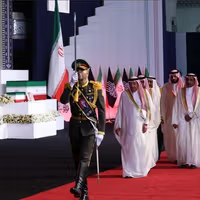
Rights group says security forces killed at least 24 children in Iran protests
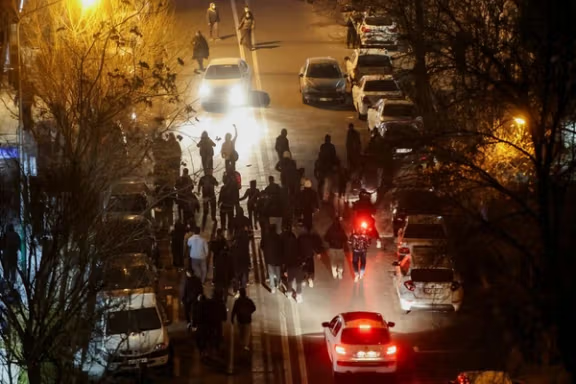

At least 24 children, including a three-year-old, were killed by direct fire from security forces during Iran’s nationwide protests, the HANA Human Rights Organization said on Monday.
The group said it had confirmed the identities of the children through on-the-ground research and cross-checking of multiple sources.
The group added the shooting of children was not an isolated incident but a systematic and ongoing pattern, with gunfire in many cases directed at vital parts of the body.


Reports from Tehran by a British Muslim commentator depicting normalcy and freedom after Iran’s violent crackdown on dissent have triggered a backlash, with critics accusing authorities of using foreign voices to legitimize their narrative.
Bushra Shaikh, who was in Tehran for the state-backed 22 Bahman rally marking the anniversary of the 1979 revolution, wrote on X that she walked through the gathering without wearing a headscarf and faced no interference.
“Yes, I walked the entire rally in Tehran without a hijab and guess what happened? Absolutely nothing,” she wrote. “There is evidently more of a relaxed tone around hijab—I experienced it for myself.”
Critics said her experience reflected selective tolerance, pointing out that she had to wear a headscarf when appearing on Iran’s English-language state broadcaster.
Community notes attached to her posts added context, stating that hijab remains legally mandatory in Iran and that enforcement has been widely documented by human rights organizations.
In her posts and interviews, Shaikh also challenged Western coverage of Iran, arguing that the government enjoys broad public support and that sanctions—not hijab laws or political repression—are the public’s primary concern.
She further accused Israel’s Mossad and its alleged agents of killing civilians and security forces during unrest to inflate casualty figures.
Her comments prompted widespread condemnation online. Many Iranian users said her reporting echoed official narratives and ignored the risks faced by Iranian women who defy compulsory veiling.
One user wrote that Shaikh’s ability to appear unveiled at the rally was the result of sacrifices made by protesters. “
The same Bushra Shaikh, who today is reporting without hijab in Revolution Street for Western eyes in praise of freedom of dress, is the result of the blood of hundreds of youths who died right here three years ago,” the post said.
The controversy unfolded as state media aired interviews with several unveiled women at the rally—an unusual sight at official events. Government outlets presented the interviews as evidence of broad public support, including among women who do not adhere to strict dress codes.
Amjad Amini, the father of Mahsa (Jina) Amini, whose death in morality police custody in 2022 sparked nationwide protests, responded by reposting an image of one such interview.
“They killed my innocent daughter over a few strands of hair, and no one was held accountable,” he wrote on Instagram. “And now they film girls with bare heads … at official ceremonies and broadcast it, and no one cries out that Islamic rules have been broken. Strange times.”
Hijab enforcement in Iran has shifted unevenly since the Woman, Life, Freedom protests of 2022 and 2023, which forced authorities into a partial retreat in the face of widespread defiance. Increasing numbers of women now appear unveiled in public spaces, particularly in major cities.
But compulsory hijab remains law, and enforcement continues in institutional settings, including government offices, schools and universities.
Responding to Shaikh’s posts, US-based women’s rights activist Atieh Bakhtiar wrote on X that her experience did not reflect reality for most Iranian women.
“If thousands hadn’t died … the Islamic Republic would’ve arrested her and beaten her,” she said. “Instead, she’s their mouthpiece now.”
The US Central Command released images showing EA-18G Growlers from Electronic Attack Squadron 133 and F-35C Lightning II aircraft from Marine Fighter Squadron 314 preparing for launch aboard the USS Abraham Lincoln in the Middle East.
CENTCOM said in a post on X that the aircraft carrier was operating in international waters and conducting around-the-clock flight operations in support of regional security.


A court in Iran has issued death sentences to 14 protesters who took part in the recent unrest, holding the proceedings online, sources familiar with the matter told Iran International.
The virtual sessions were convened by Judge Abolghasem Salavati, head of Branch 15 of Iran’s Revolutionary Court, the sources said.
They said Salavati heard cases in groups of 14 defendants at the same time.
US President Donald Trump said in January that he halted a planned mass execution of 800 prisoners, a claim for which no corresponding evidence has appeared in Iranian official announcements or domestic reporting.
One of the defendants who was handed a death sentence on Monday was Abolfazl Karimi, 35, who was shot and arrested after trying to help two injured protesters in Tehran on January 6.
Karimi, who is father of a young child and works as a motorbike courier in eastern Tehran, was returning from work when he encountered the two women wounded by security forces’ gunfire on Hengam street.
On Sunday, Judge Salavati, who has been sanctioned by the United States for his role in human rights abuses, also issued a death sentence to Mohammadamin Biglari, a 19-year-old detained during protests.

Social media platform X removed premium verification badges from senior Islamic Republic officials, triggering a surge of blue-ticked parody accounts that impersonate them and blurring the line between official statements and satire.
Within hours of the badges disappearing, accounts styled as satirical versions of Foreign Minister Abbas Araghchi and senior official Ali Larijani began drawing thousands of views and followers.
One parody account using Larijani’s name published a post arguing that anyone who believes a meaningful agreement can be reached with the Islamic Republic is naïve.
Another account in Araghchi’s name, which was suspended later, published the monarchist slogan “Long live the King.”
X also removed blue ticks from accounts attributed to Judiciary chief Gholamhossein Mohseni Ejei and parliament speaker Mohammad Bagher Ghalibaf, according to a review of the platform.
An account using the name of Supreme Leader Ali Khamenei posted a message suggesting he seek refuge with the Taliban. “If our friendly neighboring brothers, the Taliban, kindly issue six-month tourist visas, the situation is dire,” the post read.

Separately, parody accounts posing as parliament speaker Mohammad Bagher Ghalibaf and late Quds Force commander Qassem Soleimani posted mocking replies in comment threads.
One fake Ghalibaf account warned the United States that if it repeated a hostile act “once more, it will become twice,” mimicking official rhetoric in an exaggerated, satirical tone.
A parody account impersonating former president Ebrahim Raisi posted a Valentine’s Day message lamenting that “no one sent us a teddy bear,” while another billed itself as “the first president in Iran’s history to be eaten by a bear” – a darkly comic nod to the online satire that has persisted around his death.

Most of the new profiles visibly carry the label “Parody account,” a designation that appears when a user identifies their profile as satirical.
Under X rules, accounts that present themselves as real individuals without clearly disclosing their unofficial nature can face suspension, prompting many users to add the parody label to reduce the risk of removal.
A parody account created in Khamenei’s name drew nearly 9,000 followers within hours. Similar accounts impersonating Araghchi and Larijani quickly grew to more than 20,000 and about 12,000 followers, respectively.
Official silence, media warning
Islamic Republic officials have not formally addressed the wave of impersonations. The Guards-linked Tasnim website wrote that following the removal of blue verification badges, several fake accounts misusing Larijani’s name and image had become active.
The episode follows earlier disputes between Iranian authorities and the platform. In November, X introduced a location feature showing the approximate origin of posts.
The update exposed numerous pro-government figures and individuals tied to the Islamic Republic posting from inside Iran, enjoying a tiered, privileged internet, where most users must bypass state restrictions on social media through tools such as VPNs.

The platform also replaced the Islamic Republic flag emoji with the pre-1979 Lion and Sun emblem for accounts set to Iran, prompting criticism from pro-government users and praise from some opposition voices.

Fifty-one Iranian lawmakers urged the foreign minister to state Iran’s opposition to the Abraham Accords, a US-brokered normalization agreement launched under President Donald Trump, and to adopt what state media described as a “revolutionary stance” against the plan.
In a written warning read out during a parliamentary session on Monday, the lawmakers called on Foreign Minister Abbas Araghchi to state Iran’s position transparently and explain the dimensions of the proposal in relation to Islamic countries.
The Abraham Accords were US-brokered agreements launched in 2020 under Trump that led several Arab states, including the United Arab Emirates and Bahrain, to normalize relations with Israel. Iran has strongly opposed the accords.