The hardline newspaper Kayhan, aligned with Supreme Leader Ali Khamenei, warned on Sunday that raising bread prices could have “catastrophic consequences,” cautioning that “Iranian society cannot tolerate a new shock.”
Kayhan urged the heads of Iran’s executive, legislative and judicial branches to intervene, calling the planned price increase “mysterious and suspicious” and accusing economic advisers to President Masoud Pezeshkian of “playing into the hands of Iran’s enemies.”
The warning came days after government spokesperson Fatemeh Mohajerani said bread prices would “most certainly” rise soon, signaling a politically sensitive move affecting a staple food relied upon by millions of low-income Iranians.
Iran’s Statistical Center reported inflation at about 60%, sharply reducing purchasing power and placing essential goods increasingly out of reach for poorer households.
Economists warn that price increases in staples such as bread can ripple across the economy, raising costs and accelerating inflation.
Blame game
Bread has long been a politically sensitive commodity in Iran, where subsidies have historically helped preserve social stability. Price increases or subsidy cuts affecting basic goods have previously triggered protests and unrest.
Kayhan linked the issue to recent protests, saying earlier subsidy cuts had already produced “heavy social and security consequences.” It said officials had “chosen the worst possible time” for further increases, given the country’s economic and political pressures.
The dispute reflects a broader pattern in Tehran, where competing factions often blame one another for economic hardship. Hardline outlets and political figures frequently accuse elected governments of mismanagement, while President Pezeshkian and his allies have said entrenched interests and powerful unelected institutions are obstructing efforts to stabilize the economy.
Rarely acknowledged in these public exchanges is the extent to which Iran’s economic trajectory is shaped by political and foreign policy decisions made at the highest levels of the system.
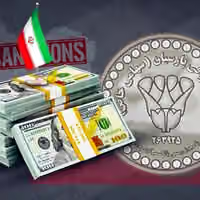
Under Iran’s constitution, Supreme Leader Ali Khamenei holds ultimate authority over key areas including foreign policy, defense and the nuclear program, decisions that have played a central role in triggering sanctions and shaping the country’s economic environment.
Cash payments
The newspaper also accused the government of disguising subsidy reductions through technical language, saying officials claim subsidies have merely been “shifted in the supply chain” rather than eliminated.
Such explanations, Kayhan said, “never convince the people and will certainly lead to crises.”
The government has said it plans to offset higher bread prices through cash payments to households.
But economic researcher Yaser Bagheri said the current monthly subsidy allows recipients to buy only three loaves of bread, highlighting the limited impact of compensation measures.
Iranian outlets including the moderate Rouydad24 reported last week that food prices rose by more than 13.7% in a single month, underscoring mounting pressure on household budgets.
Kayhan’s unusually blunt warning underscores growing concern within Iran’s political establishment that economic hardship—especially involving essential goods such as bread—could carry serious political consequences.