The Azadi (Freedom) Tower rises over Tehran’s Azadi Square, a landmark commissioned by Mohammad Reza Pahlavi for Iran’s 2,500-year Persian Empire celebrations and long associated with national ceremonies and mass gatherings.
Two competing futures are being sketched for Iran: a bleak “Syria-style” slide into chaos, or a more optimistic path grounded in economic research and detailed transition planning by the Iran Prosperity Project, tailored to the country’s specific realities.
To understand what could follow the Islamic Republic, it helps to start with where Iran stands now. As of February 2026, with the Islamic Republic still in power, tens of thousands of Iranians have been killed.
Inflation has surged: year-on-year inflation hit 60% in January, with annual inflation hovering at 45%. By comparison, Iraq’s inflation rate in 2002 – before Saddam Hussein was toppled – was around 19%, although Iraq had already lived through a severe five-year crisis from 1991 to 1995.
Years of politically mandated lending and the rapid expansion of private banks have pushed Iran into an acute banking crisis. Bank Ayandeh has collapsed, and by the Central Bank’s own criteria only nine banks in the country are not considered insolvent. The strain has now reached Bank Sepah, which pays the salaries of Iran’s military – an institution that itself was once created through mergers of military-linked banks to avert systemic failure.
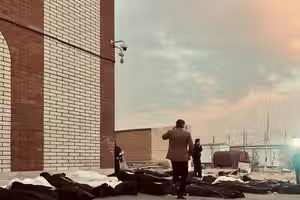
Civilian deaths in the US-led invasion of Iraq to remove Saddam are widely estimated at roughly 7,000. In Iran, by contrast, at least 36,500 citizens were killed over two days and a matter of hours in what was described as a massacre – without any foreign military intervention – exceeding the toll of some of the largest wars and crackdowns in modern history over a comparable timeframe.
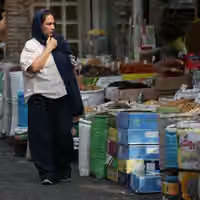
The economic disruption is already visible in daily life. In 2024, the state’s inability to supply gas in winter and electricity in summer meant at least one province was effectively shut for 72 of 291 working days. A survey by Iran’s Chamber of Commerce of more than 3,000 businesses found firms were operating at just 39% of capacity in autumn 2025.
Taken together, the figures suggest that even before the national uprising began in January 2026, Iran was already exhibiting the hallmarks of a country battered by war.
Pessimistic scenarios
Since the mid-2010s – especially after the civil wars in Syria and Lebanon – much of the media conversation about a post-Islamic Republic Iran has centered on worst-case outcomes. Those arguments have resurfaced again in recent months. The main scenarios typically cited are:
War and foreign intervention: In a central power vacuum, neighboring states could intervene directly or back separatist groups. Yet after the fall of Iraq’s Baathist regime and the Taliban in Afghanistan, regime collapse did not automatically trigger large-scale foreign invasions.
The challenge of post-collapse security, the argument goes, is likely to be as much political as military.
The Iran Prosperity Project, launched in 2025 as a transition-era economic and governance blueprint supported by exiled Prince Reza Pahlavi, sets out an “emergency phase” handbook that urges early outreach to neighbors – particularly Pakistan, Saudi Arabia and Turkey – as a way to contain spillover risks and reduce the chances of destabilization after a collapse.
Fragmentation and civil war: Another fear is a spiral into armed conflict – either from forces loyal to the Islamic Republic resisting change, or from ideological and ethnic fighting on the model of Syria, Libya or Yemen – creating space for extremist groups such as ISIS and driving insecurity along Iran’s borders. Supporters of this view point to the danger of militia-style violence and state breakdown.
At the same time, the reported entry of at least 5,000 Iraqi mercenaries during the January crackdown could be read as a sign of uncertainty about the reliability of domestic forces.
And during the January uprising, the same pro-monarchy slogans were heard from Kurdish-majority Kermanshah to Turkish-dominant Tabriz and Baluch-majority Zahedan – alongside Tehran and Fars – without clear evidence of widespread ethnic or sectarian fracture, even as the risk is still seen as latent.
A rebranded Revolutionary Guard dictatorship: In this scenario, the Islamic Revolutionary Guard Corps (IRGC) fills the vacuum, consolidating power with a less overtly religious posture.
But the IRGC’s reach is already a central driver of international pressure on the current system, making it unlikely – under this reading – that foreign powers would accept its continued dominance after a collapse.
A drawn-out transition: A slower-motion breakdown is another widely cited possibility: deepening economic isolation, accelerating brain drain, sharp declines in production, rolling protests and a society worn down by exhaustion and uncertainty.
Disillusionment with transitional justice and a revival of the Islamic Republic: A further risk is political backlash if accountability is perceived as weak. Public anger over mass killings and systemic corruption could turn against a transitional administration if leading perpetrators are not quickly brought to justice and if assets transferred abroad – an outflow US Treasury Secretary Scott Bessent pointed to in January – cannot be traced and seized. In that climate, loyalist networks could regroup, backed by money moved offshore.
Planning for transition
By most economic and statistical measures, Iran under the Islamic Republic already bears the hallmarks of a war-damaged state. The January killings were unprecedented in scale over such a short period.
In recent years, the Iran Prosperity Project – backed by Prince Reza Pahlavi and affiliated with advocacy organization the National Union for Democracy in Iran – has developed an extensive policy framework for a post-Islamic Republic transition.
A series of white papers published on the project’s website address governance, energy, foreign policy, healthcare, industry and macroeconomic stabilization.
From these documents, the authors compiled an “Emergency Period Handbook” outlining how to manage the interval between regime collapse and the installation of a new government.
The latest version, released in summer 2025, spans 15 chapters and focuses on the first 100 to 180 days after the fall of the Islamic Republic.
Supporters describe it as the only fully structured opposition blueprint for the immediate post-collapse period, drafted by a 26-member team of specialists with input from additional unnamed advisers inside and outside Iran, whose identities are withheld for security reasons.
The plan assumes the absence of civil war and broad public backing for Prince Pahlavi during the transition.
Preventing famine and securing essential goods
One of the first challenges in any transition would be stabilizing supply chains.
Mohammadreza Jahanparvar, an economist involved in the project, told Iran International that financing essential imports would not be the primary obstacle.
“Funding essential goods is not particularly difficult,” he said. “The greater challenge is restoring communication and negotiation with suppliers. Iran has never been sanctioned on food.”
According to Jahanparvar, supplier countries have been identified and preliminary discussions held to allow imports to resume immediately after regime collapse.
Security, however, poses a parallel challenge. Control over ports, customs terminals and transportation corridors would be critical to prevent disruption. The handbook’s section on “Maintaining Core Functions” prioritizes the rapid restoration and protection of vital systems, including food production and healthcare, from day one through the first three months.
Maintaining uninterrupted flows of energy and water is another pillar. In its “Seize and Stabilize” section, the plan calls for securing key infrastructure – energy facilities, oil and gas installations, water systems and power plants – using vetted army units to deter sabotage. The criteria for vetting are not publicly detailed, likely for security reasons.
A related initiative, known as “National Cooperation,” was launched in July 2025. It invited civil servants, security personnel and members of the armed forces to signal their willingness to cooperate in a future transition by scanning a QR code broadcast during a live Iran International program. In August, Prince Pahlavi said 50,000 individuals had responded. Iran’s armed forces are estimated to number roughly 640,000.
Financing the transition
Tehran’s draft budget for the next Iranian year (starting on March 21) projects total expenditures of 401,740 billion tomans (or 4,017.4 trillion rials) approximately $25 billion at an exchange rate of 1,620,000 rials to the dollar – equivalent to about $2 billion per month simply to sustain current operations.
Sanctions have frozen substantial Iranian assets abroad while also limiting the country’s external borrowing.
Jahanparvar estimates that between $100 billion and $200 billion in Iranian assets could potentially be recovered.
By comparison, oil export revenue in 2025 was estimated at between $30 billion and $60 billion, meaning recoverable assets could equal two to seven years of oil income.
Sanctions nonetheless pose a practical hurdle. Even if assets exist overseas, access would not be automatic during a transition. Jahanparvar argues that the US president could grant temporary three-month waivers, with comparable measures potentially adopted by European governments.
“Based on precedents in other sanctioned countries,” he said, “short-term exemptions pending formal legal review are both feasible and common.”
Other stopgap measures could include securing a modest loan from the United States – not primarily for its size, but for the signal it would send to global financial markets. Even if frozen assets remain temporarily inaccessible, they could serve as collateral to unlock short-term international financing.
“Iran has not drawn on its IMF quota since the 1960s,” Jahanparvar noted. “With the political constraints associated with the Islamic Republic removed, those channels could reopen.”
Pessimism or optimism?
All of these measures relate to the emergency phase immediately following a collapse.
If the more dire scenarios fail to materialize, the subsequent stabilization phase could see the return of thousands of Iranian entrepreneurs and professionals. With at least nine million Iranians living abroad, the diaspora represents a significant pool of capital, expertise and investment potential. During the national uprising, many demonstrated continued ties to their homeland.
The future remains uncertain and dependent on both internal dynamics and external actors. Yet one variable, proponents argue, lies largely in the hands of Iranians themselves: national cohesion.
Until 24 hours before the January 8-9 uprising, some questioned whether Prince Pahlavi commanded broad public backing. Then the largest street protests in the Islamic Republic’s history erupted.
For years, the Islamic Republic has invoked worst-case scenarios – “Syrianization,” lack of alternatives, war and insecurity – to discourage defections and blunt support for change.
Yet Iran’s economic indicators already resemble those of a country at war, and the two-day massacre exceeded even the Islamic Republic’s own official tally of 276 civilian deaths from Israel’s 12-day full-scale attack.
Iranian society and political actors may need to prepare for pessimistic outcomes. But at pivotal moments, the country’s recent history suggests, the public has shown an ability to defy the expectations of analysts.
Iran’s oil exports declined sharply at the start of 2026, new tanker-tracking data show, raising fresh questions about the durability of Tehran’s most important economic lifeline under renewed US sanctions pressure.
Crude oil loadings from Iran’s Persian Gulf terminals fell to below 1.39 million barrels per day in January, a 26 percent drop from a year earlier, according to data from commodity intelligence firm Kpler reviewed by Iran International.
The decline extends a steady downward trend since October, suggesting sustained pressure rather than a temporary disruption.
The slowdown is most visible in China, Iran’s primary—and effectively only—major oil buyer under sanctions. Daily discharges of Iranian crude at Chinese ports fell to 1.13 million barrels per day last month, down from an average of around 1.4 million barrels per day in 2025.
Unsold Iranian crude is also accumulating at sea. The volume of oil stored on tankers has nearly tripled over the past year to more than 170 million barrels, a sign that shipments are becoming harder to sell or deliver.
Keeping that oil afloat is costly. Chartering a Very Large Crude Carrier typically costs more than $100,000 per day, and tankers carrying sanctioned Iranian oil command even higher rates due to legal and insurance risks. Analysts estimate that roughly one-fifth of Iran’s oil revenue is effectively consumed by these transport and storage costs.
Much of the oil remains stranded in Asian waters. About one-third of Iranian tankers are anchored offshore, while others move continuously or conduct ship-to-ship transfers to evade sanctions enforcement—tactics that have become standard within Iran’s so-called shadow fleet.
Sanctions are increasingly targeting those networks. According to Kpler, 86 percent of the tankers transporting Iranian oil over the past year have themselves been sanctioned by the United States, highlighting the expanding scope of enforcement.
The pressure has forced Iran to offer steep discounts to maintain sales. Iranian crude is currently priced about $11 to $12 per barrel below comparable benchmarks, up from a discount of roughly $3 per barrel early last year, significantly reducing Tehran’s net income.
The decline extends beyond crude oil. Exports of petroleum products such as fuel oil fell to about 350,000 barrels per day in January, down from 410,000 barrels per day a year earlier, with China and the United Arab Emirates among the main buyers.
Additional pressure may be coming. President Donald Trump recently signed an executive order imposing a 25 percent tariff on trade partners of Iran, a measure that could further deter companies and countries from handling Iranian oil.
The mounting economic strain provides important context for renewed indirect talks between Washington and Tehran.
For Iran’s leadership, easing sanctions remains the most direct path to stabilizing oil revenues and relieving fiscal pressure. But deep differences over Iran’s nuclear program, missile development, and regional activities make an agreement unlikely unless one side decides to compromise on core demands.
Taken together, the data suggest that Iran’s ability to sustain oil exports under sanctions—long a cornerstone of its economic resilience—is becoming more constrained.
A tightening security atmosphere inside schools across several Iranian cities has prompted a new wave of student absences, according to messages sent to Iran International, with families saying classrooms no longer feel like safe spaces for their children.
In recent weeks, parents and students from Mashhad, Gorgan, Tehran and other cities across Iran have described schools shifting from educational environments to spaces marked by heightened monitoring and questioning.
A student in the religious city of Mashhad said school officials and affiliated forces had searched students’ mobile phones and, in some cases, searched schoolbags.
After this started, a few of my classmates stopped coming to school, the student added.
Similar accounts have emerged from girls’ schools in Gorgan, northern Iran. Several students told Iran International that inspections were accompanied by what they described as an atmosphere of intimidation, leading some families to temporarily withdraw their children from classes.
Rising absenteeism amid safety fears
No official figures have been released on attendance rates, but interviews with teachers in Tehran and Alborz province suggest that classroom numbers have dropped in some schools.
“In a class of 25, some days fewer than half are present,” a high school teacher in Tehran said, requesting anonymity due to the sensitivity of the issue. “Parents say they do not consider the situation safe.”
Schoolgirls in Iran raise fists in protest; a handwritten sign reads, “This is the final battle, Pahlavi will return.”
A mother of an eighth-grade student in eastern Tehran said she had allowed her child to stay home for several days. “School should be the safest place for a child,” she said. “When I hear about inspections and questioning, it is natural to hesitate.”
The latest reports follow earlier accounts of security forces and Basij members entering schools in cities including Abadan in the south, Arak and parts of Mazandaran province, north of Iran.
Families previously reported that students were asked to sign written pledges without their parents present. In Bandar Abbas, Malayer and Gorgan, students were questioned about their families and protest-related activities. In Arak and Sari, some educational facilities were said to have been used as bases for security forces.
‘Deep rupture' between families and schools
Saba Alaleh, a Paris-based clinical psychologist and socio-political psychoanalyst, told Iran International that the developments point to a structural break in trust.
“We are witnessing a profound psychological and social rupture between families and schools,” she said.
“This rupture is not limited to recent events; it is the result of years of accumulated distrust.”
Experiences during the Woman, Life, Freedom protests in 2022, when schools were described as spaces of fear and pressure, intensified that mistrust, Alaleh said.
“A school should provide a sense of security. When it becomes associated with surveillance and threat, it transforms into a source of anxiety,” she added.
She warned that exposure to inspections and questioning could have lasting consequences for children. “When students experience constant monitoring, education can lose its meaning,” she argued.
“This can lead to declining motivation, deeper distrust and even identity confusion.”
Healthy psychological development, Alaleh explained, depends on a functional partnership between family and school.
“When that bond collapses, children may find themselves caught between conflicting value systems, complicating their social and identity development,” she added.
Long-term consequences for education
Nahid Hosseini, a London-based researcher on women’s affairs and education, said the recent developments reflect a broader crisis within the education system.
“When an educational environment is perceived as unsafe, it is natural for parents to withhold their children,” she told Iran International. “But the result is the deprivation of millions of students from their right to education.”
With Iran’s student population estimated at more than 15 million, Hosseini said sustained absenteeism and declining trust in schools could have far-reaching social and economic consequences.
“Schools should be spaces of stability and growth. When they become associated with fear, the cost is borne not only by students but by society as a whole.”
A sanctuary no longer certain
For many families, the issue is no longer limited to temporary absences but to a broader shift in how they view the institution of schooling.
“In the past, even if there were problems, we still believed school was fundamentally safe,” a mother in Tehran said. “Now I feel my child is under pressure there.”
In the absence of transparent communication about the scope and purpose of security measures inside schools, distrust appears to be widening.
Experts warn that once a school loses its standing as a safe haven, rebuilding that trust may prove far more difficult – with implications that could shape a generation’s relationship with formal education for years to come.
The latest US-Iran diplomacy may reflect coordinated pressure rather than compromise, analysts told Iran International’s Eye for Iran podcast, describing Washington and Jerusalem as playing a potential “good cop, bad cop” strategy.
Middle East analyst Dr. Eric Mandel said the contrasting public tones adopted by US President Donald Trump and Israeli Prime Minister Benjamin Netanyahu should not necessarily be read as disagreement.
“This could be a giant ruse — Netanyahu and Trump playing bad cop, good cop,” Mandel said, arguing that diplomacy may be designed to demonstrate that all political options were exhausted before stronger measures are considered.
Former US ambassador John Craig echoed that assessment.
“The pressure is deliberate,” Craig said, adding that talks could represent “a prequel… to military action,” as Washington increases its force posture in the region.
Military buildup alongside diplomacy
That military posture has become increasingly visible. President Donald Trump has said he is considering sending a second US aircraft carrier to the Middle East as tensions with Tehran escalate, describing an expanding naval deployment intended to reinforce American leverage.
“We have an armada that is heading there and another one might be going,” Trump said in an interview with Axios, signaling that additional forces could be deployed if diplomacy fails.
The United States has already positioned the USS Abraham Lincoln carrier strike group, accompanied by destroyers armed with long-range Tomahawk missiles, within the US Central Command area covering the Middle East.
The Pentagon has also moved additional fighter jets, air defense systems and other military assets into the region.
Defense planners are weighing further options should Trump authorize a broader buildup, including the possible deployment of additional carrier groups.
The military movements come as Washington pursues indirect talks with Iranian officials over Tehran’s nuclear program — the first such discussions since US strikes targeted three major Iranian nuclear facilities last June was held in Oman last week. A second meeting is set to continue this week in Geneva.
At the same time, the Trump administration has warned US commercial vessels to avoid parts of the Strait of Hormuz and the Gulf of Oman.
Netanyahu struck a notably cautious tone following his meeting with Trump in Washington, the seventh between the two leaders since the US president returned to office.
Speaking before departing the United States, the Israeli prime minister said Trump believes Iran could still be pushed into accepting what he called “a good deal,” but made clear he remains doubtful.
“I do not hide my general skepticism about the possibility of reaching any agreement with Iran,” Netanyahu said, stressing that any deal must address ballistic missiles and Tehran’s regional proxy network in addition to its nuclear program.
Trump, meanwhile, warned that failure to reach an agreement would be “very traumatic for Iran,” while urging Tehran to move quickly toward accepting US conditions.
Pressure grows as unrest inside Iran deepens
The diplomacy is unfolding against the backdrop of one of the deadliest crackdowns in the Islamic Republic’s history. Iranian security forces opened fire on nationwide protests on January 8-9 with at least 36 thousand killed in a matter of days as demonstrations spread across multiple cities.
Voices connected to people inside Iran, shared on Eye for Iran, suggest that the internal crisis is shaping how many Iranians now view international negotiations.
Mina, an Iranian speaking on the program whose friends were killed or imprisoned during the protests, described a level of desperation.
“There are people in Iran who watch the air traffic every night to see if there are fewer airplanes in the sky,” she said. “Maybe tonight intervention will come.”
Her account reflects a growing sentiment among some protesters who, after years of failed reform movements and escalating repression, say they no longer believe internal change alone is possible.
Many, she said, now see outside pressure — including potential military action — as the only remaining path to ending the rule of the Islamic Republic.
Analysts say that reality adds urgency to the current diplomatic moment. Washington emphasizes negotiations, while Israel highlights the risks of delay, creating what Mandel described as a coordinated messaging strategy rather than a clear policy divide.
“The president wants to show he has gone to the nth degree diplomatically,” Mandel said.
“But that doesn’t mean other options disappear.”
Craig argued the visible military buildup is intended to shape Iranian calculations during talks, warning Tehran may attempt to prolong negotiations to buy time — a pattern seen in previous nuclear negotiations.
Netanyahu’s skepticism mirrors longstanding Israeli concerns that agreements focused narrowly on nuclear restrictions fail to address broader threats posed by Iran’s missile program and proxy forces operating across the region.
The Israeli leader also announced he would not return to Washington next week for a planned Board of Peace gathering and will instead address the AIPAC conference virtually, a move that has fueled speculation about the urgency surrounding current Iran discussions.
“If you told me tonight something dramatic happened,” Mandel said, “I wouldn’t be surprised.”
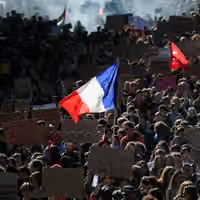
Over one million Iranians rallied across Europe, North America and Australia on Saturday in response to a call by exiled Prince Reza Pahlavi, while nighttime chants echoed from rooftops and apartment blocks inside Iran in a coordinated show of solidarity.
The largest gatherings took place in Toronto, Los Angeles and Munich, the three cities highlighted in the exiled prince's calls for solidarity rallies, where almost one million demonstrated.
In Munich, the local police estimated the crowd at around 250,000 people. Protesters filled the Theresienwiese grounds, waving lion-and-sun flags and chanting slogans in support of the national uprising in Iran.
In a speech delivered to the massive crowd in Munich, Pahlavi called the current moment “our final battle.”
The Toronto and Los Angeles rallies of Iranians also each drew 350,000 people, according to the two cities’ police.
In Toronto, Canadian officials including Ontario Premier Doug Ford and provincial ministers addressed demonstrators, voicing support for the Iranian people and condemning Tehran’s crackdown.
In Los Angeles which is home to the biggest population of Iranian diaspora, speakers and cultural figures joined the rally, framing the turnout as a message to Western governments to increase pressure on the Islamic Republic.
The global demonstrations coincided with renewed nighttime protests across Iranian cities following a call by the exiled prince.
Videos sent to Iran International showed residents in Tehran, Karaj, Shiraz, Isfahan, Rasht, and Kermanshah chanting “Death to the dictator” and other anti-government slogans from rooftops and windows. In some neighborhoods, chants referenced Pahlavi directly, echoing slogans heard at overseas rallies.
Political developments unfolded in parallel. Canada announced sanctions against seven individuals accused of involvement in repression and transnational intimidation.
In Washington, two US officials told Reuters the military is preparing contingency plans for a possible multi-week operation against Iran if ordered by President Donald Trump.
Meanwhile, Axios reported that US negotiators Steve Witkoff and Jared Kushner consider the prospects of a comprehensive agreement with Tehran “difficult, if not impossible,” ahead of expected talks in Geneva hosted by Oman.
Iran’s exiled Prince Reza Pahlavi called for tighter sanctions, potential military action and rapid political transition to topple Iran’s ruling system, warning that negotiations and delay would cost more lives.
Addressing journalists on the sidelines of the Munich Security Conference on Saturday, Pahlavi argued that failure to confront the authorities decisively would embolden authoritarian actors beyond Iran.
Diplomatic pressure alone, he added, was insufficient. “It is time to end the Islamic Republic,” he said.
His remarks came at a time when Iran, nuclear negotiations, regional tensions and domestic crackdowns have been among the key issues discussed at the Munich Security Conference.
Protests persist despite crackdown
Resistance inside Iran, Pahlavi said, continues despite arrests and executions of the people.
“When they came to the streets, they were only met with this brutal genocidal level, industrial level massacre,” he said, adding that many were forced to retreat but “people are still out there chanting.”
He warned that delay could cost lives. “Every day that goes by, more people could die,” he said, arguing that negotiations would not yield meaningful results.
The 2026 Munich Security Conference has become one of the most outspoken platforms for presenting international perspectives on the future of the Islamic Republic, with Prince Reza Pahlavi, US Senator Lindsey Graham, European Parliament President Roberta Metsola, and Ukrainian President Volodymyr Zelensky each addressing the issue from different angles – including Iran’s protests, the role of the Revolutionary Guards, international pressure and possible future scenarios.
Sanctions and revenue pressure
Pahlavi urged stronger enforcement of sanctions to weaken the government’s ability to sustain its security forces.
“One way to weaken the regime even further is to impose more restrictions so that their source of revenue is cut off so they can no longer sustain their own elements,” he said.
“Any source of revenue to the regime will contribute to its ability to sustain itself a little bit longer, but at the end it will fall,” he added, describing financial pressure as a way to accelerate collapse.
Earlier, Pahlavi designated February 14 as a global day of action and called on Iranians abroad to rally in Munich, Los Angeles and Toronto, as well as in other cities worldwide, to demonstrate their support for the “Lion and Sun Revolution” and their compatriots inside the country.
Regional instability and Europe’s stakes
Instability across the Middle East is rooted in radical Islamist movements, including forces linked to Tehran, Pahlavi noted.
“This regime has only one purpose which is to export this ideology. It is a threat to its own people.”
He said political change would benefit neighboring countries and Europe alike.
“We have now a possibility of even more migration to Europe as a result of any continuation of the status quo.”
“A free Iran that would be able to supply Europe with its energy needs would certainly be an alternative to the only source that you have right now,” he added, referring to Europe’s reliance on Russia.
He described a post-Islamic Republic transition as a “win-win” outcome that would open trade and investment while strengthening stability.
Ready to lead transition
The exiled prince said calls for his leadership inside Iran carry both weight and responsibility.
“Millions of Iranians chanted my name and called for my return. That humbles me and gives me a lot of responsibility at the same time to answer their call and to be the leader of this transition as they have asked for,” he said.
He emphasized that participation in the movement is broad-based.
“Anybody who agrees with those four core principles, irrespective of their political affiliation or viewpoints, can be part of this national struggle for freedom,” he said.
First 100 days and institutional continuity
Stabilizing the country would be the priority immediately after a collapse, Pahlavi added.
The first phase would be to “stabilize the country, stabilize the economy” and ensure security, he said, arguing that encouraging “maximum defections” would prevent chaos similar to Iraq after Saddam Hussein.
Those “criminally responsible” with “the blood of people on their hands” would face courts, he added.
He also outlined a phased constitutional process culminating in elections.
“At the end of this process, once the constitution is approved and the nation votes in a referendum to adopt it, we will have the election of the first new parliament and the first new government of that future democracy.”
Monarchy, republic and inclusion
Asked about the future political system, Pahlavi said voters – not factions – should decide.
“Democracy is not about exclusion, it’s about inclusion, unless you are not in conformity with democratic principles,” he noted.
“My position is neutral towards the outcome,” he said, arguing that Iranians should decide “by the ballot box.”
He rejected criticism that he seeks power for himself.
“I’m not running for office. I’m not running for a job. I’m not seeking a power or a title,” he said.
“The day that happens, I consider that the end of my political mission in life.”