School students told to burn images of Trump and Netanyahu
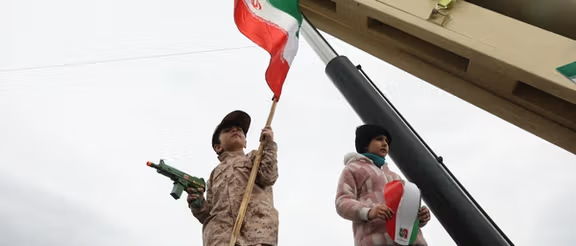
Iranian education officials asked school students to burn photos of US President Donald Trump and Israeli Prime Minister Benjamin Netanyahu as part of government-organized events to mark the 1979 Islamic revolution.
A message shared on the Shad educational application, the Education Ministry’s student-learning and messaging platform, showed an instructions to students to film the act and send the video to school authorities, reminding them that they will be honored at a celebration in exchange.
Officials titled the campaign “Khamenei Is My Life,” presenting it as an initiative for students to demonstrate loyalty to Supreme Leader Ali Khamenei.






An Iranian teachers' union has confirmed the identities of 200 students killed during the January protests and published their names, defying efforts to suppress information about the deaths.
The Coordinating Council of Iranian Teachers’ Trade Associations released the list in a public statement, calling it both a record of loss and a demand for accountability.
The council emphasized that documenting the names is not only a way to honor the victims but also to assert fundamental rights – life, education, and a future – that it says were systematically taken from these children.
The group said that the publication is a direct response to efforts to obscure the circumstances surrounding the deaths.
Little is known about the students’ lives, as many families have been pressured into silence, with some avoiding mentioning the cause of death in funeral notices for fear of retaliation.
Activists report that threats have included warnings regarding the safety of surviving children.
The teachers’ council addressed these pressures directly, writing: “They banned the names, forced burials in silence and denied the truth. Erasure, denial and distortion were a continuation of the same policy that had already taken their lives.”
Mohammad Habibi, spokesperson for the council, stressed the scale of the loss in a post on X: “We are no longer talking about ‘desks’ and ‘classrooms’; by reaching the number 200, they have effectively massacred an entire school.”
On social media, users have circulated photos and accounts of the teenagers under hashtags such as “empty desks,” sharing stories that are largely absent from official media coverage.
Fifteen-year-old Ghazal Janghorban, an only child and a computer studies student, was killed in Isfahan on January 9 while protesting with her parents.
She was struck by three bullets – one to the chest, one to the abdomen, and one to the leg – and died in the same hospital where she was born. Her mother has shared videos of her singing and images of her empty room on Instagram, paying tribute to her daughter and writing that her cat still waits for her return.
Sina Ashkbousi, also an only child, was shot dead in eastern Tehran on January 8.
Just days earlier, friends had celebrated his seventeenth birthday at a café with a Harry Potter theme, reflecting his love for the series.
His father later wrote online that he was proud of a son who had grown up quickly and whose life had ended too soon.
Amir-Mohammad Safari, 15, was killed in Tehran on January 8 by two live rounds to the heart.
His family searched for six days before identifying his body in a hospital. Like several others on the list, he balanced school with work, taking on manual labor and street vending to help support his family.
Also among those named is 14-year-old Sam Sohbatzadeh, who had worked since age 10 to help support his household.
He left school in the fall to work full time and was killed by a direct gunshot wound to the head on January 8 in southern Tehran.
According to the Kurdpa news agency, his family secretly transported his body overnight to their hometown, where he was buried two days later in a village cemetery in Ardabil province.
Some families continue to grieve quietly. Fifteen-year-old Abolfazl Norouzi, killed by gunfire in Mashhad, had left school to work in a mechanic’s shop and support his family.
Relatives say security authorities pressured the family to label him a member of the IRGC’s Basij volunteer paramilitary forces, a request they refused. They also report being denied permission to hold a formal mosque ceremony and say mourning banners were removed from their home.
Abolfazl had planned to resume his studies in evening classes and dreamed of buying a motorcycle with his earnings. Friends and relatives describe him as kind, responsible, and eager to help, a teenager whose plans for the future were cut short.
Iranian exiled Prince Reza Pahlavi urged Iranians abroad to stay united as they prepare for protests by Iranian expat communities around the world on February 14.
“As you are prepare for the Global Day of Action on February 14th, I ask all my fellow compatriots around the world no to pay attention to side issues and distractions, but instead with unity of voice and continued discipline — just as in past weeks — to be a worthy representative of the Iranian nation and the Lion and Sun Revolution,” he wrote on X.
Prince Pahlavi has declared February 14 as a global day of action and solidarity in support of the uprising, urging Iranians abroad, particularly in Munich, Los Angeles, and Toronto, to take to the streets and demand immediate, practical support from the international community for the people of Iran.
Iranian singer Mehdi Yarrahi resurfaced online with a new song titled “Auschwitz,” triggering widespread discussion on Iranian social media.
Yarrahi, who is known for his protest songs in support of the Women, Life, Freedom movement, received 74 lashes as part of his sentence last March.
He was arrested in August 2023 after releasing Rousarieto (Take Off Your Headscarf).
The new track features lyrics by Hossein Shanbehzadeh, an Iranian blogger who was arrested in 2024 after posting a single dot in response to a tweet from Supreme Leader Ali Khamenei.
Free expression group ARTICLE 19 said China has spent more than a decade helping Iran build one of the world’s most restrictive internet control systems, supplying technology and a governance model used for censorship, surveillance and shutdowns.
The report released on Monday, titled “Tightening the Net: China’s Infrastructure of Oppression in Iran,” traces cooperation dating back to at least 2010 and says Chinese firms supplied or supported equipment and know-how used for internet filtering, deep packet inspection, centralized traffic management, and mass surveillance.
It named companies including ZTE, Huawei, Tiandy, and Hikvision, and describes how Iran built out a tightly controlled “National Information Network” designed to function as a domestic intranet while progressively limiting access to the open, global internet.
“In its pursuit of total control over the digital space, Iran borrows directly from the Chinese digital authoritarian playbook,” Michael Caster, head of ARTICLE 19’s China program, said in the report.
The organization said Tehran’s embrace of Beijing’s “cyber sovereignty” concept – the idea that governments should have near-total authority over online information flows within their borders – has helped normalize censorship and surveillance in international forums.
“Emulating China’s infrastructure of oppression helps Iran entrench power, sidestepping accountability and exercising full control over the information environment. That way, dissent is not just silenced, it is prevented from ever surfacing,” said Mo Hoseini, the head of the group’s Resilience department said.
ARTICLE 19 said the technology and institutional alignment have become more visible during major crackdowns, including the recent wave of protests that began late December.
The group said authorities responded with widespread violence and arrests, and then escalated to nationwide network interference on January 8, 2026, followed by broad disruption of internet, phone, and mobile networks by January 11, cutting off communications as security forces moved to suppress dissent.
The report said the latest blackout showed a level of centralized control that reached beyond social media and messaging, affecting essential services including banking, healthcare, and emergency response.
It added that Iran has repeatedly used shutdowns during earlier periods of unrest, including during the 2022 “Woman, Life, Freedom” protests and demonstrations in 2019-2020, but argued the 2026 disruption was broader and more aggressively enforced than previous episodes.
ARTICLE 19 said Iran also intensified efforts to restrict satellite connectivity. It said Starlink traffic was heavily disrupted during the crackdown and that the sophistication of the disruption suggested military-grade capabilities.
The report said authorities also seized satellite equipment door-to-door and imposed harsh penalties under a 2025 law criminalizing the possession of satellite internet terminals.
While the group said China’s direct role in the specific Starlink disruption was not confirmed, it argued that Chinese assistance has been central to the foundations of Iran’s internet control architecture, and that Beijing continues to provide a template for the state’s approach to “digital authoritarianism.”
The report describes Iran’s Supreme Council of Cyberspace – established in 2012 and chaired by Supreme Leader Ali Khamenei – as structurally similar to China’s Cyberspace Administration of China, with both bodies overseeing centralized filtering, restrictions on foreign platforms, and the expansion of state-approved domestic alternatives.
It said Iran’s National Information Network increasingly mirrors features associated with China’s “Great Firewall,” including embedded surveillance and mechanisms to compel service providers to share data or throttle traffic.
The organization said the spread of surveillance and censorship tools risks entrenching repression inside Iran while eroding broader norms of internet freedom.
It also called for stronger export controls and sanctions enforcement targeting suppliers of surveillance and filtering technologies, greater corporate transparency, and increased support for secure circumvention tools and resilient connectivity options for Iranians during shutdowns.
An explosion struck a military convoy in the Mahmoudabad area of Iranshahr in southeastern Iran on Wednesday, destroying at least two armored vehicles, reported Halvash Telegram channel, which covers developments in Sistan-Baluchestan province.
Sources cited by Halvash said the sound of the explosion was heard across the city and that military and security forces increased their presence around the scene afterward.
There was no official statement from authorities regarding the incident.