Iran negotiators have no authority to discuss missiles, Khamenei advisor says
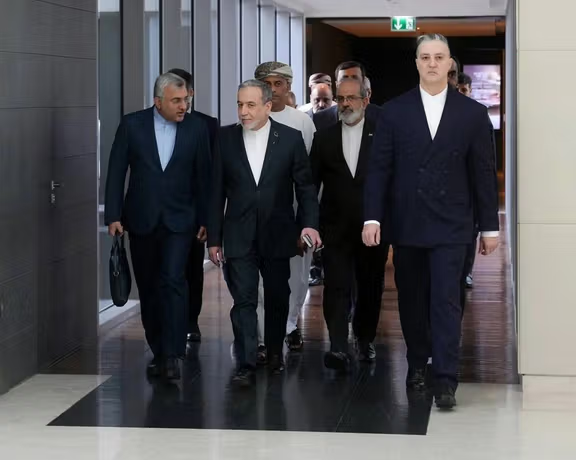
Iran’s negotiators have no authority to discuss missile capability in their talks with the US, a senior advisor to Supreme Leader Ali Khamenei, who was recently appointed as the Secretary of Supreme Defense Council, said on Wednesday.
Ali Shamkhani warned that war with the United States would not be limited to the two sides and would extend in the region, Tasnim News Agency reported.
“This war in such a region would, in principle, not be confined to military issues alone, and given the region’s energy capacity, it would certainly affect numerous factors around the world that impact the lives of people globally,” he added.
Shamkhani also said Iran's missile capabilities are a red line and not up for negotiations.





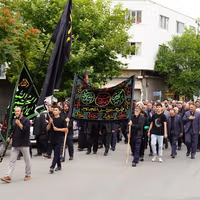
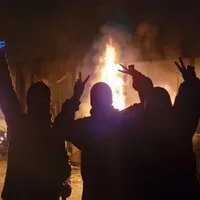
As the Islamic Republic marked the 47th anniversary of its 1979 revolution on Wednesday, Iranian authorities staged nationwide rallies while the country’s leadership faced mounting pressure at home and abroad.
State media broadcast images of large crowds gathering in Tehran and other cities to commemorate the anniversary, an annual event organized by the government.
In the capital, participants assembled at Azadi Square, waving Iranian flags and portraits of Supreme Leader Ali Khamenei and the late Ruhollah Khomeini, the founder of the Islamic Republic.
President Masoud Pezeshkian addressed the gathering in Tehran, saying Iranians had risen up in 1979 to seek justice and independence.
He said the anniversary demonstrated that people had turned out “in their millions” to defend the revolution, follow the country’s leadership and uphold national values.
Pezeshkian accused the United States and European countries of seeking to undermine the Islamic Republic since its founding, referring to the 1980–88 Iran-Iraq war and longstanding Western sanctions.
The commemorations came as Iran’s clerical establishment confronts renewed external pressure and lingering domestic unrest.
US President Donald Trump said this week he was considering sending another aircraft carrier group to the Middle East, as indirect nuclear talks resume and Israeli Prime Minister Benjamin Netanyahu presses Washington to take a harder line on Tehran.
While state television highlighted the scale of the anniversary rallies, witnesses in Tehran reported hearing anti-government chants from residential neighborhoods on Tuesday night during government-organized festivities, a sign of tensions that have simmered since a bloody crackdown on nationwide protests in January.
Iran’s leadership has long used the anniversary to project unity and resilience. Analysts say participation includes committed supporters of the system, members of state institutions and others attending what has become a public holiday marked by organized events.
The anniversary events unfolded against a backdrop of economic strain, Western sanctions and uncertainty over the future of nuclear negotiations against the backdrop of US military buildup in the region.
Iranian media published images from the government-organized 22 Bahman rally in Tehran showing mock coffins draped with US flags and bearing the names and photos of senior US military commanders.
The names and images of Brad Cooper, commander of US Central Command, Randy George, US Army chief of staff, and Curtis R. Bass, deputy commander of Ninth Air Force (Air Forces Central) and deputy air component commander for US Central Command, appeared on the coffins among other US military officials.
Cooper attended the talks in Oman on Friday as a member of the US negotiating delegation in discussions with the Islamic Republic.
A student-linked newsletter at Iran’s Khajeh Nasir University of Technology said on Wednesday it backed exiled Prince Reza Pahlavi as a key figure for national convergence and political change, according to a statement published on its Telegram channel.
“The Khajeh Nasir Newsletter, in continuation of its previous positions and within the framework of its historical and national responsibility, announces its explicit and clear support for Prince Reza Pahlavi as one of the key alternatives for fostering national convergence, moving beyond the current situation, and rebuilding the governance structure in Iran,” read the statement.
The statement was released on 22 Bahman (11 February), the day the Pahlavi dynasty was overthrown, giving way to the establishment of the Islamic Republic.
The arrest of several prominent reformist figures in Tehran appears less aimed at silencing dissent than at tightening control at a moment of acute vulnerability for the state, as Iran navigates renewed talks with the United States under the shadow of war.
The detentions, which have targeted senior members of the Reform Front of Iran and figures associated with President Masoud Pezeshkian, come as the Islamic Republic remains shaken by the deadliest crackdown in its history.
The protests, which gained momentum after a call by exiled Prince Reza Pahlavi, were crushed by the Islamic Republic’s live fire, leading to the massacre of at least 36,500 people.
The arrests also come at a time when Tehran’s theocracy is deeply uncertain about the trajectory of diplomacy with Washington.
Officials have framed the arrests as a response to “coordination with enemy propaganda” and efforts to undermine national cohesion—language that signals heightened sensitivity to any challenge to the state’s narrative at a time of external pressure.
With talks with the United States back on track, Iran’s leadership appears intent on closing ranks at home, moving to eliminate deviations from the official line, particularly among figures who until recently were tolerated as part of a tightly managed political spectrum.
Public statements by judicial and security bodies have offered little ambiguity. Those detained have been accused of promoting “surrenderism” toward the United States and acting in the interests of Israel.
The hardline daily Kayhan, whose editor is appointed by the supreme leader, described those arrested as extremists who had aligned themselves with “overthrowists,” effectively placing even moderate critics beyond the pale.
The detainees
Those detained include senior figures from the Reform Front and its largest constituent party, the Union of Islamic Iran People Party. Among them are Azar Mansouri, head of the Reform Front; Javad Emam, its spokesman; former diplomat Mohsen Aminzadeh; and the veteran politician Ebrahim , the leader of radical students who stormed the US embassy in 1980.
One case appears to reflect a clearer red line.
An audio recording that circulated online captured remarks by Ali Shakouri-Rad, a senior party figure, who rejected the official account of the recent protests and accused security forces of manufacturing violence.
“Security institutions in Iran, in every protest, have injected violence to use it as a pretext for repression,” he said. “It has been like this from the beginning, and it has gotten worse day by day.”
Yet for much of Iranian society—still grieving the mass killing of protesters in January—this confrontation within the political elite has the feel of an argument unfolding in a parallel universe.
The protests, which began over economic hardship and rapidly escalated into nationwide calls for the overthrow of the Islamic Republic, were met with overwhelming force. Tens of thousands were killed in a matter of days, according to internal assessments reviewed by Iran International.
In the aftermath, Pezeshkian and the moderate camp from which he emerged broadly aligned themselves with the state’s narrative, avoiding public confrontation with the security establishment.
That alignment proved decisive. For many Iranians, Pezeshkian’s election in 2024 represented a final, tentative wager on incremental change from within the system. His conduct during and after the crackdown extinguished that hope.
Against that backdrop, the latest arrests appear less a dramatic rupture than a belated narrowing of a political space that had already collapsed in the public mind.
The exception lies with a small group of activists who crossed a line the system still treats as inviolable. Several of those detained were linked to a January 2 statement signed by 17 political and civil figures declaring the Islamic Republic illegitimate and calling for a peaceful transition of power.
Unlike most reformist figures, the signatories explicitly rejected the framework of the existing order, underscoring where the authorities continue to draw their true red lines.
Figures associated with the 2009 Green Movement have also been swept up, including advisers and relatives of its leaders, Mir-Hossein Mousavi and Mehdi Karroubi. Mousavi, under house arrest for more than a decade, recently described the killing of protesters as a “black page in Iran’s history” and called on leaders to step aside.
As negotiations with the United States resume amid warnings of war, the leadership is signaling that internal discipline will take precedence over political pluralism — even of the carefully managed kind once associated with reformism.
For most Iranians outside the corridors of power, however, the arrests change little. Few still see themselves reflected in the state’s internal disputes.
The Canadian Senate held a hearing on Tuesday on a new immigration and border security bill with much of the discussion focusing on individuals allegedly linked to the Islamic Republic living freely in Canada.
The bill, dubbed C-12, introduces strict asylum filing deadlines, shifts many decisions to paper-based reviews, expands border officers’ powers to search digital devices without judicial oversight, and allows the government to suspend visas and permits for public interest reasons.
Among those who testified were Ardeshir Zarezadeh, a lawyer and president of the International Centre for Human Rights, Timothy McSorley, National Coordinator of the International Civil Liberties Monitoring Group; as well as representatives from Amnesty International and the UN Refugee Agency, UNHCR.
“Thousands of Iranians have been killed in the streets simply for protesting, while at the same time individuals affiliated with the Iranian regime are able to live comfortably in Canada and benefit from Canadian values,” Zarezadeh said.
He called the bill’s emphasis on asylum deadlines a “misdirection” and said Canada already has tools to identify and deport Islamic Republicagents — the failure is in “weak visa screening systems prior to entry.”
Other witnesses argued that rigid one-year claim deadlines disproportionately harm genuine refugees, especially those traumatized or suddenly displaced, while security threats often enter with fraudulent documents and evade such barriers.
While the government emphasizes the need for swift passage of the bill to address US border security concerns, the Senate committee is currently synthesizing these expert testimonies to prepare its final report.
Canada last week condemned the killing of protesters and use of violence by Iranian authorities after a video shared by Iran International showed an armored vehicle operated by Iranian security force running over demonstrators in Ardabil, northwest of Iran.
Human rights advocates in Canada are urging the country’s national police to gather evidence on Canadians linked to Iran’s repression apparatus after thousands of protesters were killed in January.
The push comes amid mounting demands for accountability after Iran International’s Editorial Board confirmed that more than 36,500 Iranians were killed by security forces during the January 8–9 crackdown, the deadliest two-day protest massacre in history.
Advocates say Canada must ensure perpetrators cannot find refuge abroad — and that Iranian Canadians have a direct avenue to report evidence.