New analysis by the Institute for Science and International Security (ISIS), published on Monday, shows that all known entrances to the underground tunnel complex at Iran’s Esfahan Nuclear Technology Center have been completely backfilled with earth.
"High-resolution commercial satellite imagery taken on February 8–9 indicates that the middle and southern tunnel entrances are fully covered and no longer recognizable, while the northernmost entrance has also been buried, blocking internal access to the complex," the report said.
According to the report, no vehicle activity was visible around the entrances at the time the imagery was collected.
The report said the work is a systematic effort to harden the underground complex against potential aerial attack and to complicate access by ground forces. The project was previously observed at the northern entrance and has now been extended across the entire site.
The report said that it is possible, though unconfirmed, that equipment or materials were moved into the tunnels before the entrances were sealed.
“Esfahan houses key facilities for uranium conversion, fuel fabrication and other nuclear activities,” the ISIS report said.


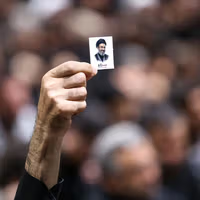
Iran’s Revolutionary Guard intelligence organization and the Intelligence Ministry have pressured families of those detained during nationwide protests to attend the state-organized February 11 rally marking the anniversary of the 1979 Revolution, sources close to the families told Iran International.
Security officials informed several families their presence at the February 11 march must be “verifiable,” including by taking photos and videos of themselves at the rally and sending them to security bodies, the sources said.
The sources said officials coupled the demand with threats and psychological pressure, telling families that only if they comply might their detained relatives be released, spared execution, or see their sentences reduced.
The reported pressure comes amid what Iran International has previously documented as an intensifying crackdown following nationwide protests, including mass arrests and a rise in reported deaths in custody. Observers have said the trend may signal a broader “purge” phase aimed at eliminating evidence of a bloody suppression.

Weeks after Iran’s bloody January crackdown, intimate tragedies are emerging from the silence, among them the story of a young auto mechanic and his dog.
Ali Karami, 26, who was shot and killed by Iran’s security forces on January 8, had one wish: “If I die before my dog,” he said, “let her see my lifeless body.”
He said it in a video posted to Instagram in October 2024, narrating as he played tug-of-war with his dog, Ariel—laughing, absorbed in an ordinary moment of life.
After his death, the video spread widely across Iranian social media, capturing the public imagination as viewers returned to his words with disbelief.
Karami believed dogs understand death, and that without seeing him, she might think he had simply abandoned her.
He may have contemplated the possibility of dying young, but not like this—not shot in the street, his private reflection transformed into a national elegy.
Karami was an auto repair mechanic and a devoted dog lover who rescued stray animals. Originally from Kermanshah Province, in the country’s Kurdish region, he later moved to Tehran for school and work.
His Instagram account, @alikaramiservis, offers a window into his daily life—his pride in his craft, his affection for dogs, and his love of nature and music, including the songs of Dariush Eghbali.
It is also a record of one of the tens of thousands of people who took to the streets demanding freedom and were met with bullets.
Karami was reportedly trying to protect an elderly woman when he was shot and killed.
In many of his photos, Ariel—the dog he referred to as his daughter—is never far from his side. They play ball, cook, or simply share quiet time at the repair shop: fragments of an unremarkable, joyful life.
“She understands death,” Karami says in the October video. “If she does not see my lifeless body, she will think I abandoned her and will keep waiting for me to come back.”
“That’s a friendship without limits,” he adds. “Pure loyalty.”
Karami’s final post, dated December 30, shows him proudly displaying his work: a car he had restored at Sehand Car Clinic in Tehran.

From February 8 onward, the account appears to have been run by family members or friends. That day, they posted a tribute video showing Karami dancing, exercising, and spending time with Ariel. They also reposted the October video—his voice now echoing with an unintended prophecy.
This time, there was an ending.
The final images show Ariel lying at Karami’s gravesite.
Just as he had asked.
In the most tragic way, a fate he once spoke of—unknowingly—was fulfilled.

Turkey’s foreign minister said on Monday there is no immediate threat of a military conflict between Iran and the United States, stressing Ankara is working to avert a “disaster”.
"At the moment, there does not seem to be at least an immediate threat of war (between Iran and the United States)," Turkish Foreign Minister Hakan Fidan told CNN Turk.
"One night during the 12-day June war, we received a phone call from the US Secretary of State (Rubio) who said, 'Tell the Iranians, anything can happen in a few hours'. I talked to my Iranian counterpart and he said, “How can that be possible? We had set a date for the meeting.”
"It was the US that was talking, and Israel that was striking. This time the situation may be different. We are doing everything we can to prevent a disaster," Fidan said.
Asked about the possibility of regime change in Iran, Fidan said, "The regime does not change with an airstrike or anything else. It's a pipe dream."
"The problem is not the regime itself, the problem is the decisions and policies taken by the regime. There are also regimes that are more centrally totalistic than the Iranian regime."
He warned that if an Iran-US war breaks out, it is not clear where it will stop.
"If there is genuine will to resolve the issue, you can see its impact on the ground. What matters to us is that as talks move toward a concrete outcome, the threat of war also steadily recedes," he added.

Mohammad-Javad Larijani, an Islamic Republic insider and former senior adviser to Iran’s Supreme Leader, said any US military strike would trigger a harsh response from that could kill many American troops.
He said Tehran would abandon proportional retaliation and instead move to strike what he described as the “roots” of American interests across the region.
“In response to a potential act of aggression, we are not looking to respond tit for tat,” Larijani said. “Our posture would move from defensive to offensive, striking points where we believe we must hit the roots of that force’s presence in the region.”
He contrasted what he called a “defensive philosophy” — limited, proportional retaliation — with what he described as a broader strategy that would be activated if the United States initiated hostilities.

“This time, if they do it, we will move beyond that into a much broader offensive approach,” he said, adding that Iran’s “target set changes significantly” under such a scenario.
Referring to past hostilities, Larijani said Iran had gained “a great deal of experience” in the June conflict with the United States and Israel and warned there would be “many surprises” for the enemy.
He also took aim at President Donald Trump’s approach, saying his strategy of launching a rapid strike followed by a propaganda campaign “would not be workable” under the framework set by Iran’s leadership.
“They should prepare many coffins for the bodies of their slain troops who will arrive in Washington,” Larijani said, adding that American interests in the region would “go up in smoke.”

A senior official in Iran’s Islamic Revolutionary Guard Corps said the United States warned Tehran it could face military action if it did not accept a set of conditions ahead of renewed diplomatic talks.
Islamic Revolutionary Guard Corps official Aziz Ghazanfari, a deputy head of the Guard’s political department, said Washington initially presented Iran with four demands that went beyond the nuclear issue when outlining a framework for diplomacy.
According to Ghazanfari, US officials insisted that any diplomatic path would require Iran to address its ballistic missile program, curb support for regional armed groups, and accept limits on uranium enrichment.
In a commentary published by Sobh-e Sadegh, a weekly outlet affiliated with the Revolutionary Guards, he said the message was accompanied by a warning that failure to accept the conditions would leave Iran vulnerable to military action.
Ghazanfari described the approach as “psychological warfare” aimed at pressuring Tehran ahead of indirect talks held in Muscat.
The indirect talks in Oman, which began on Friday through intermediaries, were described by both sides as preliminary.
Officials have said the discussions may continue this week, though neither Washington nor Tehran has publicly outlined a timetable or agenda beyond broad references to diplomacy.
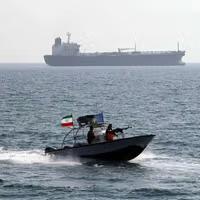
The talks come as the United States has stepped up its military posture in the region. Washington has deployed the aircraft carrier USS Abraham Lincoln and accompanying naval assets to the Middle East, citing the need to deter escalation.
President Donald Trump has warned that “bad things could happen” if Iran does not reach a deal, while also saying he prefers a diplomatic outcome.
Ghazanfari said Iran rejected the US conditions outright and insisted that negotiations be limited to the nuclear file, asserting that Tehran’s position prevented Washington from setting the terms of engagement through threats or coercion.
He portrayed Tehran’s stance as a demonstration of resolve, arguing that refusing to negotiate under pressure reflected what he described as Iran’s “national strength.”