Several Mideast-bound flights cancelled amid Iran conflict fears


Several airlines, including Lufthansa, Air France, KLM, and Swiss have canceled their flights to the Middle East on Friday evening and Saturday including to Israel, the UAE, and Saudi Arabia, according to flight information published on airport websites, amid fears of a conflict involving Iran.
KLM said it has stopped flying to Israel, Saudi Arabia, and the United Arab Emirates, making it among the first major European airlines to suspend operations to several Middle Eastern destinations at once.
The airline told NOS that it will not fly to the Middle East until further notice due to "the geopolitical situation".
Air France said it had scrapped flights to Tel Aviv and Dubai due to the shifting security conditions in the region, adding that it has not yet set a date for resuming service.
British Airways said it has paused its evening flights to Dubai, noting that it is closely tracking developments and assessing whether further route changes are necessary.

US officials told Iraqi leaders Washington would starve Baghdad of oil revenue if it kept up economic links with Iran and would suspend ties if politicians deemed close to Iran became ministers, Reuters reported on Friday citing sources.
The warnings would mark a sharp uptick in rhetoric on Iraq by the administration of US President Donald Trump as it pursues its maximum pressure campaign of sanctions against its Mideast arch-nemesis Iran.
Citing three Iraqi officials and a source familiar with the matter, the news agency reported that US Charge d'Affaires in Baghdad Joshua Harris conveyed the warnings in conversations over the past two months with Iraqi officials from across its fractured political spectrum.
Iran relies closely on the banking sector its Western neighbor, where recent parliamentary polls kept Shi'ite Muslim parties in the ascendant and delivered gains for politicians from the kaleidoscope of militias and parties backed by Tehran.
The Islamic Republic's own economic lifeline of oil exports is under heavy pressure from US sanctions, even if export levels remain buoyant one year into Trump's second term, and Iraqi financial instruments help it skirt US curbs.
Following a 2003 US invasion, the United States has maintained de facto control over Iraqi oil revenues and its preponderant banking and financial puts the funds within its reach.
"The United States supports Iraqi sovereignty, and the sovereignty of every country in the region," Reuters quoted a US State Department spokesperson as saying in response to a request for comment. "That leaves absolutely no role for Iran-backed militias that pursue malign interests, cause sectarian division, and spread terrorism across the region."
US warnings also broached cutting off engagement with Baghdad if 58 members of parliament Washington views as linked to Iran are elevated by Prime Minister Shia al-Sudani to cabinet positions.
"The American line was basically that they would suspend engagement with the new government should any of those 58 MPs be represented in cabinet," Reuters quoted an Iraqi officials as saying.
"They said it meant they wouldn't deal with that government and would suspend dollar transfers," the source added.
Forming the new cabinet is due to take months and the US moves did not appear to be linked to a recent deadly crackdown on protestors in Iran, which resulted in new US sanctions on Iranian officials and oil shipping networks.

Iranian security forces deployed unknown chemical substances amid deadly crackdowns on protestors in several cities earlier this month, eyewitnesses told Iran International, causing severe breathing problems and burning pain.
They described symptoms that they said went beyond those caused by conventional tear gas, including severe breathing difficulties, sudden weakness and loss of movement.
“What was fired was not tear gas,” one protester said.
"People collapsed," another eyewitness said.
Iranian authorities crushed unrest earlier this month in the deadliest crackdown on protestors in the Islamic Republic's nearly 50-year history.
According to accounts, the gases caused intense burning of the eyes, skin and lungs, along with acute respiratory distress, repeated coughing, dizziness, loss of balance and, in some cases, vomiting or coughing up blood.
Witnesses said the severity and persistence of the symptoms differed from their past experiences with tear gas, although they said they could not identify the substances used.
Gas fired into crowds and escape routes
Witnesses said gas canisters were fired into crowds and along escape routes, including narrow streets and alleys.
According to the accounts, in some cases gunfire began at the same time, or immediately after, protesters lost the ability to walk or run and fell to the ground.
Several witnesses said that moments of immobilization became points at which shooting intensified, particularly when protesters collapsed in alleys or while trying to flee.
Reports came from multiple cities, including Tehran, Isfahan and Sabzevar.
Sabzevar footage
Videos received from Sabzevar, a city in Razavi Khorasan province in northeastern Iran, and reviewed by Iran International showed security personnel wearing special protective clothing and masks designed for hazardous chemical materials, positioned on military-style vehicles in city streets.
Warning symbols associated with hazardous substances were visible on vehicles in the footage. Sounds consistent with gunfire could be heard in separate videos.
Iranian forces are seen wearing chemical-hazard protective gear on military-style vehicles in the streets of Sabzevar, northeast Iran.
A yellow triangular hazardous-materials warning sign is visible in the footage, while gunfire can be heard in a separate video.
Isfahan accounts
In central province of Isfahan, witnesses said tear gas with chemical characteristics was fired directly into crowds of protesters, including teenagers, young people and older individuals.
They said attempts to reduce the effects of the gas using common methods such as wet cloths quickly proved ineffective.
Witnesses described scenes in which people fleeing into alleys developed severe breathing difficulties and collapsed after running short distances. They said shooting began while protesters were in that condition, with scenes they described as “like war movies.”
Other witnesses described the smell of the gases as a mixture of pepper, swimming-pool chlorine, bleach and vinegar, and said the sky filled with smoke in red, yellow and white colors.
Several women and a 17-year-old girl described seeing an unknown device that, they said, “without the sound of gunfire, fired something like flames in red and yellow.”
“Seconds later, the street was full of smoke and vapor,” they said, adding that the smell resembled ammonia, drain cleaner and, in some areas, mustard.
One woman said two plainclothes agents put on protective masks before throwing gas canisters toward nearby crowds. She said young people closest to the impact “quickly developed coughing, intense burning and inability to move” and shouted: “I’m burned.”
Tehran accounts
In Tehran, witnesses from several neighborhoods said gas was fired repeatedly, producing thick smoke and severe irritation.
Protesters said the gases caused intense burning of the eyes and lungs and numbness in the lips, with smoke described as green, yellow and black.
Witnesses said protesters who felt suffocation sought refuge inside nearby homes, but said security agents were positioned near some of those locations.
In addition to tear gas, witnesses spoke of “unknown gases with more severe effects,” saying those exposed experienced sudden weakness, inability to walk and loss of breath.

Fear of hospitals
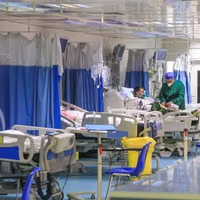
In a number of accounts, witnesses said fear of the presence of security agents at hospitals and the risk of arrest led many wounded protesters to avoid medical centers.
They said some treatment was instead carried out at private homes with the help of volunteer doctors.
Some witnesses said people they knew continued to suffer severe coughing, nausea and skin blistering days after exposure.
Medical assessment
Alan Fotouhi, a physician and professor of clinical pharmacology based in Sweden, told Iran International that the symptoms described by witnesses did not match those typically associated with standard tear gas.
He said the pattern of symptoms, severity of harm and persistence of effects differed from what is normally observed with conventional tear gas exposure.
Fotouhi said the reported effects could result from a combination of high-dose tear gas and other highly irritating chemical substances, but said identifying the exact materials would require laboratory analysis.
Iranian authorities have not commented on the witness accounts.
Iran is a signatory to the Chemical Weapons Convention, which restricts the use of chemical agents against civilians.
Human rights groups have condemned the use of force against protesters in Iran, including the use of tear gas and live ammunition.
The UN Human Rights Council on Friday overwhelmingly passed a resolution condemning what it described as an unprecedented violent crackdown by Iranian security forces on nationwide protests, citing the deaths of thousands of protesters, mass arrests, widespread internet shutdowns, and serious human rights violations since demonstrations erupted in late December.
The Council said it “strongly deplores the human rights situation in the Islamic Republic of Iran, especially the violent crackdown of peaceful protests resulting in the deaths of thousands of persons, including children,” while urging Tehran to immediately halt extrajudicial killings, arbitrary detentions, enforced disappearances, and the use of lethal force against protesters.


The US Treasury on Friday slapped new sanctions on ships and their owners it accuses of enriching the Iranian state and fueling its repression following mass killings of protestors earlier this month.
The measures targeting nine vessels from what the United States dubs Iran's "shadow fleet", their owners and management firms, saying their activities have together exported hundreds of millions of dollars’ worth of Iranian oil and petroleum products.
“The Iranian regime is engaged in a ritual of economic self-immolation—a process that has been accelerated by President Trump’s maximum pressure campaign. Tehran’s decision to support terrorists over its own people has caused Iran's currency and living conditions to be in free fall,” US Treasury Secretary Scott Bessent was quoted as saying in a statement.
“Today’s sanctions target a critical component of how Iran generates the funds used to repress its own people. As previously outlined, Treasury will continue to track the tens of millions of dollars that the regime has stolen and is desperately attempting to wire to banks outside of Iran."
The new US sanctions come after the treasury last week announced sanctions on several top Iranian commanders and the country's powerful security chief Ali Larijani, whom it accused of being "architects" of the violence.
Iranian security forces opened fired on protestors nationwide in violence that culminated on Jan. 8-9 this month which medics and government sources told Iran International claimed the lives of at least 12,000 people.
The number may be more than 20,000, the UN special rapporteur on human rights in Iran said Thursday, citing reports from doctors inside the country.
The US Treasury on Friday slapped new sanctions on ships and their owners it accuses of enriching the Iranian state and fueling its repression following mass killings of protestors earlier this month.
The measures targeting nine vessels from what the United States dubs Iran's "shadow fleet", their owners and management firms, saying their activities have together exported hundreds of millions of dollars’ worth of Iranian oil and petroleum products.