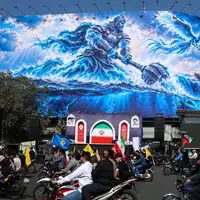
The UN Human Rights Council on Friday overwhelmingly passed a resolution condemning what it described as an unprecedented violent crackdown by Iranian security forces on nationwide protests, citing the deaths of thousands of protesters, mass arrests, widespread internet shutdowns, and serious human rights violations since demonstrations erupted in late December.
The Council said it “strongly deplores the human rights situation in the Islamic Republic of Iran, especially the violent crackdown of peaceful protests resulting in the deaths of thousands of persons, including children,” while urging Tehran to immediately halt extrajudicial killings, arbitrary detentions, enforced disappearances, and the use of lethal force against protesters.
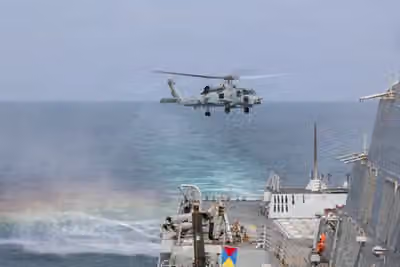


The US Treasury on Friday slapped new sanctions on ships and their owners it accuses of enriching the Iranian state and fueling its repression following mass killings of protestors earlier this month.
The measures targeting nine vessels from what the United States dubs Iran's "shadow fleet", their owners and management firms, saying their activities have together exported hundreds of millions of dollars’ worth of Iranian oil and petroleum products.
“The Iranian regime is engaged in a ritual of economic self-immolation—a process that has been accelerated by President Trump’s maximum pressure campaign. Tehran’s decision to support terrorists over its own people has caused Iran's currency and living conditions to be in free fall,” US Treasury Secretary Scott Bessent was quoted as saying in a statement.
“Today’s sanctions target a critical component of how Iran generates the funds used to repress its own people. As previously outlined, Treasury will continue to track the tens of millions of dollars that the regime has stolen and is desperately attempting to wire to banks outside of Iran."
The new US sanctions come after the treasury last week announced sanctions on several top Iranian commanders and the country's powerful security chief Ali Larijani, whom it accused of being "architects" of the violence.
Iranian security forces opened fired on protestors nationwide in violence that culminated on Jan. 8-9 this month which medics and government sources told Iran International claimed the lives of at least 12,000 people.
The number may be more than 20,000, the UN special rapporteur on human rights in Iran said Thursday, citing reports from doctors inside the country.
The US Treasury on Friday slapped new sanctions on ships and their owners it accuses of enriching the Iranian state and fueling its repression following mass killings of protestors earlier this month.
The measures targeting nine vessels from what the United States dubs Iran's "shadow fleet", their owners and management firms, saying their activities have together exported hundreds of millions of dollars’ worth of Iranian oil and petroleum products.


Iran has deployed a nationwide militarized crackdown to scotch dissent and obscure the scale of its mass killings of protestors earlier this month, rights watchdog Amnesty International said in a report on Friday.
Security forces, Amnesty said, moved quickly after the killings to impose sweeping controls aimed at silencing survivors, intimidating families of victims and preventing documentation of what it described as unlawful mass killings carried out to crush what it called a popular uprising.
The measures included arbitrary mass arrests, enforced disappearances, bans on gatherings, night-time curfews, and a near-total internet blackout, alongside the deployment of heavily armed patrols across cities and inter-city roads, Amnesty International said.
“While people in Iran are still reeling from the grief and shock of the unprecedented massacres during protest dispersals, the Iranian authorities are waging a coordinated attack on the rights of people in Iran to life, dignity and fundamental freedoms in a criminal bid to terrorize the population into silence,” said Diana Eltahawy, Amnesty International’s deputy regional director for the Middle East and North Africa.

“Through the ongoing internet shutdown, the authorities are deliberately isolating over 90 million people from the rest of the world to conceal their crimes and evade accountability.”
“The international community must not allow another chapter of mass atrocities in Iran to be buried without consequence. Urgent international action, including steps towards accountability through independent international justice mechanisms, is long overdue to break the cycle of bloodshed and impunity.”
Conflicting death tolls
The clampdown followed the killings of protesters during demonstrations on January 8 and 9, which Amnesty described as unprecedented in scale.
On January 21, Iran’s Supreme National Security Council put the total number of people killed during the uprising at 3,117.
Days earlier, Mai Sato, the UN special rapporteur on human rights in Iran, said estimates suggested at least 5,000 civilians had been killed, adding that figures based on reports from doctors inside Iran could be significantly higher.
The information blackout since January 8, Amnesty said, has made independent verification difficult and led to the loss of crucial evidence after security forces confiscated mobile phones from those killed or detained.
Mass arrests and enforced disappearances
Tens of thousands of people, including children, have been arbitrarily detained, according to Amnesty. Arrests were reported during night-time home raids, at checkpoints, in workplaces, and in hospitals.
The organization said security forces removed wounded protesters from hospitals in several provinces and threatened medical staff with prosecution for treating injured demonstrators without notifying authorities.
Families and lawyers have frequently been denied information about detainees’ whereabouts, amounting to enforced disappearance under international law.
Amnesty documented cases of torture and ill-treatment, including beatings, sexual violence, threats of execution and denial of water, food and medical care.
Intimidation of families
Families of those killed have faced sustained pressure, Amnesty said, including being forced to bury victims by night, demands for money in exchange for bodies, and coercion to issue false statements blaming protesters or labeling victims as members of pro-government forces.
State media has broadcast forced “confessions” and statements from grieving relatives, a practice Amnesty said mirrors past efforts to justify repression and pave the way for harsh sentences, including executions.
Militarized control
Amnesty said security forces have established dense networks of checkpoints, enforced curfews, and warned residents through loudspeakers to remain indoors.
Videos reviewed by the group showed armored vehicles, heavy weapons and water-cannon trucks deployed in multiple cities.
The organization called on Iranian authorities to restore internet access, release arbitrarily detained individuals, disclose the fate of the disappeared, end harassment of victims’ families and allow independent investigations into the killings.

The UN Fact-Finding Mission on Iran said the priority must now be to collect evidence and hold perpetrators accountable following what it described as the Iranian government’s deadliest crackdown on protesters since the 1979 revolution.
Addressing a special session of the UN Human Rights Council in Geneva, mission chair Sara Hossain said credible reports indicated that “thousands of people have been killed since the protests erupted on 28 December,” while more than 24,000 people were reportedly arrested, including children, journalists and human rights defenders.
“In the context of the shocking recent events in Iran, the priority must now be gathering evidence and establishing whether human rights violations and crimes under international law, including crimes against humanity, may have occurred,” Hossain said, adding that accountability was “the only way to prevent the recurrence of such abuses and break the cycle of impunity.”
The mission said protests spread to all 31 provinces and that, since Jan. 8, authorities imposed a near-total internet shutdown, obscuring the true scale of the violence. Despite this, it has gathered testimonies and reviewed footage that appears to show security forces firing lethal ammunition into crowds, using metal pellets at close range, and pursuing mass arrests, including of the wounded.
Hossain said the scale and pattern of violations underscored “an urgent need for the international community to act,” while stressing that identifying and holding perpetrators and state structures accountable was imperative to prevent further harm.

The UN special rapporteur on human rights in Iran, Mai Sato, urged the international community to support the Iranian people and back a UN investigation into alleged abuses linked to Iran’s protests, saying accountability was essential.
“Now is the time for the international community to respond and to support the people of Iran in their pursuit for fundamental rights and accountability,” Sato told the UN Human Rights Council on Friday.
A proposal before the Geneva-based body seeks to extend by two years the mandate of a UN investigation launched in 2022 after a previous wave of protests and to open an urgent inquiry into violations linked to unrest that began on Dec. 28, for possible future legal proceedings.
“I respectfully urge this Council to empower the Fact-Finding Mission to investigate these protest-related violations to ensure transparency and accountability,” Sato said.
Sato said Iran’s near-total internet shutdown had obscured the true scale of the violence.
“The death toll remains contested due to the shutdown, enabling the state to control information flow,” she said, adding that official figures cite more than 3,000 deaths while some civil society estimates run into the tens of thousands, though “neither these figures can be verified.”
She said she had received reports of the use of lethal force against unarmed protesters, mass detentions including of schoolchildren, raids on hospitals and coercion of detainees into false confessions.