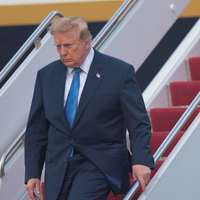
The proposed secondary tariffs were announced by President Donald Trump earlier this week in response to a violent crackdown on protesters in Iran.
Some commentators have questioned whether such measures could be enforced, pointing to Iran’s trade links with more than 140 countries. Others have focused on China’s open opposition, noting that Beijing is Iran’s largest trading partner.
Yet recent experience suggests that secondary tariffs can be far more damaging to the sanctioned country than to those doing business with it.
What past examples say?
A telling precedent is the United States’ action against India over its imports of Russian oil in late August last year. Although the mechanics differed, the effect became clear within months.
By late 2025, Russian crude was selling at discounts of up to $20 to $30 per barrel compared to discounts of around $3 per barrel in summer and $10 in autumn. Even at a discounted price, Russia’s oil exports to India fell by 29 percent in December compared with the previous month.
The pain, in short, was absorbed primarily by Russia, not India.
US Census Bureau data show that despite the imposition of 25 percent tariffs on Indian goods, India’s exports to the United States did not decline significantly. Cheap Russian oil helped Indian refiners remain competitive.
China’s experience tells a similar story. While Chinese exports to the United States fell by about 20 percent in 2025 under US tariffs, China’s total global exports grew by 5.5 percent. Supported by discounted Russian oil and gas, Beijing posted a record $1.2 trillion trade surplus.
Taken together, these cases suggest that secondary tariffs tend to extract concessions from the sanctioned exporter rather than meaningfully penalizing its trading partners.
How secondary tariffs on Iran would work?
Washington has yet to publish detailed guidance on how the proposed 25 percent tariff would be applied. Still, Trump’s public statements indicate that the measure would not be limited to countries purchasing Iranian crude oil.
As with its oil exports to China, Tehran would likely be forced to lower prices across a wide range of goods so that buyers can offset the cost of tariffs imposed on their exports to the United States.
Even if secondary tariffs were applied only to buyers of Iranian energy and petrochemical products, the impact would be severe.
According to data from the commodity intelligence firm Kpler, seen by Iran International, Iran currently exports around 1.3 million barrels per day of crude oil—almost all to China.
It also exports more than half that volume in refined petroleum products, primarily to the United Arab Emirates, Turkey, Iraq, India, and Pakistan.
Annual revenues from liquefied petroleum gas exceed $10 billion, fuel oil generates roughly $7 billion, and gas exports about $5 billion. When petrochemical shipments are included, income from these products roughly matches Iran’s crude oil earnings.
Here, too, vulnerabilities are mounting.
Iran’s 25-year gas supply contract with Turkey is set to expire in five months, with no indication that Ankara intends to renew it. Gas deliveries to Iraq have also been halted because of domestic shortages, prompting Baghdad to seek alternative suppliers.
Tehran shouldering the costs
The United Arab Emirates—the largest buyer of Iranian fuel oil and a major importer of Iranian LPG—maintains extensive economic ties with the United States, making it unlikely to risk exposure to secondary tariffs.
Other Asian buyers, including India, Singapore, Malaysia, and Pakistan, import Iranian products in volumes too small to justify jeopardizing access to the US market.
The most likely outcome is that Iran will once again be pushed to rely overwhelmingly on China, offering steep discounts to preserve market share.
If implemented, secondary tariffs would not isolate Iran’s trading partners so much as narrow Iran’s options, deepen its dependence on a single buyer, and erode its earnings at a moment of acute domestic and fiscal strain.
In that sense, the policy may prove more damaging than conventional sanctions—by forcing Iran itself to absorb the cost of maintaining its already limited presence in the global economy.