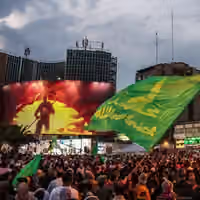
Iranian security forces fired tear gas and confronted merchants and protesters in central Tehran on Sunday, as authorities moved to reopen major shopping centers after several days of closures.
Witnesses said security forces targeted merchants at Alaeddin shopping center and Charsou mall, firing tear gas and clashing with shopkeepers who had kept their businesses closed.
Videos received by Iran International showed crowds gathering outside Charsou mall, chanting “bi-sharaf” (“shameless”) at security forces.
Videos also showed security forces firing tear gas toward merchants outside Alaeddin shopping center and engaging in physical confrontations.
Footage also showed motorcycle-mounted security units deployed along Jomhouri Street, a key commercial artery in central Tehran.
The Telegram channel Civil Protest of the Bazaar reported a large-scale security deployment across Tehran’s bazaar and said some merchants were forced to reopen shops.
Amnesty International Australia on Sunday called on Iranian authorities to halt the crackdown on protesters and urged international action to address what it described as serious human rights violations.
In a statement issued by its Iran National Network, Amnesty International Australia said the right to protest was fundamental and accused the Islamic Republic of using violence, detention and intimidation against demonstrators.
“The systematic killing, detention, and intimidation of peaceful protesters are grave violations of international human rights law and constitute crimes under international jurisdiction,” the statement said.
The group called for an immediate end to the use of lethal and so-called less-lethal force against civilians, warning that such orders could trigger individual criminal responsibility under international law.
It also demanded the unconditional release of all people detained for protesting or dissent, an immediate halt to executions, and unrestricted access for United Nations-mandated investigators and human rights monitors.
Amnesty International Australia further called for international pressure and support for what it described as the Iranian people’s right to determine their own future.
“The current authorities must cooperate with the establishment of a neutral, temporary transitional authority, under international supervision, to stabilize the country and prepare for a free, fair, and verifiable national referendum,” the group said in a statement.
“The right to protest is a cornerstone of a free world.”

Protests continued across Iran for a seventh day and night on Saturday, with demonstrations reported in scores of cities and a sharp rise in fatalities marking one of the most violent phases of the unrest so far.
Videos and eyewitness accounts received by Iran International showed security forces opening fire on protesters in several locations, most notably in Malekshahi, a city in Ilam province, where state-linked media confirmed multiple deaths following clashes.
Based on information shared with Iran International, during protests in Malekshahi at least five protesters were killed by direct fire from security forces, and around 30 others were wounded.
Footage from the city showed wounded protesters and scenes of chaos after live ammunition was used.
Overall, at least 15 protesters and one member of the security forces have been reported killed during seven days of demonstrations, according to rights group HRANA.
Iran International was able to confirm that dozens more were wounded by live fire or pellet guns, while arrests were reported across several provinces.
The unrest, initially driven by economic grievances, has increasingly taken on a political character, with protesters chanting slogans against clerical rule and the Supreme Leader, as well as calling for a return of monarchy.


Demonstrations were reported in major cities as well as smaller provincial centers, despite heavy security deployments and warnings from authorities.
In his first public remarks since the protests began, Supreme Leader Ali Khamenei described participants as “rioters” and called for their suppression, signaling a hardening official stance as the unrest entered its second week.

Protests and street gatherings have been recorded in at least 174 locations across Iran over the past seven days, a rights group said, despite an intensified security crackdown aimed at curbing dissent.
The Human Rights Activists News Agency (HRANA) said demonstrations, labor strikes and street protests were reported in 60 cities across 25 provinces, indicating that unrest has extended beyond major urban centers into smaller cities and surrounding areas.
The group said protest activity had taken varied forms, including at least 18 student gatherings at 15 universities.
According to HRANA, at least 582 people were arrested during the past week, a figure it described as a minimum estimate, warning that the actual number is likely higher due to reporting restrictions and security pressure.
The data showed a significant number of those detained were minors. In the southwestern city of Yasouj alone, at least 81 people were arrested, including 70 under the age of 18, HRANA said.
Arrests of teenagers aged 15 to 17 were also reported in cities including Sabzevar, Izeh, Zahedan, Isfahan and Yasouj.
HRANA said it had confirmed at least 16 deaths linked to the protests during the seven-day period, including one member of Iran’s security forces. The remaining fatalities were civilians, it said.


At least 44 protesters were wounded by live ammunition or pellet fire, according to HRANA and separate reporting by Iran International. Dozens of others were injured by beatings, tear gas or during arrests, the reports said.
HRANA warned that the death toll could rise, citing conflicting official accounts, pressure on families and severe limits on information flow.
Iranian authorities have not issued comprehensive public figures on arrests or casualties.
Iranian security forces deployed heavily across Tehran’s main bazaar on Sunday, as parts of the commercial district remained closed amid expectations of protest activity.
Witnesses said several sections of Tehran’s main bazaar, including parts of its retail and wholesale areas, remained closed on Sunday, according to a Telegram channel linked to protest activity.
They said roughly half of shops in some corridors were shut, while security forces maintained an unusually heavy presence across the complex.
In Lalehzar Street, witnesses reported a heavy presence of plainclothes security agents. Some protesters were heard chanting “death to the dictator,” before security forces moved in to disperse them, the Telegram channel Civil Protest of the Bazaar said.
An Iranian lawmaker said on Sunday that rising inflation and currency instability were key drivers of recent protests, criticizing what he described as a lack of coordination within the government.
Ahmad Naderi, a member of parliament’s presiding board, said there was no serious will within the government to organize the foreign exchange and gold markets.
“There is no serious determination in the government to bring order to the situation of the currency and gold rates, and as a result of this lack of coordination and the outcome seen in rising exchange rates, we are witnessing protests,” he said.
“Today we are witnessing runaway inflation that puts pressure on the middle class and, more importantly, on deprived groups, and this has led to social dissatisfaction,” he said.