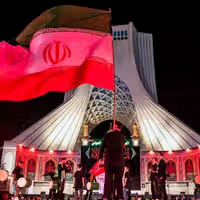
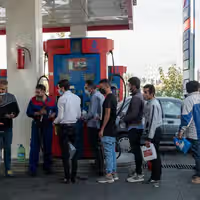
Nighttime protests took place on Thursday in several cities across Iran, with demonstrators taking to the streets and chanting anti-government and pro-monarchy slogans, according to videos received by Iran International.
In central Iran, protesters were seen in Qazvin and in the holy city of Qom, chanting slogans including “This is the final battle, Pahlavi will return.”
In northern Iran, videos showed nighttime gatherings continuing in Babol, where protesters chanted “Death to the dictator.”
Additional footage showed demonstrations in western Iran, including Gohardasht near Karaj in Alborz province, Azna in Lorestan province, and Farsan in Chaharmahal and Bakhtiari province.
In southern Iran, protests were also reported in Kavar, in Fars province.


As protests once again ripple across Iran, the country’s political establishment is moving quickly to revive an economic reform agenda that many Iranians say no longer speaks to the core of their anger.
While demonstrators chant against the entire system, the government of President Masoud Pezeshkian has focused its response on reshuffling economic managers and pressing ahead with long-delayed currency reforms, betting that technical fixes can still defuse a crisis that has increasingly become political.
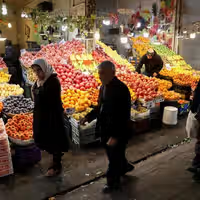
The renewed unrest was triggered by a sharp bout of currency volatility that briefly pushed the U.S. dollar to around 1.45 million rials on the open market, intensifying already high inflation and accelerating the erosion of purchasing power.
“Protesting the dollar is protesting instability; protesting a life that cannot be planned,” wrote journalist Mustafa Danandeh in the daily Ettelaat. “People who do not know whether six months from now their rent will double, medicine will be available, or their job will survive.”
A new old face
In response, Pezeshkian reshuffled the leadership of the Central Bank of Iran, reappointing Abdolnaser Hemmati and reviving a controversial push toward a single exchange rate—an idea long advocated by economists but repeatedly stalled by politics, sanctions and entrenched interests.
Hemmati, a prominent centrist figure, had been forced out less than seven months into his tenure as economy minister after parliament impeached him over exchange-rate volatility.
His return—this time to a post that does not require parliamentary approval—has infuriated hardline lawmakers and highlighted widening rifts within the political elite.
“This explicitly ignores parliament’s vote and shows disregard for the will of representatives,” said Zeynab Gheisari, an ultra-hardline lawmaker from Tehran. Another hardline legislator, Amir-Hossein Sabeti, said the move demonstrated the government’s “disregard for the people and the country’s economy.”
In his first public remarks after the appointment, Hemmati laid out familiar priorities: controlling inflation, managing the foreign exchange market and tightening oversight of banks.
It’s the economy—or is it?
The reform effort centers on dismantling Iran’s multi-rate currency regime, a system dating back to the Iran–Iraq war of the 1980s, when preferential exchange rates were introduced to subsidize essential imports. Over time, the widening gap between official and market rates turned the system into a major source of rent-seeking, corruption and uncertainty.
As the business news outlet Tejarat News noted, the policy “failed to provide sustainable support for domestic producers and created severe uncertainty for investment and production planning.”
The Entekhab news site cautioned that in an economy burdened by sanctions, fiscal shortfalls and political distrust, inflationary expectations tend to regenerate quickly once short-term interventions fade.
On Thursday, the president announced the immediate elimination of the subsidized exchange rate of 285,000 rials per dollar for basic goods and animal feed imports, saying the subsidy would instead be transferred directly to consumers to eliminate “rent, bribery and corruption.”
In unusually blunt remarks, Pezeshkian acknowledged that public anger was directed at the state itself. Dissatisfaction, he said, was the government’s responsibility, adding that “there is no need to look for America to blame.”
Many protesters appear keenly aware that Pezeshkian’s authority is tightly constrained by entrenched power centers, a reality reflected in slogans that target the theocratic system itself and its supreme leader rather than the exchange rate.
A photo obtained by Iran International shows the slogan “Long Live the King” sprayed on the door of a store in Isfahan, central Iran.

The Paris-based Narges Foundation, run by the family of jailed Nobel Peace Prize laureate Narges Mohammadi, issued a statement on her official X account on Thursday backing protesters in Iran.
“As streets in Iran once again see live fire, tear gas, beatings and mass arrests, with unarmed protesters killed in recent days, silence is not an option,” the message said.
The group said standing with the people of Iran is not a political choice but a human and moral duty, so that 'victims of oppression' can achieve their legitimate demands and no grievance is met with prison, bullets or intimidation.
“We stand with families who have lost loved ones, detainees held incommunicado in prisons and security detention centers, and the wounded who are denied safe medical treatment, as well as all those demanding security, freedom, justice and a better future.”
“The way out of the cycle of violence and repression is a transition to democracy and guarantees for citizens’ rights, toward a free and equal future for everyone,” it added.
The foundation said it was speaking out in the absence of Mohammadi herself, on the 21st day of her latest detention and confinement.
Spectators chanted the slogan “Reza Shah, may your soul rest in peace” after the end of the Sepahan–Esteghlal football match on Thursday evening in the central Iranian city of Isfahan, according to videos received by Iran International.

Iran erected banners across Tehran on Thursday threatening further attacks against Israel and a US base in Qatar, with state media publishing images of the banners showing maps and locations of strikes carried out during a 12‑day war in June.
The phrase “It Will Happen Again” appears above images of sites targeted during the June war, including Israel’s Nevatim airbase and the Haifa refinery and power plant, as well as Qatar’s Al‑Udeid airbase, which hosts American troops and was targeted in June.
Iranian officials framed those strikes as only a fraction of the country’s missile capabilities and warned that future retaliation could be more extensive.
The new banners come after recent remarks by US President Donald Trump on his support for possible Israeli attacks on missile or nuclear sites in Iran, prompting senior state and military officials in Tehran to issue a series of defiant and threatening messages.
Trump said on Monday he would support possible Israeli strikes on Iran if the Islamic Republic further develops its ballistic missile or nuclear programs, warning Tehran against rebuilding military capabilities destroyed in Israeli and American airstrikes in June.
“Israel should remember the blows it received in the recent war and take a lesson from the previous attack before thinking of entering a new one,” IRGC spokesman Brigadier General Mohammad Ali Naeini said on Wednesday.
“Iran’s power is increasing by the day, and Israelis only talk about a weak Iran in the media while they themselves know very well how strong our missile capabilities are,” Naeini added.
The United States held five rounds of negotiations with Iran over its nuclear program earlier this year, for which Trump set a 60‑day deadline. When no agreement was reached by the 61st day on June 13, Israel launched a surprise military offensive, followed by US strikes on June 22 targeting key nuclear facilities in Isfahan, Natanz and Fordow.
The attacks killed several nuclear scientists along with hundreds of military personnel and civilians, while Iranian counterattacks killed 32 Israeli civilians and an off‑duty soldier, according to official tallies from both sides.
On June 23, Iran launched around 14 short‑ and medium‑range ballistic missiles at Al‑Udeid base as part of its retaliation for US strikes on Iranian nuclear facilities the previous day.
US officials said air defenses in Qatar intercepted 13 of the missiles and that one fell short of the base, but satellite imagery later indicated a missile had struck and damaged a large US radar dome used for secure communications, while Washington reported no American casualties.
Iran denies seeking nuclear weapons and says its nuclear program is for peaceful purposes, while Supreme Leader Ali Khamenei has said dealing with Trump is beneath the dignity of the Islamic Republic and officials have rejected US demands to end uranium enrichment and curb missile capabilities.
The United States has long insisted that Iran must completely halt its uranium enrichment program, stop supporting its armed allies in the Middle East and accept restrictions on its ballistic missile program. Tehran has rejected the demands.