• العربية
  • فارسی
Brand
  • Iran Insight
  • Politics
  • Economy
  • Analysis
  • Special Report
  • Opinion
  • Podcast
  • Iran Insight
  • Politics
  • Economy
  • Analysis
  • Special Report
  • Opinion
  • Podcast
  • Theme
  • Language
    • العربية
    • فارسی
  • Iran Insight
  • Politics
  • Economy
  • Analysis
  • Special Report
  • Opinion
  • Podcast
All rights reserved for Volant Media UK Limited
volant media logo

Reformist veteran defines 'reform’ as gradual change, warns it could take decades

Dec 30, 2025, 13:53 GMT+0

Iranian reformist figure Behdad Nabavi said in an interview published Tuesday that reform means peaceful, legal change within the current system, while acknowledging that the process has become so difficult it could take decades.

In comments to Jamaran, Nabavi said reformism does not seek to overthrow the system or use illegal or violent methods.

“Reformism means changing the existing situation to a desirable one through a legal and peaceful path,” he said. “It does not want to overthrow the system.”

He said reformists aim to move the country toward what they define as a better outcome “within this same structure” and through “calm and legal” methods.

Nabavi added that he has concluded the reform path is now “very winding” and difficult, arguing that today’s young people have little tolerance for a gradual process.

“It may take 50 years,” he said, describing a slow legal route that, in his view, struggles to meet the urgency of public expectations.


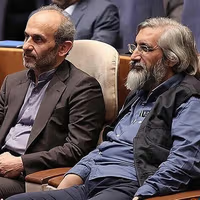
Behdad Nabavi
100%
Behdad Nabavi

Most Viewed

Iran’s president defends US talks as he lays bare economic strain
1

Iran’s president defends US talks as he lays bare economic strain

2

Pezeshkian says Iranians must accept inflation as country is in war

3

Amnesty says Iran drove global surge in executions in 2025

4

IRGC-linked propaganda posts targeted across platforms, Europol says

5

Trump holds off planned Iran strike as Arab allies buy Tehran time

Banner
Banner

Spotlight

  • Two years after Raisi’s crash: Iran has no sanctuary
    ANALYSIS

    Two years after Raisi’s crash: Iran has no sanctuary

  • Can Iran’s economy survive a twin squeeze from blockade and blackout?
    PODCAST

    Can Iran’s economy survive a twin squeeze from blockade and blackout?

  • Iran’s café culture buckles as everyday life contracts
    INSIGHT

    Iran’s café culture buckles as everyday life contracts

  • China’s Iran balancing act grows more costly
    ANALYSIS

    China’s Iran balancing act grows more costly

  • Tehran media sees rising risk of war as US talks stall
    INSIGHT

    Tehran media sees rising risk of war as US talks stall

  • Xi may help Trump on Iran, but at a price
    ANALYSIS

    Xi may help Trump on Iran, but at a price

•
•
•

More Stories

Iran’s top judge says 'legitimate' protests must be heard

Dec 30, 2025, 13:44 GMT+0

Head of the Supreme Court of Iran, Mohammad Jafar Montazeri, said on Tuesday that authorities must listen to what he described as legitimate and lawful protests, acknowledging widespread economic pressure as demonstrations continued across Iran.

According to a statement published by the Supreme Court, Montazeri said officials should act with caution and address public grievances to prevent misuse of protests by hostile actors.

“Legitimate and lawful protests of the people must be heard,” he said.

Tehran University students call on public to march toward campus

Dec 30, 2025, 13:37 GMT+0

Students at the University of Tehran called on the public on Tuesday to move toward the campus, saying heavy security around the university was preventing them from joining street protests, according to messages circulated by student groups.

In statements shared online, students said security forces had encircled areas around the university, limiting movement in and out of the campus.

They urged citizens to approach Tehran University so that students could link up with protesters outside the campus perimeter.

The appeal came on the third day of protests and strikes over economic hardship, as universities across Tehran reported demonstrations alongside tightened security and access controls.

Tehran University has been a recurring focal point during protest waves, with students often attempting to connect campus gatherings to wider street demonstrations.

File photo of a protest at the University of Tehran  (December 2017)
100%
File photo of a protest at the University of Tehran (December 2017)

Security forces fire at protesters on Tehran’s Mellat Street

Dec 30, 2025, 13:08 GMT+0

Iranian security forces fired directly toward protesters on Tehran’s Mellat Street on Tuesday as demonstrations continued across the capital.

Footage showed officers aiming weapons toward groups of demonstrators on the street, with shots audible as people scattered.

The videos did not make clear whether the ammunition used was live or less-lethal, and there was no immediate information on injuries.

Mellat Street is located near central administrative and commercial areas of Tehran and has seen protest activity during previous unrest.

'Freedom' slogans echo in Tehran bazaar

Dec 30, 2025, 13:06 GMT+0

Protesters inside Tehran’s Grand Bazaar chanted calls for freedom on Tuesday.

Footage showed groups of people chanting “Azadi, azadi, azadi” – “Freedom, freedom, freedom” – inside the market.

Iran unrest nearing 'critical threshold' as strikes spread - SpecialEurasia

Dec 30, 2025, 12:48 GMT+0

SpecialEurasia, an open-source intelligence and forecasting outlet, said in a report updated Tuesday that Iran’s internal security situation has reached what it called a “critical threshold” as economic grievances merge into broader political defiance.

The report said strikes and demonstrations have spread from Tehran’s commercial center to major cities, driven by a falling currency, resource shortages and renewed international pressure.

It said the protest tone has shifted from trade-related complaints to political slogans, which it described as a sign of weakening legitimacy among parts of the merchant class.

SpecialEurasia said the government appears to favor dialogue, while the security apparatus is preparing for “extended internal strife.”

The report linked the unrest to tightened external constraints and domestic shortages, highlighting risks from water and energy disruptions that could widen the protest base beyond traders.

It also warned that heavier policing could raise the risk of deaths and follow-on demonstrations, and that Iran’s internal instability could shape regional calculations by outside actors.