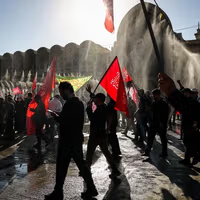
Protesters inside Tehran’s Grand Bazaar chanted calls for freedom on Tuesday.
Footage showed groups of people chanting “Azadi, azadi, azadi” – “Freedom, freedom, freedom” – inside the market.
SpecialEurasia, an open-source intelligence and forecasting outlet, said in a report updated Tuesday that Iran’s internal security situation has reached what it called a “critical threshold” as economic grievances merge into broader political defiance.
The report said strikes and demonstrations have spread from Tehran’s commercial center to major cities, driven by a falling currency, resource shortages and renewed international pressure.
It said the protest tone has shifted from trade-related complaints to political slogans, which it described as a sign of weakening legitimacy among parts of the merchant class.
SpecialEurasia said the government appears to favor dialogue, while the security apparatus is preparing for “extended internal strife.”
The report linked the unrest to tightened external constraints and domestic shortages, highlighting risks from water and energy disruptions that could widen the protest base beyond traders.
It also warned that heavier policing could raise the risk of deaths and follow-on demonstrations, and that Iran’s internal instability could shape regional calculations by outside actors.

Students at the University of Tehran tore down a sign for the office representing Supreme Leader Ali Khamenei on Tuesday, according to video received by Iran International.
Footage showed students the sign of the representative office on the ground during a gathering on campus.
The office represents the Supreme Leader at the university and is part of a broader network overseeing religious and ideological activities at higher-education institutions.
Protesters on Tehran’s Jomhouri Street forced security forces to retreat on Tuesday, according to video received by Iran International, as demonstrations continued across the capital.
Footage showed groups of protesters advancing along the street as officers pulled back from their positions.
A senior Basij official said on Tuesday that the United States wants to restore Iran’s former monarchy, responding to pro-Pahlavi slogans heard in recent protests as unrest over economic conditions continues.
Ghasem Ghorishi, deputy head of IRGC’s Basij Organization, said the chants calling for the return of the Pahlavi dynasty reflected what he described as long-standing US hostility toward the Islamic Republic.
“One of America’s grudges is that it wants to continue a government whose path the Iranian people blocked,” Ghorishi said.
In broader remarks, he portrayed US policy as rooted in domination and regime change, saying Washington’s strategic goal was to remove governments that do not align with its interests.
He also referred to the June war with Israel as evidence of hostile intentions by Western powers, accusing critics inside Iran of either naivete or serving foreign agendas.
Protesters in the western Iranian city of Kermanshah shouted insults at security forces on Tuesday after officers moved in to disperse a demonstration, according to videos received by Iran International.
Footage showed security forces advancing on protesters as crowds shouted “bi-sharaf,” a Persian insult meaning “shameless,” one of the most common chants directed at security forces during protests.
The chants followed what residents described as an attempt by officers to suppress the protest.