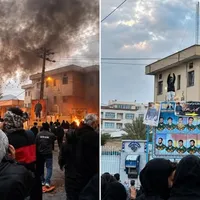
A group of shopkeepers in Tehran gathered on Sunday to protest poor economic conditions and the rial’s historic fall, chanting “Dishonorable, dishonorable” at officials, a video sent to Iran International showed.
Iran’s exiled prince Reza Pahlavi’s press office revived a year-old message calling for strikes as Tehran shopkeepers protested amid a sharp fall in the rial.
In the message dated December 30, 2024, Pahlavi had called on Iranians to support one another beyond sectoral demands, saying on X: “Strikes and civil disobedience, alongside street protests, are an effective way to bring this regime to its knees… It is through solidarity and unity among all segments of the Iranian people that the greater goal of freedom and the salvation of Iran can be achieved.”
Shopkeepers in Lalehzar, a central Tehran commercial district known for lighting and electrical goods, have called for a strike on Monday to protest the rial’s fall and what they described as economic injustice and mismanagement by authorities, according to a statement shared with Iran International.
“The time has now come to stand together, show unity, and defend our rights. We, the owners of guilds, shopkeepers, and bazaar traders in New Lalehzar and South Lalehzar, raise our voices as one against economic injustice and the mismanagement of officials: as long as the situation does not change, the nationwide strike will continue,” the statement said.
“The bazaar is united, and no power can silence our voice. (Join the) strike,” the statement added.
Mobile phone traders gathered outside the Iran Mobile Center and the Alaeddin Mobile Shopping Center on Hafez Street in central Tehran, according to eyewitness accounts and videos sent Iran International.
An eyewitness said the chants began with shopkeepers, with passersby later joining in on Jomhouri Street near the Hafez underpass on Sunday.

Protests broke out among shopkeepers in central Tehran on Sunday after a sharp slide in the rial, with videos sent to Iran International showing crowds chanting antigovernment slogans.
Mobile phone traders gathered outside the Iran Mobile Center and the Alaeddin Mobile Shopping Center on Hafez Street in central Tehran, according to eyewitness accounts and videos sent Iran International.
An eyewitness said the chants began with shopkeepers, with passersby later joining in on Jomhouri Street near the Hafez underpass on Sunday.
Reports also circulated on social media of protests at Tehran’s Charsou mall.
Separately, iron market traders in Tehran stopped work on Sunday morning, closing their shops to protest the rial’s decline, according to reports on social media.
The protests come as Iran’s rial weakened to new historic lows on Sunday, falling to about 1,445,000 per dollar, 1,700,000 per euro and 1,950,000 per pound, according to Tehran's open market rates.
A day earlier, the rial was trading at about 1,370,000 to the dollar. About a month earlier, it was valued at around 1,140,000 per dollar on the open market.
In recent months, runaway inflation and the rial's declining value have added to concerns over worsening economic conditions in Iran.
Over the past year, prices of food items in Iran have risen by an average of more than 66 percent, according to official data.
Iran’s Statistics Center said on Saturday that year-on-year, or point-to-point, inflation rose to 52.6 percent.

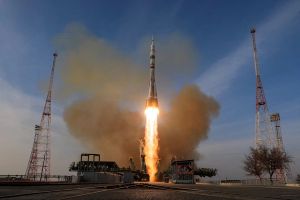
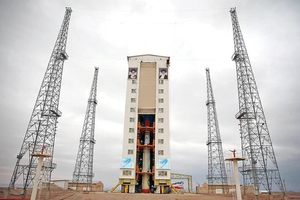
Iran on Sunday launched three domestically built satellites into low Earth orbit aboard a Russian Soyuz rocket, deepening space cooperation between Tehran and Moscow in a program Western governments say draws on technologies applicable to long-range missiles.
The satellites were placed into orbit from Russia’s Vostochny Cosmodrome in a multi-payload launch that Iranian officials described as the country’s seventh satellite mission carried out using Russian launch vehicles.
“These satellites were designed and manufactured by Iranian scientists, and both government bodies and the private sector have been involved,” Iran’s ambassador to Russia, Kazem Jalali, said in remarks published ahead of the launch.
“Two of the satellites belong to the government and one belongs to the private sector, and our knowledge-based companies and universities are active in this field.”
Jalali said Iran had continued to advance its space capabilities despite international pressure. “Despite all the threats and sanctions that exist, we have something to say in this field.”
Iran’s space agency chief, Hassan Salarieh, said the launch reflected what he described as Iran’s standing among a small group of countries with end-to-end space capabilities.
“Iran is among 10 or 11 countries in the world that simultaneously possess the capability to design and build satellites, launch vehicles and the infrastructure for launching, receiving data and processing images,” he said.
Salarieh said Iran aimed to expand both the number and precision of its satellites. “What is necessary for us is increasing the number of satellites, improving their accuracy and quality, and developing different classes of satellites,” he said.


Iranian media identified the satellites as Paya, also known as Tolou-3, Zafar-2, and a prototype satellite called Kowsar-1.5. The spacecraft were launched alongside a large cluster of mainly Russian satellites into a sun-synchronous low Earth orbit.
Paya (Tolou-3), built by the Iranian Space Agency, is Iran’s heaviest Earth-observation satellite to date, weighing about 150 kilograms.
Iranian officials say it is capable of producing black-and-white images with a resolution of about five meters and color images with a resolution of around 10 meters, and is intended for applications including agriculture, water management, environmental monitoring and disaster assessment.
Zafar-2, developed by Iran University of Science and Technology, is also an Earth-observation satellite designed for mapping, environmental monitoring and tracking natural hazards.
Kowsar-1.5 combines imaging and internet-of-things capabilities and is aimed primarily at agricultural and farm-monitoring uses, Iranian officials say.
Jalali described Iran’s space cooperation with Russia as extensive and said Moscow’s experience had played a key role.
“Russia is advanced in the space field, including satellites, launch vehicles and satellite launches, and we have been able to transfer part of the technology and work together,” he said.
He also described the Soyuz rocket as highly reliable. “Before Russia’s relations with the West deteriorated, many Western satellites were launched using Soyuz,” Jalali said.
The launch also carried Russian Earth-observation satellites, internet-of-things platforms and university-built spacecraft, according to launch data, as well as satellites from partner countries including Belarus, Kuwait and Montenegro.
Iran says its space program is civilian and focused on scientific and economic goals, but Western governments argue that satellite launch technology overlaps with systems used to develop intercontinental ballistic missiles.