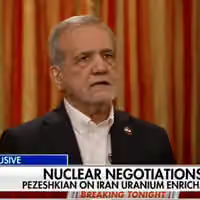
“When people are struggling with livelihoods, you cannot govern,” Pezeshkian told the open session. “They say increase wages; someone tell me where I should bring the money from?”
The draft budget submitted to parliament proposes a 20% rise in public-sector wages, while expanding income-tax exemptions to soften the hit from inflation, which has remained among the highest in the world.
Pezeshkian acknowledged the increase “is not proportionate to inflation,” but said the government had tried to compensate by raising tax-free thresholds.
Under the proposal, salaried workers earning up to 400 million rials a month (about $282) would be exempt from income tax, while those earning between 400 million and 930 million rials ($282–$655) would pay a 10% rate, according to figures cited by Iranian media.
Pezeshkian said the budget’s main aim was to reduce what he called “the fire of inflation” and avoid a deficit that fuels money creation. He said the government had raised its own current spending by only 2%, cutting what he described as nonessential lines and moving toward “performance-based budgeting,” under which ministries would have to specify services to receive funds.
Parliament Speaker Mohammad Bagher Ghalibaf said the budget’s wage assumptions needed further work, warning that household livelihoods were at stake.
“The importance of the budget is clear for all of us … the budget is people’s lives,” Ghalibaf told lawmakers, adding that the 20% wage increase “has its problems and needs to be corrected.”
Lawmakers warn currency slide and subsidy policy risk stoking prices
Several lawmakers used the debate to attack what they described as a lack of credible plans to stabilize the currency and contain inflation.
MP Mohsen Zanganeh said advisers to Pezeshkian believed the exchange rate would rise in line with inflation, which he said implied a roughly 40% increase by the end of the next year.
“Mr. Pezeshkian, your economic team has accepted that it does not have the ability to reduce inflation and control the currency rate, and therefore it is only seeking to give vouchers,” Zanganeh said.
Jabbar Kouchakinejad, a deputy head of parliament’s budget committee, said officials appeared unwilling to curb the exchange rate’s rise and suggested the government might be using hard-currency sales to plug fiscal gaps.
“It seems there is no will in the government to control the exchange rate and balance it,” Kouchakinejad told ILNA, adding: “This trend is continuing quickly and prices are rising rapidly.”
Pezeshkian said the government planned to expand targeted support, including a consumer voucher program, arguing that price swings in the currency market feed directly into household costs.
The government spent about $6 billion importing gasoline this year and had budgeted around $8 billion for subsidized foreign exchange for essential imports next year, while many goods were effectively priced at the market rate, according to the president.
He also pointed to energy subsidies as a core distortion, arguing that higher consumption channels more state support to wealthier households. He described the system as inequitable.
Iran has recently introduced a three-tier gasoline pricing system, keeping subsidized rates while adding a higher tier aimed at limiting subsidy costs and discouraging non-card refueling and quota overuse, a move officials have presented as gradual reform after past price hikes triggered unrest.
The budget deliberations come as Iran’s economy faces chronic inflation, sanctions pressure, and financial constraints that officials say limit room for maneuver, even as the government argues it is trying to protect lower-income households through tax exemptions and targeted aid.
The rial slid on Sunday to a new record low of 1,420,000 per dollar, as point-to-point inflation ran at over 50% and the central bank reported the economy had contracted despite a modest rise in oil output and sales.