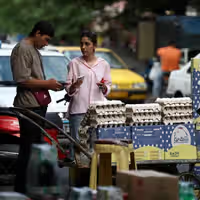
Watermelons displayed at a market in Iran’s northwest city of Tabriz, December 20, 2025
A rare on-air admission of economic collapse by a senior Iranian official this week briefly pierced the state’s carefully managed narrative—only to be reinforced hours later by leaked budget talks revealing how little financial room the government actually has.
The moment came during a live appearance by Vice President Jafar Ghaempanah on IRINN, Iran’s state television news channel.
Pressed repeatedly on the economy, Ghaempanah acknowledged that a roughly 30 percent decline in oil revenues, compounded by chronic energy shortages and the continued impact of sanctions, had sharply reduced government resources and damaged livelihoods.
Since the start of President Masoud Pezeshkian’s administration, he said, falling oil income had cut into production, deepened the budget deficit and left the state with far less room to maneuver.
The interview quickly drew attention online—not only for its substance, but for what appeared to be visible strain. Ghaempanah stumbled over basic facts, briefly referring to the June conflict with Israel as the “11-day war” and seeming uncertain about its timing, while at several points losing his temper as the interviewer pressed for specifics he struggled to provide.
Budget behind closed doors
The significance of the appearance became clearer the next day, when the government presented its annual budget bill to parliament in a closed-door session from which leaks soon emerged.
According to multiple reports—some echoed by state television itself—Hamid Pourmohammadi, head of the Planning and Budget Organization, told lawmakers that the government currently has no foreign-currency resources to support the proposed budget, sparking heated exchanges with MPs.
Leaked details indicate that next year’s budget will be around five percent smaller than the current one, an unusual move for a system long accustomed to expanding nominal spending even in difficult times.
That picture sits uneasily alongside public assurances from Economy Minister Ali Madanizadeh, who has claimed the draft was prepared with a near-zero deficit.
Crisis in plain sight
For years, large portions of Iran’s budget have been directed toward ideological and propaganda bodies, as well as institutions linked to powerful security organizations, even as basic services and productive investment have suffered.
•
•
Mehdi Pazouki told the reformist Rouydad24 website that budget deficits lie at the heart of Iran’s chronic economic instability. Inflation, he argued, is not a temporary shock but the outcome of sustained mismanagement.
Pazouki urged the government to privatize state- and military-owned companies and to halt the practice of allocating oil to military bodies to sell on the state’s behalf—steps that would challenge entrenched interests.
With oil revenues shrinking, energy shortages worsening and sanctions continuing to restrict access to hard currency, the state faces mounting limits on its ability to cushion economic pain.
Ghaempanah’s faltering television appearance was less an isolated embarrassment than a revealing symptom—one that briefly aligned official rhetoric with the economic reality the system usually works to conceal.
Parliament Speaker Mohammad Bagher Ghalibaf has sharply escalated his posture toward President Masoud Pezeshkian, openly floating the prospect of impeachments and implicitly questioning the government’s survival.
Speaking on Sunday, Ghalibaf warned that if the executive fails to address rising prices of basic goods, parliament would have a “duty” to take action.
But moderate voices in Tehran argue the episode is less about procedure than positioning.
“These remarks indicate a fundamental shift in relations between the presidency and parliament,” wrote the news website Rouydad24, arguing that Ghalibaf is recalibrating his role from co-manager of the system’s crises to its chief overseer.
By adopting an openly critical stance, the outlet said, Ghalibaf is seeking to distance himself from shared responsibility for deteriorating economic conditions while presenting parliament as an independent check on executive failure.
“If reshuffling occurs, parliament will claim victory; if not, impeachment becomes the ‘last unavoidable option,’” it wrote—placing political costs squarely on the government.
Moderate politician Hossein Nourani-Nejad said impeachment threats are being used to reshape the executive politically.
“The government is centrist, not reformist,” he said. “But the right is trying to gradually turn it into a conservative government.”
Parliament has already impeached and removed Economy Minister Abdolnaser Hemmati, with pressure building on ministers overseeing agriculture, roads and urban development, industry and trade, sports and welfare.
Parliamentary attacks have focused disproportionately on reformist or centrist ministers aligned with the government’s discourse.
Some lawmakers have gone further, openly calling for Pezeshkian’s resignation and even floating his impeachment on grounds of what they describe as “political incompetence.”
Most of those voices belong to the ultra-hardline Paydari Party and are closely aligned with Saeed Jalili, Pezeshkian’s rival in last year’s presidential election.
“That the head of another branch of power would threaten the president and government by invoking impeachment demands from a specific parliamentary minority is novel,” Esmail Gerami-Moghaddam of the Etemad-e Melli Party told Etemad.
By sharpening confrontation now, critics argue, Ghalibaf is seeking to shed collective responsibility for economic distress while signalling readiness for a future political contest—one in which blame, distance and “oversight” may matter as much as policy.
The backdrop is Ghalibaf’s own defeat to Pezeshkian in the last year’s presidential race—and widespread belief in Tehran that the coming years could bring major political shifts, creating incentives for senior figures to reposition early.
Deputy Speaker Ali Nikzad acknowledged the stakes, noting that if more than half the cabinet were removed or resigned, the government would lose its quorum.
He added, however, that “the position of the system”—a reference to Supreme Leader Ali Khamenei—is that the cabinet should complete its term.
Iran’s government on Tuesday submitted its draft budget for the year starting in March 2026 to parliament, with early indications suggesting one of the most restrictive fiscal frameworks in recent years amid persistent economic strains.
Officials familiar with the drafting process at the Planning and Budget Organization say the bill was prepared with tight spending limits.
President Masoud Pezeshkian has previously blamed budget deficits for fueling inflation, while the economy minister has said the government aims to eliminate the deficit in the coming year.
Unofficial estimates suggest the overall budget ceiling may increase by less than 5%. With inflation still running above 40%, economists say this would amount to a real contraction of around 35% in government spending power, a scale of adjustment that could weigh heavily on public services, development projects and support programs.
Wage increases draw early criticism
The draft was submitted to parliament amid immediate criticism from lawmakers, particularly over a proposed 20% rise in public-sector wages, which several MPs said lags inflation and risks further eroding household purchasing power.
The bill, state media reported, is the first budget prepared under a new format in which parliament no longer debates accompanying legal provisions, reviewing only numerical tables.
The draft, Budget chief Hamid Pourmohammadi said, was submitted after removing four zeros from the national currency, in line with recent legislation.
Inflation risks in the background
In his budget speech, Pezeshkian warned that water shortages pose an urgent national challenge, saying weak management could have lasting consequences.
The budget debate comes as gold and foreign-currency prices in Tehran have surged in recent weeks, particularly after the approval of a third gasoline price tier, developments that have reinforced expectations of higher inflation.
Lawmakers earlier on Tuesday held a closed-door session with senior ministers and central bank officials to discuss currency volatility and price controls.
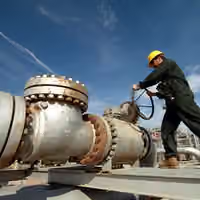
Iraq’s electricity ministry said on Tuesday that Iranian gas supplies had stopped entirely, cutting between 4,000 and 4,500 megawatts from the national power grid and reducing supply hours.
“The flow of Iranian gas has stopped completely,” ministry spokesman Ahmed Mousa said, adding that some power units were shut while others were forced to cut output.
Mousa said Tehran had informed Baghdad of the halt due to “emergency conditions,” without giving further details.
He said the Iraq Electricity Ministry had switched to domestic alternative fuel in coordination with the oil ministry, and that generation remained “under control” despite the shortfall.
Iranian gas exports to Iraq had declined sharply this year after the US tightened sanctions enforcement and revoked a long-standing waiver that allowed Iraq to pay for Iranian electricity and gas imports.
Between April and August, Iranian gas exports to Iraq fell by about 40%, according to regional trade data, as Baghdad struggled to navigate sanctions while seeking alternative supplies.
Iraq’s power sector has also faced security disruptions. In November, a rocket strike forced the shutdown of the Khor Mor gas field in northern Iraq, cutting about 3,000 megawatts from regional supply.
Local Kurdish officials blamed Iran-backed armed groups for the attack, which targeted energy infrastructure critical to electricity generation.
The electricity ministry said Iraq had prepared for peak winter demand through maintenance and upgrades at power stations, and that coordination with the oil ministry would continue until Iranian gas flows resume.
Iranian pharmaceutical industry figures warned that illicit Iranian-made medicines are increasingly appearing in Afghanistan, undercutting legal exports and deepening shortages at home.
Pharmaceutical sector representatives say the flow has accelerated after Pakistan curtailed drug exports to Afghanistan, turning Iran’s subsidized market into an attractive source for traffickers.
They argue that wide price gaps between Iran and neighboring countries have made smuggling structurally profitable, sidelining legal export channels.
Drug production has increased by around 50% but shortages persist, Mohsen Abdollahzadeh, a board member of the Drug Distributors Syndicate said on Tuesday.
“Drug smuggling from Iran to Iraq and Afghanistan is so extensive that traders in those countries are unable to import medicines legally and cannot compete with smuggled Iranian drugs,” he added.
Food and Drug Administration of Iran has conceded that so-called “reverse smuggling” exists, driven by sharp price differences with neighboring markets.
However, spokesperson Mohammad Hashemi disputed a widespread surge, saying documented cases remain limited. Continued leakage, he warned, could trigger intermittent shortages and place further strain on an already fragile supply chain.
Recent talks with an Afghan delegation, Hashemi said, focused on expanding formal pharmaceutical exports and improving monitoring, a move critics say reflects belated damage control rather than a solution to entrenched enforcement gaps.
Food market shows same fault lines
The controversy mirrors developments in food markets, where currency policy shifts and the removal of subsidized exchange rates have driven sharp increases in staple prices.
Analysts say both sectors show the same pattern: multiple pricing regimes and weak oversight have encouraged arbitrage and cross-border leakage.
For consumers, the result has been recurrent shortages and rising costs, as subsidized goods – whether medicine or food – slip out of regulated channels faster than authorities can contain them.
Authorities say medicines are still available for now, but concede that delays in transferring allocated foreign exchange, mounting arrears to suppliers and dwindling inventories have pushed the sector to the brink, increasing the risk of shortages in the final months of the Iranian year, which ends on March 20.
In an economy battered by chronic inflation and currency volatility, officials say, keeping drug prices frozen shifts the burden onto manufacturers and ultimately jeopardizes national drug supply chain.
Iran’s parliament convened a closed session with senior government officials on Tuesday to assess economic conditions, as lawmakers said subsidy and currency policies had not translated into tangible relief for many households.
The session was held to share information between the government and lawmakers on how to address public grievances, Abbas Goudarzi, spokesperson for parliament’s presiding board, told reporters after the meeting.
He said a five-member joint committee had been formed between the government and parliament, with briefings delivered by the heads of the Planning and Budget Organization and the Central Bank of Iran.
Ineffective policies
Goudarzi cited oil sales, the return of export earnings and unresolved foreign-currency obligations as key factors shaping current economic conditions, saying their combined impact had produced the present situation.
He pointed to the allocation of about $10 billion in subsidized foreign currency for essential goods as an example of ineffective policy design, adding that roughly $8 billion was directed to livestock feed while consumers continued to pay market prices for basic items.
“There is no logic in allocating this volume of currency if it does not reach its target,” Goudarzi said, adding that existing mechanisms had failed to translate support into lower costs for households.
Iran introduced its preferential foreign-exchange system in April 2018 under then president Hassan Rouhani, fixing the dollar at 42,000 rials in an effort to cushion households from price shocks and ensure imports of essential goods and medicines using oil revenues.
As the gap between the official and market rates widened – and the rial slid to record lows above 1.32 million per dollar this week – the policy became increasingly costly.
The administration of Ebrahim Raisi dismantled the system as part of what it branded “economic surgery,” arguing that it fueled arbitrage, corruption among importers, and failed to benefit consumers.
Several months later, the government reinstated subsidized currency at 285,000 rials to the dollar, roughly half the market rate at the time. The scheme initially covered 25 categories of goods, though the list has since been pared back.
In recent months, preferential currency has been removed from imports of staples including rice, vegetable oil, red meat, animal feed, and some medicines.
The Tuesday morning session, Goudarzi said, was held behind closed doors, with an open afternoon meeting scheduled with the president.
The government will submit the draft budget to Iran’s parliament on Tuesday for the first time based on the new rial, following the removal of four zeros from the national currency.
The new year's budget bill is being submitted to parliament amid signs it has been drafted as one of the most contractionary budgets in recent years.
Goudarzi described the Tuesday meeting as an attempt to coordinate the executive and legislative branches to manage economic and currency challenges.
He outlined a compressed review timetable, saying the draft budget will be examined by the combined budget committee within three days before being sent to the plenary, whether approved or rejected.
An Iranian shopper browses staple goods in a supermarket as inflation continues to erode purchasing power, pushing food prices further out of reach for many households.
If endorsed, it will then move to specialist committees for further study under strict deadlines before returning to the combined committee and, ultimately, the full chamber.
Goudarzi noted that under parliamentary rules the government was required to submit the budget on December 23, but did so a day later because no open session was held to formally trigger the review process.